Browse by Category
Fiction
- Action & Adventure
- African American
- Anthologies
- Children's Fiction
- Classics
- Comics & Graphic Novels
- Coming of Age
- Contemporary
- Cultural & Regional
- Drama
- Erotica
- Fantasy
- General
- Historical Fiction
- Horror
- Humor & Satire
- Literary Fiction
- Mystery, Thriller & Suspense
- Poetry
- Religious & Inspirational
- Romance
- Science Fiction
- Short Stories
- War & Military
- Westerns
- Women's Fiction
- Young Adult
Non-Fiction
- Antiques & Collectibles
- Arts & Photography
- Biographies & Memoirs
- Business & Money
- Children's Non-Fiction
-
Computers & Technology
- Artificial Intelligence
- Computer Science
- Cybersecurity & Cryptography
- Data Science & Analytics
- Databases & Big Data
- Game Development & Design
- General
- Hardware & DIY
- Mobile App Development
- Networking & Cloud Computing
- Operating Systems
- Programming
- Robotics
- Software
- Software Engineering
- User Experience (UX) & Design
- Web Development & Design
- Cooking, Food & Wine
- Crafts, Hobbies & Home
- Education & Teaching
- Engineering
- General
- Health, Fitness & Dieting
-
History
- African History
- African History - North Africa
- African History - Sub-Saharan Africa
- American History
- American History - 20th Century
- American History - Civil War
- American History - Colonial Period
- Ancient History
- Asian History
- Asian History - China
- Asian History - India
- Asian History - Japan
- Asian History - Southeast Asia
- European History
- European History - Ancient Greece
- European History - Ancient Rome
- European History - Medieval
- European History - Modern
- European History - Renaissance
- General
- Middle Eastern History
- Military History
- Military History - Aviation
- Military History - Naval
- Social & Cultural History
- World History
- Humor & Entertainment
- Industrial Technology
- Language Learning
- Law
- LGBTQ+ Non-Fiction
- Literary Criticism
- Medical Books
- Parenting & Relationships
- Philosophy
- Politics & Social Sciences
- Reference
- Religion & Spirituality
-
Science & Math
- Agricultural Sciences
- Astronomy & Space Science
- Behavioral Sciences
- Biological Sciences
- Botany & Plant Science
- Chemistry
- Earth Sciences
- Engineering - Chemical
- Engineering - Civil
- Engineering - Electrical
- Engineering - Mechanical
- Environment
- General
- Geology
- Mathematics
- Nature & Ecology
- Oceanography
- Paleontology
- Physics
- Statistics
- Self-Help
- Sports & Outdoors
- Study Aids
- Sustainability & Green Living
- Textbooks
- Transportation
- Travel
- True Crime
- Urban Planning & Development
- Veterinary Medicine
- Writing & Publishing
Jump to Section
MixCache.com Total Access
Unlimited reading and audiobooks for every book published by MixCache.com.
Included titles carry the MTA badge.
Learn more →
Europe at War: A Strategic History of World Wars I and II
MTA
An integrated military, political, and social account of Europe's two world wars
About this book:
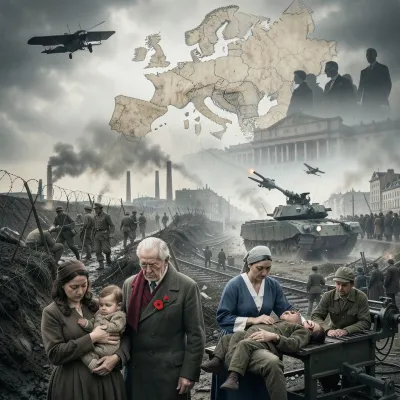
"Europe at War: A Strategic History of World Wars I and II" presents an integrated account of the two global conflicts, emphasizing the interwoven military, political, and social dimensions that made them "total wars." The book argues that strategy was deeply social, shaped by industrial capacity, alliance systems, evolving ideologies, and the mobilization of entire civilian populations. It traces the origins of World War I to Europe's industrial competition, complex alliance networks, and militarism, highlighting how the assassination of Archduke Franz Ferdinand triggered an irreversible chain of mobilizations and a rapid descent into trench warfare. This initial period of movement quickly gave way to a brutal stalemate, forcing nations to embark on unprecedented industrial mobilization to sustain a war of attrition.
The narrative details the immense human and material costs of the First World War, including the Shells Scandal, the battles of Verdun and the Somme, and the profound transformation of home fronts through rationing, propaganda, and women's entry into the workforce. The pivotal year 1917 brought revolution in Russia, mutinies in the French army, and the decisive entry of the United States, shifting the strategic balance. The book then covers the breaking of the deadlock in 1918 through Allied combined-arms offensives, leading to the collapse of the Central Powers and the Armistice. The subsequent Treaty of Versailles, with its territorial adjustments, military restrictions, and reparations demands, is portrayed as a flawed peace that, while attempting to create a new international order with the League of Nations, inadvertently sowed the seeds of future conflict by fueling German resentment and failing to secure lasting stability.
The interwar period is characterized by economic instability, marked by postwar booms and the devastating hyperinflation in Germany, culminating in the Great Depression. This environment fostered the rise of aggressive, totalitarian ideologies: Italian Fascism, German Nazism, and Soviet Communism, each offering radical solutions and rejecting liberal democracy. Hitler’s rearmament of Germany, in defiance of Versailles, and the Western democracies’ policy of appeasement are analyzed as a constrained strategic dance that ultimately failed to prevent war. World War II erupts with Germany’s Blitzkrieg invasion of Poland and the rapid fall of France, leaving Britain to fight alone, relying on air and sea power. The narrative then shifts to Hitler’s consolidation of a vast occupied empire and the ideological "War of Annihilation" on the Eastern Front with Operation Barbarossa, culminating in the turning point battles of Stalingrad, El Alamein, and Kursk.
The book explores the intricate logistical challenges of managing a mass war, the crucial role of science and intelligence (e.g., radar, Ultra), and the global maritime struggle in the Atlantic, Arctic, and Mediterranean. It dedicates significant attention to the Holocaust, emphasizing its systematic and industrialized nature as an integral part of the Nazi war effort, and the pervasive moral dilemmas of resistance and collaboration across occupied Europe. The final chapters detail the Allied liberation campaigns in Italy and Western Europe (Operation Overlord), the devastating Soviet offensives in the East, and the ultimate collapse of the Third Reich. The book concludes with the immediate aftermath of the war, focusing on the complex processes of surrender, denazification, war crimes trials, and the immense crisis of displaced persons. Finally, it examines the profound legacies of total war, including the massive reconstruction efforts (e.g., the Marshall Plan), the forging of national and collective memories, and the emergence of the Cold War, which fundamentally reshaped Europe's political and social landscape for decades.
What You'll Find Inside:
- The book reveals how industrial capacity, alliance systems, and civilian mobilization created 'total war' where factories, farms, and ration cards were as strategically important as battlefield maneuvers.
- It traces the continuity between WWI and WWII, showing how lessons from trench warfare and blockade evolved into Blitzkrieg, integrated air-sea-land campaigns, and industrialized intelligence in the second conflict.
- The work examines how ideology transformed warfare into existential struggle, particularly analyzing Nazi racial ideology and the Holocaust as embedded within Germany's war-making system and occupation policies.
- It explores the critical role of civilian agency—from munitions workers to resistance fighters—demonstrating how home front actions constrained decision-makers and altered campaign outcomes across both wars.
- The book analyzes how management of mass war through science, intelligence, and logistics became decisive, with radar, codebreaking, and production miracles determining strategic outcomes as much as firepower or troop numbers.
Who's It For:
This book is ideal for students and scholars of 20th-century European history, military history, and international relations who seek an integrated understanding of how political, economic, and social factors shaped the two world wars. It will particularly benefit readers interested in the societal impacts of total war, the origins of the Cold War, and the interplay between ideology, industry, and civilian mobilization in modern conflict. General readers with a deep interest in World War I and II who want to move beyond traditional battle narratives to understand the broader context of these conflicts will also find it valuable.
Table of Contents:
- Introduction
- Chapter 1 Europe on the Brink: Industrial Power and Alliance Systems, 1870–1914
- Chapter 2 The July Crisis and the Road to Mobilization, 1914
- Chapter 3 Plans and Realities: From Movement to Stalemate
- Chapter 4 Command and Industry: Building the Machinery of Attrition, 1915–1916
- Chapter 5 Home Fronts in the First Total War: Labor, Food, and Dissent
- Chapter 6 1917: Revolution, Mutiny, and American Entry
- Chapter 7 Breaking the Deadlock: The 1918 Offensives and Armistice
- Chapter 8 The Peace that Remade Europe: Versailles, Borders, and Reparations
- Chapter 9 Between Wars: Economies, Societies, and the Shock of 1918–1929
- Chapter 10 Ideologies in Arms: Fascism, Nazism, and Soviet Communism
- Chapter 11 Rearmament and Appeasement: Strategy under Constraint, 1933–1939
- Chapter 12 Blitzkrieg and Collapse: Poland to the Fall of France, 1939–1940
- Chapter 13 Britain Alone: Air Power, Sea Power, and Survival, 1940–1941
- Chapter 14 Hitler’s Empire and the Occupation of Europe
- Chapter 15 Barbarossa: War of Annihilation in the East, 1941–1942
- Chapter 16 The Global Maritime War: The Atlantic, the Arctic, and the Mediterranean
- Chapter 17 Managing Mass War: Science, Intelligence, and Logistics
- Chapter 18 The Turning Tide: Stalingrad, El Alamein, and Kursk
- Chapter 19 Resistance, Collaboration, and Civil War in Occupied Europe
- Chapter 20 Production Miracles: Mobilizing the United States, Britain, and the Soviet Union
- Chapter 21 War Against the Jews: The Holocaust within Europe’s War
- Chapter 22 Strategic Bombing and the Ethics of Destruction
- Chapter 23 Liberation: Italy, Overlord, and the Collapse of the Reich, 1943–1945
- Chapter 24 Endings and Reckonings: Surrender, Trials, and Displaced Peoples
- Chapter 25 Legacies of Total War: Reconstruction, Memory, and the Origins of the Cold War
Author:
Published By:
Date Published:
May 15, 2026
Type:
Nonfiction
Language:
English
Word Count:
78,586 words
Reading Time:
5 hours 30 minutes
Sample:
Order:
Order Europe at War: A Strategic History of World Wars I and II (Paperback) on MixCache.com:
Buy NowPrint copy is made to order and ships worldwide. Includes the ebook free, ready to read instantly.
$5 account credit for all new MixCache.com accounts, usable toward any ebook purchase!*