
Browse by Category
Fiction
- Action & Adventure
- African American
- Anthologies
- Children's Fiction
- Classics
- Comics & Graphic Novels
- Coming of Age
- Contemporary
- Cultural & Regional
- Drama
- Erotica
- Fantasy
- General
- Historical Fiction
- Horror
- Humor & Satire
- Literary Fiction
- Mystery, Thriller & Suspense
- Poetry
- Religious & Inspirational
- Romance
- Science Fiction
- Short Stories
- War & Military
- Westerns
- Women's Fiction
- Young Adult
Non-Fiction
- Antiques & Collectibles
- Arts & Photography
- Biographies & Memoirs
- Business & Money
- Children's Non-Fiction
-
Computers & Technology
- Artificial Intelligence
- Computer Science
- Cybersecurity & Cryptography
- Data Science & Analytics
- Databases & Big Data
- Game Development & Design
- General
- Hardware & DIY
- Mobile App Development
- Networking & Cloud Computing
- Operating Systems
- Programming
- Robotics
- Software
- Software Engineering
- User Experience (UX) & Design
- Web Development & Design
- Cooking, Food & Wine
- Crafts, Hobbies & Home
- Education & Teaching
- Engineering
- General
- Health, Fitness & Dieting
-
History
- African History
- African History - North Africa
- African History - Sub-Saharan Africa
- American History
- American History - 20th Century
- American History - Civil War
- American History - Colonial Period
- Ancient History
- Asian History
- Asian History - China
- Asian History - India
- Asian History - Japan
- Asian History - Southeast Asia
- European History
- European History - Ancient Greece
- European History - Ancient Rome
- European History - Medieval
- European History - Modern
- European History - Renaissance
- General
- Middle Eastern History
- Military History
- Military History - Aviation
- Military History - Naval
- Social & Cultural History
- World History
- Humor & Entertainment
- Industrial Technology
- Language Learning
- Law
- LGBTQ+ Non-Fiction
- Literary Criticism
- Medical Books
- Parenting & Relationships
- Philosophy
- Politics & Social Sciences
- Reference
- Religion & Spirituality
-
Science & Math
- Agricultural Sciences
- Astronomy & Space Science
- Behavioral Sciences
- Biological Sciences
- Botany & Plant Science
- Chemistry
- Earth Sciences
- Engineering - Chemical
- Engineering - Civil
- Engineering - Electrical
- Engineering - Mechanical
- Environment
- General
- Geology
- Mathematics
- Nature & Ecology
- Oceanography
- Paleontology
- Physics
- Statistics
- Self-Help
- Sports & Outdoors
- Study Aids
- Sustainability & Green Living
- Textbooks
- Transportation
- Travel
- True Crime
- Urban Planning & Development
- Veterinary Medicine
- Writing & Publishing
Jump to Section
MixCache.com Total Access
Unlimited reading and audiobooks for every book published by MixCache.com.
Included titles carry the MTA badge.
Learn more →
When Empires Collide: The Ottoman and Habsburg Frontier
MTA
A case study of conflict, diplomacy, and cultural exchange on Europe's southeastern borderlands
About this book:
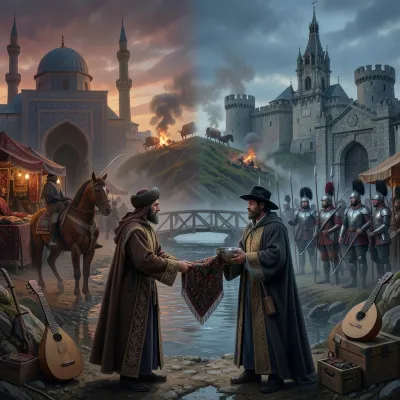
"When Empires Collide: The Ottoman and Habsburg Frontier" offers a comprehensive study of the long-standing interaction between the Ottoman and Habsburg empires, focusing on their shared borderlands from the 14th to the late 19th centuries. The book argues that this frontier was not a static line of separation but a dynamic zone of intense conflict, intricate diplomacy, and profound cultural exchange. It delves into the military strategies, administrative systems, and daily lives that shaped this unique contact zone, emphasizing that coexistence was as defining a feature as confrontation.
The narrative traces the initial Ottoman expansion into the Balkans and the Habsburg response, detailing key events like the sieges of Vienna (1529, 1683) and the partition of Hungary. It explores the sophisticated military labor systems of both empires, from the Ottoman Janissaries and sipahis to the Habsburg Grenzer, highlighting how these groups managed to sustain military readiness while adapting to the frontier's harsh realities. The book also examines the crucial roles of intermediaries, such as envoys, dragomans, merchants, and religious figures, in facilitating communication, trade, and even prisoner exchanges across ideological divides.
Beyond military and political dynamics, the book investigates the social and cultural fabric of the borderlands. It explores the diverse religious landscape, where Islam, Catholicism, Orthodoxy, and various Protestant denominations coexisted under complex systems like the Ottoman millet and Habsburg corporate estates. The text also highlights the pervasive impact of calamities like plague and famine, which transcended imperial boundaries and necessitated informal relief networks. Furthermore, it delves into the significance of cartography, intelligence gathering, and early modern science in shaping imperial perceptions and governance of the marches.
The latter chapters focus on the transformation of the frontier from the 18th century to the Congress of Berlin in 1878. Treaties like Karlowitz (1699), Passarowitz (1718), and Belgrade (1739) are analyzed as moments of territorial shifts, commercial experiments, and urban renewal, particularly in cities like Belgrade, Timișoara, Osijek, and Sarajevo. The book concludes by discussing the rise of nationalism in the Balkans, demonstrating how new nation-states emerged from the imperial collision, inheriting both the complexities and the hybrid cultures that had defined the Ottoman and Habsburg frontier for centuries.
What You'll Find Inside:
- The Ottoman-Habsburg frontier was a dynamic contact zone where conflict and coexistence were interwoven, not a static border, shaped by geography, trade, and daily negotiation.
- Negotiated sovereignties created layered authority with shared jurisdiction, mixed courts, and pragmatic compromises that defied imperial attempts at clear-cut control.
- Frontier life produced hybrid identities through conversion, migration, and communities that straddled imperial boundaries, challenging notions of fixed loyalty and identity.
- Diplomacy, trade, and cultural exchange were as crucial as warfare in shaping the frontier, with treaties redrawing maps while markets and intermediaries maintained constant interaction.
- The frontier served as a testing ground for early modern international law and governance of religious/ethnic diversity, producing models for managing difference that influenced later state formation.
Who's It For:
This book is intended for students and scholars of European history, Ottoman studies, Habsburg history, and borderlands studies. It will particularly benefit researchers interested in early modern diplomacy, military history, cultural exchange, and the governance of diversity in contested regions. General readers with a deep interest in the historical roots of modern European borders and multicultural societies will also find valuable insights.
Table of Contents:
- Introduction
- Chapter 1 Borderlands of Stone and Water: The Danube–Sava–Drina Corridors
- Chapter 2 Thresholds of Empire: Ottoman Expansion and Habsburg Response, 14th–15th Centuries
- Chapter 3 Hungary Divided: The Fall of Buda and the Threefold Kingdom
- Chapter 4 Building the Militärgrenze: Settlers, Service, and Surveillance
- Chapter 5 Vienna 1529: First Siege and the Politics of Fear
- Chapter 6 Brokers of Contact: Envoys, Dragomans, and Go-Betweens
- Chapter 7 Treaties and Trade: Capitulations, Customs, and Ragusan Mediation
- Chapter 8 Lines and Forts: Engineering the Frontier
- Chapter 9 Sacred Neighbors: Confession, Tolerance, and Tension
- Chapter 10 The Long War and Zsitvatorok, 1593–1606
- Chapter 11 Renegades and Converts: Lives Across the Line
- Chapter 12 Banditry and Border Justice: Hajduks, Uskoks, and Outlaws
- Chapter 13 Households at the Edge: Gender, Property, and Mixed Courts
- Chapter 14 1683: The Second Siege of Vienna and the Holy League
- Chapter 15 Karlowitz 1699: Cartographies of Defeat and Settlement
- Chapter 16 Passarowitz 1718: Commercial Experiment and Urban Renewal
- Chapter 17 Belgrade 1739: Retrenchment and Resilience
- Chapter 18 Calamity and Care: Plague, Famine, and Relief Networks
- Chapter 19 Seeing and Knowing the Marches: Maps, Intelligence, and Science
- Chapter 20 Cities of Passage: Belgrade, Timișoara, Osijek, Sarajevo
- Chapter 21 Governing Difference: Millets, Estates, and Petitioning
- Chapter 22 Soldiers of Two Worlds: Janissaries, Grenzer, and Military Labor
- Chapter 23 Law and War at the Border: Truces, Hostages, and Prisoners
- Chapter 24 Languages in Contact: Schools, Print, and Everyday Multilingualism
- Chapter 25 From Empires to Nations: 1770s–1878 and the Making of Modern Borders
Author:
Published By:
Date Published:
May 15, 2026
Type:
Nonfiction
Language:
English
Word Count:
77,182 words
Reading Time:
5 hours 24 minutes
Sample:
MixCache.com Total Access
Get unlimited access to this book + all books published by MixCache.com for $11.99/month
Subscribe to MTAOr purchase this book individually below
Order:
Buy the When Empires Collide: The Ottoman and Habsburg Frontier ebook on MixCache.com:
Buy Now
Full ebook will be available immediately
- read online or download as a PDF file.
$5 account credit for all new MixCache.com accounts, usable toward any ebook purchase!*



Ratings & Reviews
Ask Questions About This Book
Have a question about the content? Ask our AI assistant!
Start by asking a question about "When Empires Collide: The Ottoman and Habsburg Frontier"
Example: "Does this book mention William Shakespeare?"
Thinking...