Browse by Category
Fiction
- Action & Adventure
- African American
- Anthologies
- Children's Fiction
- Classics
- Comics & Graphic Novels
- Coming of Age
- Contemporary
- Cultural & Regional
- Drama
- Erotica
- Fantasy
- General
- Historical Fiction
- Horror
- Humor & Satire
- Literary Fiction
- Mystery, Thriller & Suspense
- Poetry
- Religious & Inspirational
- Romance
- Science Fiction
- Short Stories
- War & Military
- Westerns
- Women's Fiction
- Young Adult
Non-Fiction
- Antiques & Collectibles
- Arts & Photography
- Biographies & Memoirs
- Business & Money
- Children's Non-Fiction
-
Computers & Technology
- Artificial Intelligence
- Computer Science
- Cybersecurity & Cryptography
- Data Science & Analytics
- Databases & Big Data
- Game Development & Design
- General
- Hardware & DIY
- Mobile App Development
- Networking & Cloud Computing
- Operating Systems
- Programming
- Robotics
- Software
- Software Engineering
- User Experience (UX) & Design
- Web Development & Design
- Cooking, Food & Wine
- Crafts, Hobbies & Home
- Education & Teaching
- Engineering
- General
- Health, Fitness & Dieting
-
History
- African History
- African History - North Africa
- African History - Sub-Saharan Africa
- American History
- American History - 20th Century
- American History - Civil War
- American History - Colonial Period
- Ancient History
- Asian History
- Asian History - China
- Asian History - India
- Asian History - Japan
- Asian History - Southeast Asia
- European History
- European History - Ancient Greece
- European History - Ancient Rome
- European History - Medieval
- European History - Modern
- European History - Renaissance
- General
- Middle Eastern History
- Military History
- Military History - Aviation
- Military History - Naval
- Social & Cultural History
- World History
- Humor & Entertainment
- Industrial Technology
- Language Learning
- Law
- LGBTQ+ Non-Fiction
- Literary Criticism
- Medical Books
- Parenting & Relationships
- Philosophy
- Politics & Social Sciences
- Reference
- Religion & Spirituality
-
Science & Math
- Agricultural Sciences
- Astronomy & Space Science
- Behavioral Sciences
- Biological Sciences
- Botany & Plant Science
- Chemistry
- Earth Sciences
- Engineering - Chemical
- Engineering - Civil
- Engineering - Electrical
- Engineering - Mechanical
- Environment
- General
- Geology
- Mathematics
- Nature & Ecology
- Oceanography
- Paleontology
- Physics
- Statistics
- Self-Help
- Sports & Outdoors
- Study Aids
- Sustainability & Green Living
- Textbooks
- Transportation
- Travel
- True Crime
- Urban Planning & Development
- Veterinary Medicine
- Writing & Publishing
Jump to Section
MixCache.com Total Access
Unlimited reading and audiobooks for every book published by MixCache.com.
Included titles carry the MTA badge.
Learn more →
Dragon Roads: The Tang Dynasty and the Making of Global China
MTA
How Tang-era trade, culture, and diplomacy forged early Chinese cosmopolitanism and connected Eurasia
About this book:
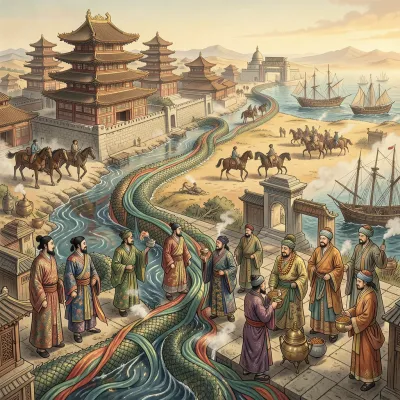
*Dragon Roads* provides a comprehensive historical analysis of the Tang Dynasty (618–907 CE), positioning it as a pivotal era of early globalization. The book explores how the dynasty’s territorial expansion and sophisticated statecraft created a cosmopolitan crucible fueled by the "Dragon Roads"—a vast mesh of overland Silk Road trails and maritime "monsoon highways." By integrating archaeological findings with primary texts like the Dunhuang manuscripts, the narrative illustrates how the empire functioned as a central node for the exchange of luxury commodities, such as silk and tea, and transformative technologies, including papermaking and advanced astronomy.
The text emphasizes the human infrastructure of this connectivity, highlighting the role of ethnic middlemen—specifically Sogdian and Uighur merchants—and the diverse religious communities that thrived under imperial patronage. From the planned urban grids of Chang’an and Luoyang to the bustling southern ports of Guangzhou and Yangzhou, the book depicts an empire that managed cultural difference through pragmatic legal codes and ethnic quarters. It also sheds light on the significant roles played by women in court, commerce, and monasteries, challenging traditional patriarchal narratives by showcasing their agency in a world in motion.
A major theme of the work is the resilience of these networks in the face of crisis, particularly the cataclysmic An Lushan Rebellion. The book details how this mid-eighth-century upheaval forced a strategic reconfiguration of China's global engagement, shifting the economic center of gravity from the northern overland routes to the southern maritime corridors. This transition not only sustained the empire’s fiscal foundations through new monopolies and taxes but also ensured the survival of Tang-era cosmopolitanism through the subsequent Five Dynasties period and into the Song Dynasty.
Ultimately, *Dragon Roads* invites a rethinking of globalization by demonstrating that the integration of Eurasia began centuries before European maritime expansion. The author argues that the Tang Dynasty’s history of managing long-distance trade, religious pluralism, and technological diffusion provides an essential historical perspective on how modern polities navigate the tensions of an interconnected world. The legacy of the Tang—found in its enduring artistic styles, legal frameworks, and cultural myths—continues to shape Chinese identity and its contemporary global ambitions.
What You'll Find Inside:
- How Tang-era overland Silk Road caravans and maritime monsoon routes created a connected Eurasian network facilitating exchange of goods, ideas, and people
- The cosmopolitan character of Tang capitals Chang'an and Luoyang with foreign merchant quarters, religious diversity, and cultural hybridity
- The tributary system as a flexible diplomatic theater that enabled trade and cultural exchange while maintaining Sinocentric hierarchy
- Transmission of technologies (paper, horse breeding, ceramics) and religions (Buddhism, Islam, Christianity) along the Dragon Roads
- How crises like the An Lushan Rebellion reconfigured rather than ended Tang connectivity, shifting trade emphasis to maritime routes
Who's It For:
This book is ideal for students and scholars of Chinese history, world history, or premodern globalization who seek an evidence-based exploration of Tang dynasty connectivity. It will particularly benefit readers interested in Silk Road studies, early Eurasian trade networks, and the cultural exchange that shaped civilizations across continents. Academics and serious history enthusiasts looking to understand how premodern societies managed cross-cultural interaction will find valuable insights into the foundations of global China.
Table of Contents:
- Introduction
- Chapter 1 The Mandate and the Map: Founding the Tang and Reorienting Eurasia
- Chapter 2 Gateways of Empire: Chang’an, Luoyang, and the Urban Grid
- Chapter 3 Threads of the Silk Roads: Overland Caravans and Oasis States
- Chapter 4 Monsoon Highways: The Maritime Routes to the South Seas and Indian Ocean
- Chapter 5 Merchants and Middlemen: Sogdians, Uighurs, and the Brokers of Exchange
- Chapter 6 Diplomacy in Motion: Envoys, Embassies, and the Tributary Theatre
- Chapter 7 Gifts and Technologies: Horses, Paper, and the Circulation of Things
- Chapter 8 Faiths on the Move: Buddhism, Daoism, Islam, Zoroastrianism, and Christianity
- Chapter 9 Images Across Borders: Art, Aesthetics, and the Cosmopolitan Gaze
- Chapter 10 Life in the Metropolis: Markets, Entertainments, and Everyday Consumption
- Chapter 11 Frontier Ecologies: Steppes, Deserts, and the Geography of Power
- Chapter 12 Securing the Routes: Garrisons, Guards, and Pirates
- Chapter 13 Money, Taxes, and the State: Fiscal Foundations of Connectivity
- Chapter 14 Women at the Crossroads: Court, Market, and Monastery
- Chapter 15 Languages and Scripts: Chinese, Sogdian, Sanskrit, and Syriac
- Chapter 16 The Dunhuang Cache: Manuscripts as Windows on a Connected World
- Chapter 17 Tea, Ceramics, and Textiles: Commodities That Traveled
- Chapter 18 Science and Skills: Astronomy, Medicine, and Craft Knowledge in Exchange
- Chapter 19 Crisis and Reconfiguration: The An Lushan Rebellion and Its Afterlives
- Chapter 20 Ports of Contact: Guangzhou, Yangzhou, and the Coastal Cosmopolis
- Chapter 21 Neighbors and Rivals: Tibet, Korea, Japan, and the Steppe Empires
- Chapter 22 Law, Regulation, and the Ethnic Quarters
- Chapter 23 Memory and Myth: Writing the Tang in Later Chinese Identity
- Chapter 24 After Tang: Five Dynasties, Ten Kingdoms, and Pathways into Song
- Chapter 25 Rethinking Globalization: What the Tang World Teaches Today
Author:
Published By:
Date Published:
May 14, 2026
Type:
Nonfiction
Language:
English
Word Count:
71,009 words
Reading Time:
4 hours 58 minutes
Sample:
Order:
Order Dragon Roads: The Tang Dynasty and the Making of Global China (Paperback) on MixCache.com:
Buy NowPrint copy is made to order and ships worldwide. Includes the ebook free, ready to read instantly.
$5 account credit for all new MixCache.com accounts, usable toward any ebook purchase!*