Browse by Category
Fiction
- Action & Adventure
- African American
- Anthologies
- Children's Fiction
- Classics
- Comics & Graphic Novels
- Coming of Age
- Contemporary
- Cultural & Regional
- Drama
- Erotica
- Fantasy
- General
- Historical Fiction
- Horror
- Humor & Satire
- Literary Fiction
- Mystery, Thriller & Suspense
- Poetry
- Religious & Inspirational
- Romance
- Science Fiction
- Short Stories
- War & Military
- Westerns
- Women's Fiction
- Young Adult
Non-Fiction
- Antiques & Collectibles
- Arts & Photography
- Biographies & Memoirs
- Business & Money
- Children's Non-Fiction
-
Computers & Technology
- Artificial Intelligence
- Computer Science
- Cybersecurity & Cryptography
- Data Science & Analytics
- Databases & Big Data
- Game Development & Design
- General
- Hardware & DIY
- Mobile App Development
- Networking & Cloud Computing
- Operating Systems
- Programming
- Robotics
- Software
- Software Engineering
- User Experience (UX) & Design
- Web Development & Design
- Cooking, Food & Wine
- Crafts, Hobbies & Home
- Education & Teaching
- Engineering
- General
- Health, Fitness & Dieting
-
History
- African History
- African History - North Africa
- African History - Sub-Saharan Africa
- American History
- American History - 20th Century
- American History - Civil War
- American History - Colonial Period
- Ancient History
- Asian History
- Asian History - China
- Asian History - India
- Asian History - Japan
- Asian History - Southeast Asia
- European History
- European History - Ancient Greece
- European History - Ancient Rome
- European History - Medieval
- European History - Modern
- European History - Renaissance
- General
- Middle Eastern History
- Military History
- Military History - Aviation
- Military History - Naval
- Social & Cultural History
- World History
- Humor & Entertainment
- Industrial Technology
- Language Learning
- Law
- LGBTQ+ Non-Fiction
- Literary Criticism
- Medical Books
- Parenting & Relationships
- Philosophy
- Politics & Social Sciences
- Reference
- Religion & Spirituality
-
Science & Math
- Agricultural Sciences
- Astronomy & Space Science
- Behavioral Sciences
- Biological Sciences
- Botany & Plant Science
- Chemistry
- Earth Sciences
- Engineering - Chemical
- Engineering - Civil
- Engineering - Electrical
- Engineering - Mechanical
- Environment
- General
- Geology
- Mathematics
- Nature & Ecology
- Oceanography
- Paleontology
- Physics
- Statistics
- Self-Help
- Sports & Outdoors
- Study Aids
- Sustainability & Green Living
- Textbooks
- Transportation
- Travel
- True Crime
- Urban Planning & Development
- Veterinary Medicine
- Writing & Publishing
Jump to Section
MixCache.com Total Access
Unlimited reading and audiobooks for every book published by MixCache.com.
Included titles carry the MTA badge.
Learn more →
Cold War Confrontations: Proxy Wars, Deterrence, and Nuclear Strategy
MTA
How Ideology, Espionage, and Technology Shaped Global Competition
About this book:
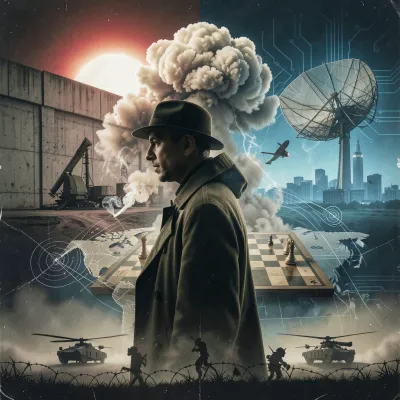
This book provides a comprehensive strategic analysis of the Cold War, framed not merely as a chronological history but as a sustained effort by the United States and the Soviet Union to manage a global rivalry under the shadow of nuclear annihilation. It explores the foundational roles of ideology and technology, tracing the evolution of nuclear strategy from early atomic monopolies to the stabilizing yet terrifying condition of Mutually Assured Destruction (MAD). By examining the "architecture of deterrence," the text highlights how command-and-control systems, early-warning technologies, and the rise of space-based surveillance reshaped the temporal and psychological dimensions of global power.
The narrative anchors these theoretical frameworks in pivotal case studies, including the Korean War’s role in defining limited war, the high-stakes brinkmanship of the Cuban Missile Crisis, and the grueling attrition of Vietnam. It shifts the focus to the "shadow wars," detailing how the CIA and KGB utilized espionage, covert interventions, and active measures to influence outcomes in the Middle East, Africa, and Latin America. These operations often resulted in "blowback," where short-term strategic gains led to long-term regional instability and moral compromise for both superpowers.
The final chapters detail the "endgames" of the conflict, focusing on Mikhail Gorbachev’s reforms, the economic exhaustion of the Soviet system, and the eventual dissipation of the existential fear that had defined the era. The book concludes by assessing the Cold War’s enduring legacy in the twenty-first century, arguing that its hard-won lessons on crisis management, the limitations of military intervention, and the necessity of strategic restraint remain essential for navigating contemporary great-power competition.
What You'll Find Inside:
- The book explains how nuclear deterrence evolved from atomic monopoly to mutually assured destruction, analyzing the strategic logic that prevented direct superpower conflict despite intense rivalry.
- It examines how limited war doctrine developed to fight conflicts under nuclear constraints, with case studies of Korea, Vietnam, and Afghanistan showing the challenges of calibrated escalation.
- The text analyzes the critical role of intelligence, espionage, and technology in shaping Cold War competition, from U-2 flights and satellite reconnaissance to covert operations and intelligence failures that nearly triggered nuclear war.
- It details how crisis management strategies like signaling, brinkmanship, and escalation control were developed and tested in flashpoints such as the Berlin Blockades, Cuban Missile Crisis, and Middle East wars.
- The book concludes with lessons for contemporary strategy, showing how Cold War insights about deterrence, intervention, and managing great-power rivalry remain relevant in today's multipolar world with new technologies.
Who's It For:
This book is ideal for students and scholars of international relations, history, and political science who seek a deep understanding of Cold War strategy and its modern implications. It will particularly benefit professionals in national security, defense policy, and intelligence fields who need to grasp the historical foundations of nuclear deterrence, crisis management, and great-power competition. General readers with an interest in 20th-century history and the origins of contemporary geopolitical tensions will also find valuable insights into how ideological, technological, and intelligence factors shaped global stability during the nuclear age.
Table of Contents:
- Introduction
- Chapter 1 Foundations of the Cold War: Ideology, Power, and the Postwar Order
- Chapter 2 The Architecture of Deterrence: From Atomic Monopoly to Mutually Assured Destruction
- Chapter 3 Command, Control, and the Nuclear Decision Chain
- Chapter 4 Limited War Doctrine: Theory, Practice, and Political Ends
- Chapter 5 Intelligence Wars: Espionage, Deception, and Covert Action
- Chapter 6 Technology Races: Bombers, Missiles, and the Revolution in Surveillance
- Chapter 7 Crisis Playbooks: Signaling, Brinkmanship, and Escalation Management
- Chapter 8 The Korean War: Limited War under the Nuclear Shadow
- Chapter 9 Berlin: Blockades, Airlifts, and the Politics of Divided Europe
- Chapter 10 Cuba 1962: The Missile Crisis and the Boundaries of Risk
- Chapter 11 Vietnam: Insurgency, Attrition, and Credibility
- Chapter 12 The Middle East Flashpoints: Suez, 1967, 1973, and Superpower Restraint
- Chapter 13 Africa and Latin America: Coups, Guerrillas, and Competing Modernities
- Chapter 14 Afghanistan: The Soviet Intervention and the Limits of Empire
- Chapter 15 The Sino-Soviet Split: Triangular Diplomacy and Strategic Realignment
- Chapter 16 Arms Control as Strategy: Test Bans, SALT, and INF
- Chapter 17 Economics of Containment: Sanctions, Aid, and the Military-Industrial Complex
- Chapter 18 Information Warfare: Propaganda, Cultural Diplomacy, and Media
- Chapter 19 Nuclear Proliferation and Extended Deterrence: Allies under the Umbrella
- Chapter 20 Maritime Strategy: Sea Power, Submarines, and the GIUK Gap
- Chapter 21 Space and Signals: Satellites, Early Warning, and Decision Cycles
- Chapter 22 Domestic Politics and Decision-Making: Bureaucracies, Presidents, and Politburos
- Chapter 23 Covert Interventions: From Iran and Guatemala to Angola and Nicaragua
- Chapter 24 Endgames: Reform, Renewal, and the Dissipation of Fear
- Chapter 25 Legacies and Lessons: Deterrence, Intervention, and the Twenty-First Century
Author:
Published By:
Date Published:
May 12, 2026
Type:
Nonfiction
Language:
English
Word Count:
87,113 words
Reading Time:
6 hours 6 minutes
Sample:
Order:
Order Cold War Confrontations: Proxy Wars, Deterrence, and Nuclear Strategy (Hardcover) on MixCache.com:
Buy NowPrint copy is made to order and ships worldwide. Includes the ebook free, ready to read instantly.
$5 account credit for all new MixCache.com accounts, usable toward any ebook purchase!*