Browse by Category
Fiction
- Action & Adventure
- African American
- Anthologies
- Children's Fiction
- Classics
- Comics & Graphic Novels
- Coming of Age
- Contemporary
- Cultural & Regional
- Drama
- Erotica
- Fantasy
- General
- Historical Fiction
- Horror
- Humor & Satire
- Literary Fiction
- Mystery, Thriller & Suspense
- Poetry
- Religious & Inspirational
- Romance
- Science Fiction
- Short Stories
- War & Military
- Westerns
- Women's Fiction
- Young Adult
Non-Fiction
- Antiques & Collectibles
- Arts & Photography
- Biographies & Memoirs
- Business & Money
- Children's Non-Fiction
-
Computers & Technology
- Artificial Intelligence
- Computer Science
- Cybersecurity & Cryptography
- Data Science & Analytics
- Databases & Big Data
- Game Development & Design
- General
- Hardware & DIY
- Mobile App Development
- Networking & Cloud Computing
- Operating Systems
- Programming
- Robotics
- Software
- Software Engineering
- User Experience (UX) & Design
- Web Development & Design
- Cooking, Food & Wine
- Crafts, Hobbies & Home
- Education & Teaching
- Engineering
- General
- Health, Fitness & Dieting
-
History
- African History
- African History - North Africa
- African History - Sub-Saharan Africa
- American History
- American History - 20th Century
- American History - Civil War
- American History - Colonial Period
- Ancient History
- Asian History
- Asian History - China
- Asian History - India
- Asian History - Japan
- Asian History - Southeast Asia
- European History
- European History - Ancient Greece
- European History - Ancient Rome
- European History - Medieval
- European History - Modern
- European History - Renaissance
- General
- Middle Eastern History
- Military History
- Military History - Aviation
- Military History - Naval
- Social & Cultural History
- World History
- Humor & Entertainment
- Industrial Technology
- Language Learning
- Law
- LGBTQ+ Non-Fiction
- Literary Criticism
- Medical Books
- Parenting & Relationships
- Philosophy
- Politics & Social Sciences
- Reference
- Religion & Spirituality
-
Science & Math
- Agricultural Sciences
- Astronomy & Space Science
- Behavioral Sciences
- Biological Sciences
- Botany & Plant Science
- Chemistry
- Earth Sciences
- Engineering - Chemical
- Engineering - Civil
- Engineering - Electrical
- Engineering - Mechanical
- Environment
- General
- Geology
- Mathematics
- Nature & Ecology
- Oceanography
- Paleontology
- Physics
- Statistics
- Self-Help
- Sports & Outdoors
- Study Aids
- Sustainability & Green Living
- Textbooks
- Transportation
- Travel
- True Crime
- Urban Planning & Development
- Veterinary Medicine
- Writing & Publishing
Jump to Section
MixCache.com Total Access
Unlimited reading and audiobooks for every book published by MixCache.com.
Included titles carry the MTA badge.
Learn more →
The Last Notary
MTA
Forgeries, Charters, and the Politics of Recordkeeping in Late Medieval Chanceries
About this book:
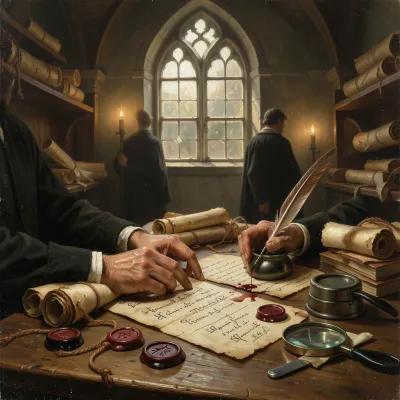
In the late medieval chancery of Saint-Michel-de-Lune, aging notary Gerard Alanté discovers a series of sophisticated forgeries designed to dispossess the de Cormont family of their ancestral lands. The investigation reveals that these documents are not merely the work of a lone rogue, but the product of a systemic conspiracy involving the young notary Edouard Pasquier, the corrupt deceased registrar Guillaume Fournier, and the powerful Lord Renaud de Mirebeau. By meticulously analyzing ink compositions, identifying a phantom episcopal seal matrix, and uncovering a "shadow archive" of tally sticks hidden beneath the floorboards, Gerard exposes a bureaucratic machinery that has been hollowing out the diocese’s integrity for decades.
As the inquiry deepens, Gerard finds that the conspiracy has infected the highest levels of local authority. The archdeacon, Hervé de Montjoie, is implicated through secret financial records, while the official cartulary has been systematically altered to siphon ecclesiastical revenues. The conspirators respond with desperation, culminating in a deliberate arson attack on the archive intended to incinerate the evidence. Despite the destruction of many original records, Gerard manages to save a scorched cartulary and his own private register of discrepancies, preserving the thread of truth necessary to challenge the forgers in a climate of institutional complicity.
The narrative reaches its climax in a dramatic courtroom confrontation where Gerard pits the rough, honest antiquity of original 13th-century deeds against the "logic of bad faith" embodied by the polished, perfect forgeries. Faced with irrefutable physical evidence and the exposure of the shadow ledgers, the archdeacon eventually offers a public confession of his negligence, and Pasquier admits to his role as the master craftsman of the fraud. Although the political reach of Lord Renaud remains a lingering threat, the legal victory secures the de Cormonts' property and initiates a painful but necessary reconstruction of the chancery’s administrative foundations.
Ultimately, the book serves as a meditation on the fragile sanctity of the written word. Gerard’s struggle demonstrates that while institutions may fail and records may be burned, the truth persists in the smallest physical details—a forgotten limp, a specific ink formula, or a notched piece of wood. By documenting the corruption, Gerard reaffirms the notary’s true vocation: not merely as a producer of documents, but as a guardian of the covenant between the record and the reality it represents.
Table of Contents:
- Introduction
- Chapter 1 The Seal That Shouldn’t Exist
- Chapter 2 A Margin Left Blank
- Chapter 3 Night Ledger at Saint-Calais
- Chapter 4 Proofs and Probations
- Chapter 5 The Serjeant’s Whisper
- Chapter 6 Palimpsest of Loyalties
- Chapter 7 The Witnesses at the Alehouse
- Chapter 8 Ink Ground in Vinegar
- Chapter 9 Custody of the Keys
- Chapter 10 The Lord Who Owned Tomorrow
- Chapter 11 Crossings in the Cartulary
- Chapter 12 Oath on a Winter Pike
- Chapter 13 The Scribe Who Forgot to Limp
- Chapter 14 Statutes of Convenience
- Chapter 15 Fire in the Archive
- Chapter 16 The Chain of Possession
- Chapter 17 A Charter Without a Dawn
- Chapter 18 The Queen’s Quiet Seal
- Chapter 19 Scribes’ Feast, Judges’ Fast
- Chapter 20 The Meadow Called Nowhere
- Chapter 21 Beneath the Tally Sticks
- Chapter 22 The Notary’s Apprenticeship
- Chapter 23 Court Day at Saint-Michel
- Chapter 24 The Logic of Bad Faith
- Chapter 25 Last Ink
Author:
Published By:
Date Published:
May 12, 2026
Type:
Fiction
Language:
English
Word Count:
87,743 words
Reading Time:
6 hours 9 minutes
Sample:
Order:
Order The Last Notary (Hardcover) on MixCache.com:
Buy NowPrint copy is made to order and ships worldwide. Includes the ebook free, ready to read instantly.
$5 account credit for all new MixCache.com accounts, usable toward any ebook purchase!*