Browse by Category
Fiction
- Action & Adventure
- African American
- Anthologies
- Children's Fiction
- Classics
- Comics & Graphic Novels
- Coming of Age
- Contemporary
- Cultural & Regional
- Drama
- Erotica
- Fantasy
- General
- Historical Fiction
- Horror
- Humor & Satire
- Literary Fiction
- Mystery, Thriller & Suspense
- Poetry
- Religious & Inspirational
- Romance
- Science Fiction
- Short Stories
- War & Military
- Westerns
- Women's Fiction
- Young Adult
Non-Fiction
- Antiques & Collectibles
- Arts & Photography
- Biographies & Memoirs
- Business & Money
- Children's Non-Fiction
-
Computers & Technology
- Artificial Intelligence
- Computer Science
- Cybersecurity & Cryptography
- Data Science & Analytics
- Databases & Big Data
- Game Development & Design
- General
- Hardware & DIY
- Mobile App Development
- Networking & Cloud Computing
- Operating Systems
- Programming
- Robotics
- Software
- Software Engineering
- User Experience (UX) & Design
- Web Development & Design
- Cooking, Food & Wine
- Crafts, Hobbies & Home
- Education & Teaching
- Engineering
- General
- Health, Fitness & Dieting
-
History
- African History
- African History - North Africa
- African History - Sub-Saharan Africa
- American History
- American History - 20th Century
- American History - Civil War
- American History - Colonial Period
- Ancient History
- Asian History
- Asian History - China
- Asian History - India
- Asian History - Japan
- Asian History - Southeast Asia
- European History
- European History - Ancient Greece
- European History - Ancient Rome
- European History - Medieval
- European History - Modern
- European History - Renaissance
- General
- Middle Eastern History
- Military History
- Military History - Aviation
- Military History - Naval
- Social & Cultural History
- World History
- Humor & Entertainment
- Industrial Technology
- Language Learning
- Law
- LGBTQ+ Non-Fiction
- Literary Criticism
- Medical Books
- Parenting & Relationships
- Philosophy
- Politics & Social Sciences
- Reference
- Religion & Spirituality
-
Science & Math
- Agricultural Sciences
- Astronomy & Space Science
- Behavioral Sciences
- Biological Sciences
- Botany & Plant Science
- Chemistry
- Earth Sciences
- Engineering - Chemical
- Engineering - Civil
- Engineering - Electrical
- Engineering - Mechanical
- Environment
- General
- Geology
- Mathematics
- Nature & Ecology
- Oceanography
- Paleontology
- Physics
- Statistics
- Self-Help
- Sports & Outdoors
- Study Aids
- Sustainability & Green Living
- Textbooks
- Transportation
- Travel
- True Crime
- Urban Planning & Development
- Veterinary Medicine
- Writing & Publishing
Jump to Section
MixCache.com Total Access
Unlimited reading and audiobooks for every book published by MixCache.com.
Included titles carry the MTA badge.
Learn more →
Castles, Cavalry, and Crossbow: Military Transformation in the Middle Ages
MTA
Siegecraft, mounted tactics, and the social forces that reshaped medieval warfare
About this book:
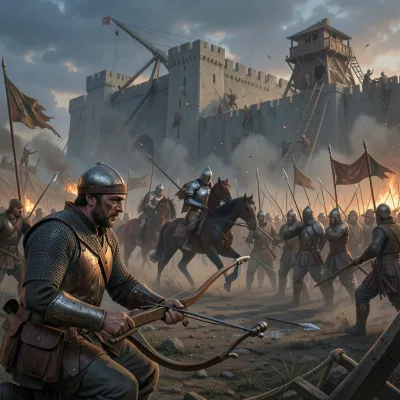
"Castles, Cavalry, and Crossbow: Military Transformation in the Middle Ages" argues against a single "military revolution," instead presenting medieval warfare as a complex, centuries-long interplay of structures, skills, and societal forces. The book examines three core elements: fortifications, mounted warfare, and missile technology, demonstrating how these elements evolved not in isolation but through continuous interaction with each other and with the economic, political, and cultural landscapes of their time.
The narrative begins with the rise of the castle, tracing its evolution from simple motte-and-bailey designs to sophisticated concentric keeps. This architectural arms race spurred corresponding innovations in siegecraft, from trebuchets and mining to psychological warfare and prolonged blockades, highlighting the immense logistical and engineering challenges involved. Simultaneously, the book explores the knightly estate, analyzing how cavalry, while embodying social status and shock power, was deeply intertwined with land tenure, economics, and a complex code of honor, forcing commanders to adapt tactics like the couched lance or dismounted combat when conditions demanded.
The crossbow emerges as a disruptive force, challenging traditional notions of armor and combat. Its mechanical nature made it accessible to urban militias and mercenary companies, leading to an "arms race" that drove advancements in plate armor and spurred debates about honor and lethality. These military developments are shown to be deeply connected to broader transformations: the growth of state fiscal machines (taxes, credit, treasuries), evolving recruitment from feudal levies to professional retinues and mercenaries, and the social forces of towns, guilds, and estates that shaped military organization and funding.
Beyond Western Europe, the book extends its scope to the Byzantine Empire, the Latin East, and the Mongol incursions, demonstrating how military knowledge was transmitted and hybridized across cultures. It reveals how the Mongol "shock" reshaped warfare through unprecedented mobility, psychological terror, and pragmatic siegecraft, forcing all settled powers to adapt. The arrival of gunpowder, while not an instant revolution, further accelerated these trends, pushing fortifications toward lower, thicker designs and making warfare increasingly dependent on centralized resources and technical expertise, ultimately illustrating a continuous process of adaptation rather than a clean break from the past.
What You'll Find Inside:
- The Middle Ages witnessed a centuries-long interplay of structures, skills, and societies rather than a sudden military revolution in warfare.
- Castles functioned as economic and administrative centers that extracted rents, guarded roads, projected power, and organized communities under a watchful keep.
- Cavalry power depended on fragile economic foundations including breeding programs, fodder supplies, and financial systems capable of supporting retinues over long campaigns.
- The crossbow disrupted traditional notions of honor and armor, prompting practical adaptations in protection and moral debates about distance and lethality in combat.
- Medieval warfare was fundamentally shaped by logistics, finance, and state formation as much as by battlefield tactics, with wars requiring sustained resource mobilization.
Who's It For:
This book is tailored for students and scholars of medieval history, military historians, and researchers interested in the socioeconomic dimensions of warfare. It will particularly benefit readers seeking to understand how technological innovations like the crossbow interacted with economic systems, state formation, and cultural exchange across Europe and the Near East. Those with some background in historical methodology will appreciate the book's use of archaeological evidence, administrative records, and technical treatises to reconstruct the material realities of medieval warfare.
Table of Contents:
- Introduction
- Chapter 1 Stone and Strategy: The Rise of the Castle
- Chapter 2 From Motte-and-Bailey to Concentric Keeps: Evolving Fortification Design
- Chapter 3 The Art of Reduction: Siege Engines, Mining, and Blockade
- Chapter 4 The Crossbow Emerges: Mechanics, Materials, and Myths
- Chapter 5 Bolts versus Armor: Protection, Penetration, and the Arms Race
- Chapter 6 The Knightly Estate: Honor, Land, and the Culture of Cavalry
- Chapter 7 Shock and Maneuver: The Evolution of Mounted Tactics
- Chapter 8 Horseflesh and Households: The Economics of Mounted Warfare
- Chapter 9 Infantry Resurgence: Pikes, Pavises, and Communal Militias
- Chapter 10 From Feudal Levy to Contract: Recruitment, Retinues, and Mercenaries
- Chapter 11 Taxes, Tallies, and Treasuries: State Formation and the Costs of War
- Chapter 12 Banners, Signals, and Sovereignty: Command, Control, and Discipline
- Chapter 13 Bread, Fodder, and Siege Trains: Logistics of the Long War
- Chapter 14 Rivers, Ports, and Passes: Geography as an Operational Weapon
- Chapter 15 Frontiers of Faith: Crusader Castles and the Latin East
- Chapter 16 At the Crossroads: Byzantium, the Steppe, and Hybrid Warfare
- Chapter 17 Engineers of Cairo and Damascus: Ayyubid–Mamluk Fortifications and Counter-Siege
- Chapter 18 Learned Hands: Transmission of Military Knowledge across Cultures
- Chapter 19 The Mongol Shock: Mobility, Psychological Warfare, and Siegecraft
- Chapter 20 Law, Chivalry, and Constraint: Norms of Violence and their Limits
- Chapter 21 Towns, Guilds, and Estates: Social Forces behind the Soldier
- Chapter 22 Markets of War: Coinage, Credit, and the Price of Victory
- Chapter 23 Battlepieces: From Hastings to Nicopolis
- Chapter 24 The Gunpowder Overture: Bombards at the Castle Gate
- Chapter 25 Continuity and Change: Rethinking “Revolution” in Medieval Warfare
Author:
Published By:
Date Published:
May 6, 2026
Type:
Nonfiction
Language:
English
Word Count:
66,964 words
Reading Time:
4 hours 41 minutes
Sample:
Order:
Order Castles, Cavalry, and Crossbow: Military Transformation in the Middle Ages (Paperback) on MixCache.com:
Buy NowPrint copy is made to order and ships worldwide. Includes the ebook free, ready to read instantly.
$5 account credit for all new MixCache.com accounts, usable toward any ebook purchase!*