
Browse by Category
Fiction
- Action & Adventure
- African American
- Anthologies
- Children's Fiction
- Classics
- Comics & Graphic Novels
- Coming of Age
- Contemporary
- Cultural & Regional
- Drama
- Erotica
- Fantasy
- General
- Historical Fiction
- Horror
- Humor & Satire
- Literary Fiction
- Mystery, Thriller & Suspense
- Poetry
- Religious & Inspirational
- Romance
- Science Fiction
- Short Stories
- War & Military
- Westerns
- Women's Fiction
- Young Adult
Non-Fiction
- Antiques & Collectibles
- Arts & Photography
- Biographies & Memoirs
- Business & Money
- Children's Non-Fiction
-
Computers & Technology
- Artificial Intelligence
- Computer Science
- Cybersecurity & Cryptography
- Data Science & Analytics
- Databases & Big Data
- Game Development & Design
- General
- Hardware & DIY
- Mobile App Development
- Networking & Cloud Computing
- Operating Systems
- Programming
- Robotics
- Software
- Software Engineering
- User Experience (UX) & Design
- Web Development & Design
- Cooking, Food & Wine
- Crafts, Hobbies & Home
- Education & Teaching
- Engineering
- General
- Health, Fitness & Dieting
-
History
- African History
- African History - North Africa
- African History - Sub-Saharan Africa
- American History
- American History - 20th Century
- American History - Civil War
- American History - Colonial Period
- Ancient History
- Asian History
- Asian History - China
- Asian History - India
- Asian History - Japan
- Asian History - Southeast Asia
- European History
- European History - Ancient Greece
- European History - Ancient Rome
- European History - Medieval
- European History - Modern
- European History - Renaissance
- General
- Middle Eastern History
- Military History
- Military History - Aviation
- Military History - Naval
- Social & Cultural History
- World History
- Humor & Entertainment
- Industrial Technology
- Language Learning
- Law
- LGBTQ+ Non-Fiction
- Literary Criticism
- Medical Books
- Parenting & Relationships
- Philosophy
- Politics & Social Sciences
- Reference
- Religion & Spirituality
-
Science & Math
- Agricultural Sciences
- Astronomy & Space Science
- Behavioral Sciences
- Biological Sciences
- Botany & Plant Science
- Chemistry
- Earth Sciences
- Engineering - Chemical
- Engineering - Civil
- Engineering - Electrical
- Engineering - Mechanical
- Environment
- General
- Geology
- Mathematics
- Nature & Ecology
- Oceanography
- Paleontology
- Physics
- Statistics
- Self-Help
- Sports & Outdoors
- Study Aids
- Sustainability & Green Living
- Textbooks
- Transportation
- Travel
- True Crime
- Urban Planning & Development
- Veterinary Medicine
- Writing & Publishing
Jump to Section
MixCache.com Total Access
Unlimited reading and audiobooks for every book published by MixCache.com.
Included titles carry the MTA badge.
Learn more →
Gold, Salt, and Song: The Rise and Reach of Ghana, Mali, and Songhai Empires
MTA
Trade, Scholarship, and Statecraft in West Africa's Medieval Period
About this book:
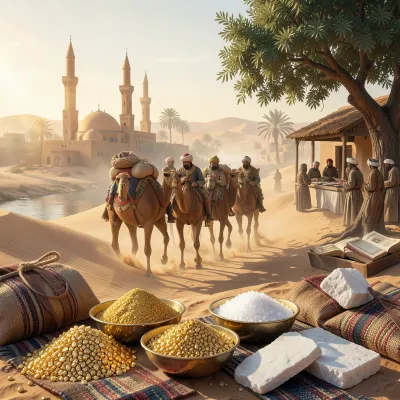
*Gold, Salt, and Song* explores the sophisticated political, economic, and intellectual landscapes of the Ghana, Mali, and Songhai Empires, which dominated West Africa’s medieval period. The narrative centers on the "Golden Age" of the Sahel, arguing that these states were not peripheral actors but central makers of the premodern world. By mastering the challenging geography of the Sahara and the Niger Bend, these empires established a "triad of power" based on the extraction of gold, the regulation of the trans-Saharan salt trade, and the cultivation of "song"—the oral and written transmission of history, law, and legitimacy.
The book details how the convergence of trade and Islam transformed early urban centers like Djenné-Jeno and Gao into cosmopolitan hubs of scholarship and commerce. The rise of Ghana (Wagadou) set the template for statecraft, which was later expanded by the Mali Empire under the legendary Sunjata and the diplomatically savvy Mansa Musa. These rulers utilized Islamic commercial law (Maliki fiqh) and merchant diasporas like the Dyula and Wangara to create a stable economic environment where credit, trust, and standardized weights allowed wealth to circulate across vast distances. Timbuktu emerged as a global center of learning, where the trade in manuscripts was often as lucrative as the trade in precious metals.
Under the Songhai Empire and leaders like Askia Muhammad, West African statecraft reached its peak of administrative complexity, integrating professional judiciaries and military units of cavalry and riverine canoes. However, this era of hegemony was fractured in 1591 by the Saadian invasion from Morocco, which introduced gunpowder technology to the region and triggered a realignment of trade toward the Atlantic. This shift ended the dominance of the great inland empires but gave rise to new coastal powers and intensified the moral and economic complexities of the transatlantic slave trade.
Ultimately, the book traces the enduring lineages of these medieval civilizations in contemporary West African life. The legacies of their legal systems, architectural styles, and oral traditions persist as a "usable past," informing modern debates on governance, religion, and identity. By centering the agency of scholars, merchants, and women alongside that of kings and commanders, the text offers a comprehensive synthesis of a world where gold and salt underwrote sovereignty, and song made that sovereignty enduring.
What You'll Find Inside:
- Gold and salt trade formed the economic backbone that fueled the rise, cohesion, and diplomatic reach of the Ghana, Mali, and Songhai empires.
- Islamic scholarship and the manuscript traditions of Timbuktu provided the legal, administrative, and ideological frameworks that converted wealth into lasting political legitimacy.
- Desert caravan technology—camels, specialized saddles, navigation techniques, and standardized weights—enabled reliable long-distance exchange across the Sahara and Sahel.
- Urban centers such as Djenné-Jeno, Gao, Niani, and Timbuktu emerged as hubs where trade, governance, and cultural production intersected to sustain imperial authority.
- Social dynamics—including gendered labor, merchant diasporas (Dyula/Wangara), and the moral economy of slavery—were integral to the functioning and resilience of these medieval states.
Who's It For:
This book is ideal for undergraduate and graduate students of African history, world history, and Islamic studies, as well as general readers interested in pre-modern trade networks, empire formation, and the intellectual heritage of West Africa. It also serves scholars seeking a source-rich synthesis that weaves together archaeological evidence, Arabic chronicles, and oral traditions to present a nuanced narrative of Ghana, Mali, and Songhai.
Table of Contents:
- Introduction
- Chapter 1 Landscapes of Exchange: Sahara, Sahel, and the Niger Bend
- Chapter 2 Paths Through the Dunes: Caravans, Camels, and the Technology of Travel
- Chapter 3 Goldfields and Grids of Power: Bambuk, Bure, and the Forest–Savanna Frontier
- Chapter 4 Salt and the City: Taghaza, Taoudenni, and the Price of Preservation
- Chapter 5 Markets Without Mint: Weights, Credit, and Islamic Commercial Law
- Chapter 6 Before the Empires: Djenné-Jeno and Early Urbanism
- Chapter 7 Wagadou Rising: The Soninke and the Making of Ghana
- Chapter 8 Courts, Cults, and the Coming of Islam in Ghana
- Chapter 9 Mandé Migrations and the Sunjata Epic: Foundations of Mali
- Chapter 10 An Empire of Rivers: Niani, the Niger, and Malian Statecraft
- Chapter 11 Mansa Musa’s Pilgrimage: Gold, Diplomacy, and a Connected World
- Chapter 12 Timbuktu Emergent: Scholars, Scribes, and the Book Trade
- Chapter 13 Gao at the Crossroads: Songhai’s Early Kingdom
- Chapter 14 Cavalry, Canoes, and Commanders: The Military of the Middle Niger
- Chapter 15 Askia Muhammad and the Architecture of Legitimacy
- Chapter 16 Jurists and Judges: Maliki Fiqh and the Politics of Law
- Chapter 17 The Dyula and Wangara: Merchant Diasporas Across West Africa
- Chapter 18 Women, Households, and the Economics of Empire
- Chapter 19 Captives, Labor, and the Moral Economy of Slavery
- Chapter 20 Sufi Paths and Scholarly Chains: Networks from Walata to Fez
- Chapter 21 Chronicle and Memory: Tarikh al-Fattash, Tarikh al-Sudan, and Oral Histories
- Chapter 22 Saadian Cannons and the Fall of Songhai: 1591 and After
- Chapter 23 From Sahara to Sea: Gold Flows, the Atlantic Turn, and Regional Realignments
- Chapter 24 Architecture, Art, and Song: Mosques, Praise Poetry, and Performance
- Chapter 25 Legacies and Lineages: The Medieval West African Imagination Today
Author:
Published By:
Date Published:
May 5, 2026
Type:
Nonfiction
Language:
English
Word Count:
71,054 words
Reading Time:
4 hours 59 minutes
Sample:
MixCache.com Total Access
Get unlimited access to this book + all books published by MixCache.com for $11.99/month
Subscribe to MTAOr purchase this book individually below
Order:
Buy the Gold, Salt, and Song: The Rise and Reach of Ghana, Mali, and Songhai Empires ebook on MixCache.com:
Buy Now
Full ebook will be available immediately
- read online or download as a PDF file.
$5 account credit for all new MixCache.com accounts, usable toward any ebook purchase!*


Ratings & Reviews
Ask Questions About This Book
Have a question about the content? Ask our AI assistant!
Start by asking a question about "Gold, Salt, and Song: The Rise and Reach of Ghana, Mali, and Songhai Empires"
Example: "Does this book mention William Shakespeare?"
Thinking...