
Browse by Category
Fiction
- Action & Adventure
- African American
- Anthologies
- Children's Fiction
- Classics
- Comics & Graphic Novels
- Coming of Age
- Contemporary
- Cultural & Regional
- Drama
- Erotica
- Fantasy
- General
- Historical Fiction
- Horror
- Humor & Satire
- Literary Fiction
- Mystery, Thriller & Suspense
- Poetry
- Religious & Inspirational
- Romance
- Science Fiction
- Short Stories
- War & Military
- Westerns
- Women's Fiction
- Young Adult
Non-Fiction
- Antiques & Collectibles
- Arts & Photography
- Biographies & Memoirs
- Business & Money
- Children's Non-Fiction
-
Computers & Technology
- Artificial Intelligence
- Computer Science
- Cybersecurity & Cryptography
- Data Science & Analytics
- Databases & Big Data
- Game Development & Design
- General
- Hardware & DIY
- Mobile App Development
- Networking & Cloud Computing
- Operating Systems
- Programming
- Robotics
- Software
- Software Engineering
- User Experience (UX) & Design
- Web Development & Design
- Cooking, Food & Wine
- Crafts, Hobbies & Home
- Education & Teaching
- Engineering
- General
- Health, Fitness & Dieting
-
History
- African History
- African History - North Africa
- African History - Sub-Saharan Africa
- American History
- American History - 20th Century
- American History - Civil War
- American History - Colonial Period
- Ancient History
- Asian History
- Asian History - China
- Asian History - India
- Asian History - Japan
- Asian History - Southeast Asia
- European History
- European History - Ancient Greece
- European History - Ancient Rome
- European History - Medieval
- European History - Modern
- European History - Renaissance
- General
- Middle Eastern History
- Military History
- Military History - Aviation
- Military History - Naval
- Social & Cultural History
- World History
- Humor & Entertainment
- Industrial Technology
- Language Learning
- Law
- LGBTQ+ Non-Fiction
- Literary Criticism
- Medical Books
- Parenting & Relationships
- Philosophy
- Politics & Social Sciences
- Reference
- Religion & Spirituality
-
Science & Math
- Agricultural Sciences
- Astronomy & Space Science
- Behavioral Sciences
- Biological Sciences
- Botany & Plant Science
- Chemistry
- Earth Sciences
- Engineering - Chemical
- Engineering - Civil
- Engineering - Electrical
- Engineering - Mechanical
- Environment
- General
- Geology
- Mathematics
- Nature & Ecology
- Oceanography
- Paleontology
- Physics
- Statistics
- Self-Help
- Sports & Outdoors
- Study Aids
- Sustainability & Green Living
- Textbooks
- Transportation
- Travel
- True Crime
- Urban Planning & Development
- Veterinary Medicine
- Writing & Publishing
Jump to Section
MixCache.com Total Access
Unlimited reading and audiobooks for every book published by MixCache.com.
Included titles carry the MTA badge.
Learn more →
Borderlands and Frontiers: The History of the US-Mexico Border
MTA
Migration, trade, conflict, and cultural exchange along one of the world's most dynamic boundaries
About this book:
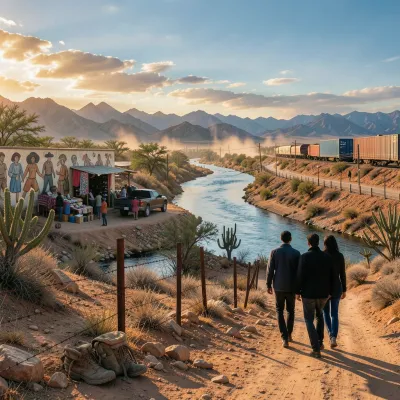
*Borderlands and Frontiers: The History of the US-Mexico Border* provides a comprehensive historical and thematic analysis of the region, tracing its evolution from indigenous networks and Spanish imperial frontiers to a modern, highly securitized boundary. The book argues that the border is a living process rather than a static line, shaped by centuries of migration, trade, and cultural exchange. It details how 19th-century conflicts and treaties, such as the Treaty of Guadalupe Hidalgo and the Gadsden Purchase, established the physical boundary, while subsequent eras of revolution, Prohibition, and labor programs like the Bracero system institutionalized the line as a site of state power and economic negotiation.
The narrative explores the 20th-century shift toward intense economic integration and parallel militarization. The rise of the maquiladora industry and the implementation of NAFTA transformed border towns into interconnected metropolises, weaving the economies of the United States and Mexico together. However, this integration coincided with the "geography of deterrence" established by operations like Gatekeeper and the post-9/11 securitization surge. These policies pushed migration into dangerous desert corridors, resulting in a persistent humanitarian crisis and the rise of a robust non-governmental response. The book highlights the tension between the border's role as an essential economic hinge and its function as a barrier that separates families and disrupts ecosystems.
In its final sections, the text examines the legal and social complexities of the contemporary borderlands, focusing on the intricate "architectures of belonging" created by asylum law, DACA, and sanctuary movements. It details how local, state, and federal powers clash over immigration enforcement, while cartels and drug wars test the limits of state authority. Despite these pressures, the book emphasizes the cultural vitality of the "contact zone," where hybrid languages, art, and music flourish. Ultimately, the book positions the borderlands as a laboratory for the future, suggesting that sustainable policy must move beyond mere enforcement to address the deep-seated economic, environmental, and human interdependencies that define the region.
What You'll Find Inside:
- The US‑Mexico border is a dynamic process of continual making and remaking, shaped by Indigenous mobility, colonial legacies, and shifting sovereign powers rather than a fixed line.
- Economic integration—from mission economies and railroads to maquiladoras and NAFTA—has repeatedly linked the two sides while producing sharp disparities in wages, labor rights, and environmental burdens.
- Enforcement strategies such as the Bracero program, Operation Wetback, Operation Gatekeeper, and post‑9/11 securitization have redirected migration flows, often increasing danger and creating humanitarian crises.
- Legal architectures of belonging (asylum, DACA, detention regimes) reflect evolving politics and create layered, conditional statuses that affect families and communities across the border.
- Environmental and cultural dimensions—water rights, wildlife corridors, language mixing, and border‑city economies—show the borderlands as a zone of exchange where ecology and culture continually challenge attempts at rigid control.
Who's It For:
This book is intended for scholars of border studies, immigration historians, policy makers, and activists who need a deep historical grounding to understand contemporary debates over migration, security, trade, and human rights along the US‑Mexico boundary. It also serves students and general readers interested in how long‑term processes of Indigenous mobility, colonialism, labor programs, and economic integration have produced today’s complex borderlands.
Table of Contents:
- Introduction
- Chapter 1 Before Borders: Indigenous Networks and Ecologies
- Chapter 2 Empire’s Edge: Spanish Frontiers, Missions, and Militias
- Chapter 3 From Colony to Republic: Mexico’s Northern Frontier
- Chapter 4 Manifest Destiny: Texas, Annexation, and War
- Chapter 5 Drawing the Line: Guadalupe Hidalgo and the Making of a Boundary
- Chapter 6 Surveyors and Speculators: The Gadsden Purchase and the Desert Line
- Chapter 7 Rails, Ranches, and Revolvers: Economies and Violence, 1870–1910
- Chapter 8 Revolution Across the Line: 1910–1920 and U.S. Responses
- Chapter 9 Policing Prohibition: Smuggling, Vice, and Early Border Enforcement
- Chapter 10 Work Across Borders: The Bracero Program and Agribusiness
- Chapter 11 Operation Wetback and the Politics of Exclusion
- Chapter 12 Checkpoints in the Cold War: Security, Migration, and Rights
- Chapter 13 Maquiladoras and the Rise of the Twin-Plant Economy
- Chapter 14 NAFTA and North American Integration
- Chapter 15 Operation Gatekeeper and the Geography of Deterrence
- Chapter 16 After 9/11: Securitization, Surveillance, and the Wall Idea
- Chapter 17 Drug Wars, Cartels, and State Power
- Chapter 18 Humanitarian Crisis in the Desert: Deaths, Rescues, and NGOs
- Chapter 19 Asylum, DACA, and the Legal Architectures of Belonging
- Chapter 20 Families at the Line: Separation, Detention, and Activism
- Chapter 21 Sanctuary and Preemption: Cities, States, and Federal Power
- Chapter 22 Culture in the Contact Zone: Language, Art, Music, and Media
- Chapter 23 Cross-Border Metropolises: San Diego–Tijuana, El Paso–Juárez, and Beyond
- Chapter 24 Rivers, Wildlife, and Climate: The Borderlands Environment
- Chapter 25 Futures at the Boundary: Policy Lessons and Humane Possibilities
Author:
Published By:
Date Published:
May 5, 2026
Type:
Nonfiction
Language:
English
Word Count:
78,056 words
Reading Time:
5 hours 28 minutes
Sample:
MixCache.com Total Access
Get unlimited access to this book + all books published by MixCache.com for $11.99/month
Subscribe to MTAOr purchase this book individually below
Order:
Buy the Borderlands and Frontiers: The History of the US-Mexico Border ebook on MixCache.com:
Buy Now
Full ebook will be available immediately
- read online or download as a PDF file.
$5 account credit for all new MixCache.com accounts, usable toward any ebook purchase!*






Ratings & Reviews
Ask Questions About This Book
Have a question about the content? Ask our AI assistant!
Start by asking a question about "Borderlands and Frontiers: The History of the US-Mexico Border"
Example: "Does this book mention William Shakespeare?"
Thinking...