
Browse by Category
Fiction
- Action & Adventure
- African American
- Anthologies
- Children's Fiction
- Classics
- Comics & Graphic Novels
- Coming of Age
- Contemporary
- Cultural & Regional
- Drama
- Erotica
- Fantasy
- General
- Historical Fiction
- Horror
- Humor & Satire
- Literary Fiction
- Mystery, Thriller & Suspense
- Poetry
- Religious & Inspirational
- Romance
- Science Fiction
- Short Stories
- War & Military
- Westerns
- Women's Fiction
- Young Adult
Non-Fiction
- Antiques & Collectibles
- Arts & Photography
- Biographies & Memoirs
- Business & Money
- Children's Non-Fiction
-
Computers & Technology
- Artificial Intelligence
- Computer Science
- Cybersecurity & Cryptography
- Data Science & Analytics
- Databases & Big Data
- Game Development & Design
- General
- Hardware & DIY
- Mobile App Development
- Networking & Cloud Computing
- Operating Systems
- Programming
- Robotics
- Software
- Software Engineering
- User Experience (UX) & Design
- Web Development & Design
- Cooking, Food & Wine
- Crafts, Hobbies & Home
- Education & Teaching
- Engineering
- General
- Health, Fitness & Dieting
-
History
- African History
- African History - North Africa
- African History - Sub-Saharan Africa
- American History
- American History - 20th Century
- American History - Civil War
- American History - Colonial Period
- Ancient History
- Asian History
- Asian History - China
- Asian History - India
- Asian History - Japan
- Asian History - Southeast Asia
- European History
- European History - Ancient Greece
- European History - Ancient Rome
- European History - Medieval
- European History - Modern
- European History - Renaissance
- General
- Middle Eastern History
- Military History
- Military History - Aviation
- Military History - Naval
- Social & Cultural History
- World History
- Humor & Entertainment
- Industrial Technology
- Language Learning
- Law
- LGBTQ+ Non-Fiction
- Literary Criticism
- Medical Books
- Parenting & Relationships
- Philosophy
- Politics & Social Sciences
- Reference
- Religion & Spirituality
-
Science & Math
- Agricultural Sciences
- Astronomy & Space Science
- Behavioral Sciences
- Biological Sciences
- Botany & Plant Science
- Chemistry
- Earth Sciences
- Engineering - Chemical
- Engineering - Civil
- Engineering - Electrical
- Engineering - Mechanical
- Environment
- General
- Geology
- Mathematics
- Nature & Ecology
- Oceanography
- Paleontology
- Physics
- Statistics
- Self-Help
- Sports & Outdoors
- Study Aids
- Sustainability & Green Living
- Textbooks
- Transportation
- Travel
- True Crime
- Urban Planning & Development
- Veterinary Medicine
- Writing & Publishing
Jump to Section
MixCache.com Total Access
Unlimited reading and audiobooks for every book published by MixCache.com.
Included titles carry the MTA badge.
Learn more →
The Last Dynastic Years: Case Studies from Ming Collapse to Qing Consolidation
MTA
Localized narratives of crisis, rebellion, and transition in seventeenth-century China
About this book:
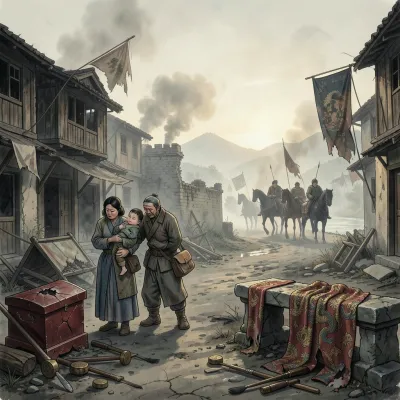
"The Last Dynastic Years: Case Studies from Ming Collapse to Qing Consolidation" examines the complex and localized processes that led to the fall of the Ming dynasty and the subsequent establishment and stabilization of the Qing empire in 17th-century China. Moving beyond grand narratives, the book delves into micro-historical accounts, utilizing sources like county gazetteers, temple records, and personal correspondence to illustrate how the transition unfolded at the ground level, across diverse regions and social strata. The author argues that the Ming's collapse was not a single, decisive event but a gradual unraveling driven by a confluence of fiscal crises, environmental disasters, and mounting rebellions, while the Qing's consolidation was a pragmatic, often improvisational process of negotiation and integration rather than pure conquest.
The book details how the Ming's fiscal system, overly reliant on silver and burdened by northern frontier defense, became brittle under environmental shocks like droughts, frosts, and locust plagues. These pressures led to widespread peasant migration and the formation of local militias, particularly in Shaanxi, which eventually coalesced into major rebel forces under leaders like Li Zicheng and Zhang Xianzhong. While Li's movement targeted the imperial capital, Zhang's "other rebellion" in Sichuan showcased a brutal struggle for urban provisioning. Simultaneously, coastal regions like Zhejiang and Fujian experienced commercial dislocation, forcing local merchants and smugglers to adapt and become crucial intermediaries for any power seeking to control trade. Jiangnan's gentry faced credit crises, leading to a complex interplay of philanthropy and self-preservation that reflected the region's wealth and institutional resilience.
The Qing's success stemmed from its adaptive statecraft. Recognizing the Ming's weaknesses, the Manchus leveraged political defection, notably at Shanhai Gate, where Ming generals switched allegiance in exchange for pragmatic concessions. The Qing absorbed surrendered Ming officials, like Hong Chengchou, integrating their administrative expertise and local knowledge to rebuild governance structures. They established the Green Standard Army from former Ming troops, normalizing military presence across the realm and turning soldiers into instruments of order and even public works. The Grand Canal, a vital logistical artery, was painstakingly restored, underscoring the Qing's commitment to predictable taxation and economic flow. Furthermore, the Qing skillfully forged alliances with Mongol chieftains, integrating them into the banner system, and pragmatically incorporated native chieftains in regions like Yunnan, using incentives and localized governance to extend their reach.
The consolidation phase also involved re-establishing social and legal order. The Qing enacted policies of amnesty and selective punishment, using public rituals and the promise of stability to encourage compliance while managing memory through carefully curated gazetteers and steles. The civil service examination system was restored, albeit with quotas and curricula subtly adapted to the new regime, offering a vital channel for elite integration and legitimizing Qing rule. Throughout these transformations, the book highlights the often-invisible roles of women in households, who managed resources, navigated displacement, and maintained crucial social networks, becoming essential agents of survival and reconstruction. Ultimately, the Qing consolidated power not by erasing the existing social and economic structures but by pragmatically adapting them, turning the chaos of the Ming collapse into a new, albeit complex and often negotiated, imperial order that prioritized functionality and predictability.
What You'll Find Inside:
- The Ming fiscal system unraveled due to silver shortages, rigid tax obligations, and the inability to align revenue demands with agricultural and market rhythms, weakening state capacity long before military collapse.
- Environmental shocks—drought, frost, locusts, and floods—interacted with fiscal stress to erode rural resilience, prompting migration, militia formation, and regional rebellion that varied by local ecology and economy.
- Rebellion was not a monolithic movement but a repertoire of localized strategies: mobile militias in Shaanxi, predatory occupation in Sichuan, and commercial dislocation on the coast, each reflecting distinct social and economic conditions.
- Qing consolidation succeeded through pragmatic integration of surrendered Ming officials, flexible taxation, and reliance on local intermediaries (banners, Green Standard Army, brokers) rather than pure coercion, rebuilding order by adapting to existing networks.
- Restoration of the civil service examination system, repair of the Grand Canal, and managed ritual submissions were key tools the Qing used to project legitimacy, reattach elite loyalty, and integrate fiscal and symbolic infrastructures across the realm.
Who's It For:
This book is aimed at graduate students and scholars of Chinese history, early modern world history, and those interested in fiscal-military state formation, environmental history, and microhistorical approaches. Readers focusing on the Ming-Qing transition, rebellion studies, or the interplay of state and society in early modern Eurasia will find its detailed local case studies and synthesis of archival sources particularly valuable.
Table of Contents:
- Introduction
- Chapter 1 The Price of Empire: Silver, Grain, and the Late Ming Fiscal Unraveling
- Chapter 2 Drought, Frost, and Locusts: Environmental Shocks in the 1620s–1640s
- Chapter 3 Tax Registers and Temple Granaries: County Finance in North Zhili
- Chapter 4 Lines of Flight: Peasant Migration and Militia Formation in Shaanxi
- Chapter 5 Li Zicheng’s March: Rebellion Networks from the Wei River to Beijing
- Chapter 6 The Other Rebellion: Zhang Xianzhong and the Rupture of Sichuan Society
- Chapter 7 Coastal Smugglers, Inland Brokers: Commercial Dislocation in Zhejiang and Fujian
- Chapter 8 Jiangnan Under Strain: Credit Crises and Gentry Philanthropy
- Chapter 9 Bound to the Pass: Shanhai Gate and the Politics of Defection
- Chapter 10 The Banner Advance: Manchu Statecraft in Liaodong and Beyond
- Chapter 11 Surrender and Service: Hong Chengchou and the Making of a Qing Officialdom
- Chapter 12 Rituals of Submission: City Entries and Oaths in North China
- Chapter 13 The Fall of the Southern Court: Nanjing and the Southern Ming Regimes
- Chapter 14 Ten Days in Yangzhou: Violence, Memory, and Urban Reconstruction
- Chapter 15 Land and Lineage in Hunan: Village Orders after Conquest
- Chapter 16 Frontier Brokers: Mongol and Manchu Alliances on the Steppe
- Chapter 17 Yunnan’s Turning: Native Chieftains and Imperial Incorporation
- Chapter 18 The Green Standard Army: Rebuilding Garrison Society
- Chapter 19 River Control, Tax Control: The Grand Canal and Qing Logistics
- Chapter 20 Faith and Doubt: Millenarian Currents and Local Cults
- Chapter 21 Women, Households, and War: Micro-histories of Survival
- Chapter 22 Writing the Catastrophe: Gazetteers, Steles, and County Memory
- Chapter 23 Law after War: Amnesty, Punishment, and the Politics of Forgetting
- Chapter 24 Examinations Restored: Schools, Quotas, and the Return of Merit
- Chapter 25 From Crisis to Order: Integrating Local Stories into Imperial Consolidation
Author:
Published By:
Date Published:
May 4, 2026
Type:
Nonfiction
Language:
English
Word Count:
68,610 words
Reading Time:
4 hours 48 minutes
Sample:
MixCache.com Total Access
Get unlimited access to this book + all books published by MixCache.com for $11.99/month
Subscribe to MTAOr purchase this book individually below
Order:
Buy the The Last Dynastic Years: Case Studies from Ming Collapse to Qing Consolidation ebook on MixCache.com:
Buy Now
Full ebook will be available immediately
- read online or download as a PDF file.
$5 account credit for all new MixCache.com accounts, usable toward any ebook purchase!*






Ratings & Reviews
Ask Questions About This Book
Have a question about the content? Ask our AI assistant!
Start by asking a question about "The Last Dynastic Years: Case Studies from Ming Collapse to Qing Consolidation"
Example: "Does this book mention William Shakespeare?"
Thinking...