
Browse by Category
Fiction
- Action & Adventure
- African American
- Anthologies
- Children's Fiction
- Classics
- Comics & Graphic Novels
- Coming of Age
- Contemporary
- Cultural & Regional
- Drama
- Erotica
- Fantasy
- General
- Historical Fiction
- Horror
- Humor & Satire
- Literary Fiction
- Mystery, Thriller & Suspense
- Poetry
- Religious & Inspirational
- Romance
- Science Fiction
- Short Stories
- War & Military
- Westerns
- Women's Fiction
- Young Adult
Non-Fiction
- Antiques & Collectibles
- Arts & Photography
- Biographies & Memoirs
- Business & Money
- Children's Non-Fiction
-
Computers & Technology
- Artificial Intelligence
- Computer Science
- Cybersecurity & Cryptography
- Data Science & Analytics
- Databases & Big Data
- Game Development & Design
- General
- Hardware & DIY
- Mobile App Development
- Networking & Cloud Computing
- Operating Systems
- Programming
- Robotics
- Software
- Software Engineering
- User Experience (UX) & Design
- Web Development & Design
- Cooking, Food & Wine
- Crafts, Hobbies & Home
- Education & Teaching
- Engineering
- General
- Health, Fitness & Dieting
-
History
- African History
- African History - North Africa
- African History - Sub-Saharan Africa
- American History
- American History - 20th Century
- American History - Civil War
- American History - Colonial Period
- Ancient History
- Asian History
- Asian History - China
- Asian History - India
- Asian History - Japan
- Asian History - Southeast Asia
- European History
- European History - Ancient Greece
- European History - Ancient Rome
- European History - Medieval
- European History - Modern
- European History - Renaissance
- General
- Middle Eastern History
- Military History
- Military History - Aviation
- Military History - Naval
- Social & Cultural History
- World History
- Humor & Entertainment
- Industrial Technology
- Language Learning
- Law
- LGBTQ+ Non-Fiction
- Literary Criticism
- Medical Books
- Parenting & Relationships
- Philosophy
- Politics & Social Sciences
- Reference
- Religion & Spirituality
-
Science & Math
- Agricultural Sciences
- Astronomy & Space Science
- Behavioral Sciences
- Biological Sciences
- Botany & Plant Science
- Chemistry
- Earth Sciences
- Engineering - Chemical
- Engineering - Civil
- Engineering - Electrical
- Engineering - Mechanical
- Environment
- General
- Geology
- Mathematics
- Nature & Ecology
- Oceanography
- Paleontology
- Physics
- Statistics
- Self-Help
- Sports & Outdoors
- Study Aids
- Sustainability & Green Living
- Textbooks
- Transportation
- Travel
- True Crime
- Urban Planning & Development
- Veterinary Medicine
- Writing & Publishing
Jump to Section
MixCache.com Total Access
Unlimited reading and audiobooks for every book published by MixCache.com.
Included titles carry the MTA badge.
Learn more →
Revolution and Remaking: Mao Zedong and the People's Republic, 1949–1976
MTA
Policy experiments, campaigns, and everyday life under Maoist rule
About this book:
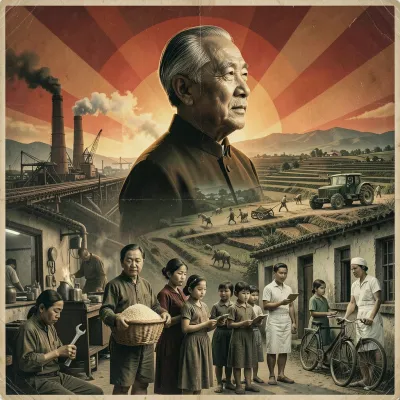
*Revolution and Remaking* provides a comprehensive history of the People’s Republic of China under Mao Zedong, balancing a top-down political narrative of state-building with a bottom-up social history of everyday life. The book traces the evolution of the party-state from its 1949 founding through the implementation of transformative policies such as land reform, the First Five-Year Plan, and the institutionalization of the work unit and *hukou* systems. It examines how the CCP utilized mass mobilization campaigns as a "governing technology" to reshape property, labor, and social hierarchies, while also exploring how ordinary citizens negotiated these state-driven changes in their kitchens, schools, and workplaces.
The narrative details the radical shifts in Maoist governance, moving from the state-building and collectivization of the 1950s to the utopian ambitions and catastrophic famine of the Great Leap Forward. Following a brief period of pragmatic readjustment in the early 1960s, the book analyzes the Cultural Revolution's assault on authority, the rise of Red Guard factionalism, and the subsequent restoration of order through military-led Revolutionary Committees. Throughout these upheavals, the text highlights the persistent structures of the Maoist era, including the "Down to the Countryside" movement, the creation of barefoot doctors, and the rigid control of culture through model operas and thought reform.
In its final sections, the book explores the complexities of Mao’s last years, characterized by intense factional infighting between pragmatists and the "Gang of Four" alongside a surprising diplomatic rapprochement with the United States. It concludes by assessing the profound legacies of Maoism—a system that achieved significant national integration and industrial expansion but at a staggering human cost involving pervasive surveillance, scarcity, and political violence. By the time of Mao’s death in 1976, China remained a society deeply transformed by decades of continuous revolution, poised between his radical ideological vision and a growing popular desire for stability and reform.
What You'll Find Inside:
- The book examines how Maoist campaigns like land reform, collectivization, and the Cultural Revolution were implemented at the grassroots level and experienced by ordinary people
- It analyzes the dual nature of Maoist governance - top-down policy conception and bottom-up social history of implementation
- The work explores how institutions like the work unit and hukou system structured everyday life and opportunities
- It covers major economic experiments including the First Five-Year Plan and Great Leap Forward, showing their ambitions and human costs
- The book traces China's foreign policy evolution from Korean War involvement to rapprochement with the United States
Who's It For:
This book is ideal for students and scholars of modern Chinese history, particularly those interested in the social and political dynamics of Maoist rule. It will benefit readers seeking to understand how revolutionary policies affected everyday life, as well as those studying the mechanisms of state control and social transformation in 20th-century revolutions. General readers with an interest in Chinese history and revolutionary movements will also find valuable insights into this pivotal period.
Table of Contents:
- Introduction
- Chapter 1 Founding the People’s Republic: State-Building, 1949–1953
- Chapter 2 Land to the Tiller: Land Reform and Rural Power, 1949–1952
- Chapter 3 Cities Remade: Urban Takeover, Commerce, and Cadres
- Chapter 4 Planning a New Economy: The First Five-Year Plan, 1953–1957
- Chapter 5 Collectivization Road: From Mutual-Aid Teams to Cooperatives, 1955–1956
- Chapter 6 Work Units and the Hukou State: Organizing Everyday Life
- Chapter 7 Thought Reform and New Culture: Schools, Media, and Propaganda
- Chapter 8 Women, Family, and the 1950 Marriage Law
- Chapter 9 Nation-Building at the Periphery: Ethnic Minorities and Autonomy
- Chapter 10 The Great Leap Forward: Mobilization and Utopia, 1958–1959
- Chapter 11 Famine and Survival: Scarcity, Coping, and State Response, 1959–1962
- Chapter 12 Readjustment and Limited Pragmatism, 1961–1965
- Chapter 13 Health and Science for the Masses: Barefoot Doctors and Beyond
- Chapter 14 Culture under Command: Literature, Film, and Model Operas
- Chapter 15 Foreign Policy and Security: Korea, Vietnam, and the Sino‑Soviet Split
- Chapter 16 Toward Cultural Revolution: Socialist Education and Criticism, 1963–1965
- Chapter 17 Red Guards and the Assault on Authority, 1966–1968
- Chapter 18 Revolutionary Committees and Military Management, 1967–1969
- Chapter 19 School, Work, and the Sent-Down Youth, 1968–1975
- Chapter 20 Coercion and Rehabilitation: Policing, Law, and the Laogai
- Chapter 21 Rationing and the Shadow Economy: Everyday Exchange under Shortage
- Chapter 22 Iconoclasm and Belief: Religion, Ritual, and Political Campaigns
- Chapter 23 Rapprochement without Reform: Ping-Pong to the Shanghai Communiqué, 1971–1972
- Chapter 24 After Lin Biao: Factionalism and the Dazhai/Daqing Models, 1971–1974
- Chapter 25 Endings and Legacies: Mao’s Final Years and the Meaning of Maoism, 1974–1976
Author:
Published By:
Date Published:
May 4, 2026
Type:
Nonfiction
Language:
English
Word Count:
65,714 words
Reading Time:
4 hours 36 minutes
Sample:
Order:
Order Revolution and Remaking: Mao Zedong and the People's Republic, 1949–1976 (Paperback) on MixCache.com:
Buy NowPrint copy is made to order and ships worldwide. Includes the ebook free, ready to read instantly.
$5 account credit for all new MixCache.com accounts, usable toward any ebook purchase!*


