
Browse by Category
Fiction
- Action & Adventure
- African American
- Anthologies
- Children's Fiction
- Classics
- Comics & Graphic Novels
- Coming of Age
- Contemporary
- Cultural & Regional
- Drama
- Erotica
- Fantasy
- General
- Historical Fiction
- Horror
- Humor & Satire
- Literary Fiction
- Mystery, Thriller & Suspense
- Poetry
- Religious & Inspirational
- Romance
- Science Fiction
- Short Stories
- War & Military
- Westerns
- Women's Fiction
- Young Adult
Non-Fiction
- Antiques & Collectibles
- Arts & Photography
- Biographies & Memoirs
- Business & Money
- Children's Non-Fiction
-
Computers & Technology
- Artificial Intelligence
- Computer Science
- Cybersecurity & Cryptography
- Data Science & Analytics
- Databases & Big Data
- Game Development & Design
- General
- Hardware & DIY
- Mobile App Development
- Networking & Cloud Computing
- Operating Systems
- Programming
- Robotics
- Software
- Software Engineering
- User Experience (UX) & Design
- Web Development & Design
- Cooking, Food & Wine
- Crafts, Hobbies & Home
- Education & Teaching
- Engineering
- General
- Health, Fitness & Dieting
-
History
- African History
- African History - North Africa
- African History - Sub-Saharan Africa
- American History
- American History - 20th Century
- American History - Civil War
- American History - Colonial Period
- Ancient History
- Asian History
- Asian History - China
- Asian History - India
- Asian History - Japan
- Asian History - Southeast Asia
- European History
- European History - Ancient Greece
- European History - Ancient Rome
- European History - Medieval
- European History - Modern
- European History - Renaissance
- General
- Middle Eastern History
- Military History
- Military History - Aviation
- Military History - Naval
- Social & Cultural History
- World History
- Humor & Entertainment
- Industrial Technology
- Language Learning
- Law
- LGBTQ+ Non-Fiction
- Literary Criticism
- Medical Books
- Parenting & Relationships
- Philosophy
- Politics & Social Sciences
- Reference
- Religion & Spirituality
-
Science & Math
- Agricultural Sciences
- Astronomy & Space Science
- Behavioral Sciences
- Biological Sciences
- Botany & Plant Science
- Chemistry
- Earth Sciences
- Engineering - Chemical
- Engineering - Civil
- Engineering - Electrical
- Engineering - Mechanical
- Environment
- General
- Geology
- Mathematics
- Nature & Ecology
- Oceanography
- Paleontology
- Physics
- Statistics
- Self-Help
- Sports & Outdoors
- Study Aids
- Sustainability & Green Living
- Textbooks
- Transportation
- Travel
- True Crime
- Urban Planning & Development
- Veterinary Medicine
- Writing & Publishing
Jump to Section
MixCache.com Total Access
Unlimited reading and audiobooks for every book published by MixCache.com.
Included titles carry the MTA badge.
Learn more →
Frontiers and Peoples: Ethnic Minorities in China's Past
MTA
Case studies of Tibetans, Uyghurs, Mongols, Zhuang, and other communities and their interactions with the Chinese state
About this book:
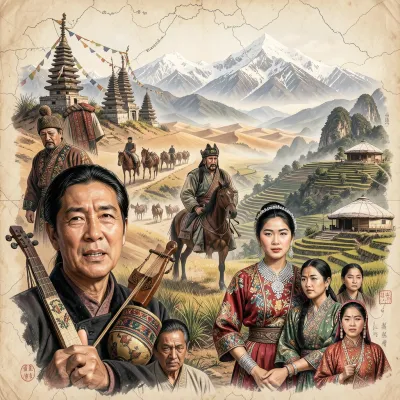
*Frontiers and Peoples: Ethnic Minorities in China's Past* explores the historical development of China’s borderlands not as peripheral edges, but as dynamic "contact zones" where ecological, economic, and religious networks intersected with imperial ambitions. By examining the trajectories of Tibetans, Uyghurs, Mongols, Zhuang, and other communities, the book demonstrates how these groups exercised significant agency through specialized institutions like the *tusi* system, monastic brokerage, and caravan guilds. Rather than a linear story of absorption, the narrative highlights a recurring cycle of negotiation, where the Chinese state—from the Han to the Qing—was forced to adapt its governance to accommodate the mobile and diverse realities of the steppe, the high plateaus, and the subtropical southwest.
The book delves into the specific mechanisms that facilitated frontier rule, emphasizing the role of intermediaries who translated imperial edicts into local idioms. Key institutions such as the Mongol banner system and the Qing patron-priest relationship with Tibet illustrate a modular approach to sovereignty that prioritized stability and revenue over cultural uniformity. The text also highlights the critical importance of "gray economies," plural legal systems, and religious landscapes—including the influence of Sufi orders, Buddhist monasteries, and local shamans—in maintaining order where central bureaucratic reach was thin. Gender and kinship are further identified as vital social technologies that enabled households to survive and prosper amidst political volatility.
As the narrative transitions from the late imperial period to the Republic and the People’s Republic of China, it tracks the transformation of fluid frontier identities into the fixed administrative categories of "nationalities." The text argues that modern mapping, ethnography, and state-led heritage projects have reified these communities, turning living histories into curated artifacts of national unity. Ultimately, the book concludes that China’s frontiers remain sites of creative negotiation, where historical memory continues to inform contemporary identities and the enduring relationship between the center and its diverse peripheries.
What You'll Find Inside:
- Frontiers functioned as dynamic contact zones where ecological conditions, trade routes, religious networks, and political ambitions created spaces requiring constant negotiation rather than fixed borders to be controlled.
- Frontier peoples exercised significant agency through tribute missions, legal forum shopping, marriage alliances, and economic specialization, actively shaping state policies as much as being shaped by them.
- Imperial incorporation relied on flexible institutions like the tusi system, banner arrangements, and patron-priest relationships that delegated authority to local elites while maintaining symbolic overlordship.
- Brokers including lamas, begs, merchants, and chiefs served as essential intermediaries who translated between state and local contexts, often reshaping imperial policies to fit frontier realities.
- The book reveals historical continuity in frontier governance from Qin-Han through Qing to modern eras, demonstrating how patterns of negotiation, accommodation, and resistance persisted despite dynastic changes.
Who's It For:
This book is essential reading for students and scholars of Chinese history, ethnic studies, and borderlands research who seek to understand the complex dynamics between China's central states and its peripheral communities. It will particularly benefit those studying specific ethnic groups like Tibetans, Uyghurs, Mongols, and Zhuang, as well as researchers interested in themes of imperial incorporation, cultural brokerage, legal pluralism, and resistance/accommodation strategies. The work offers valuable insights for anyone examining how diverse empires manage frontier regions through flexible governance rather than imposed uniformity.
Table of Contents:
- Introduction
- Chapter 1 Frontiers as Concept and Space
- Chapter 2 Empires on the Move: From Qin–Han to Tang
- Chapter 3 Tibetans, Buddhism, and Highland Polities
- Chapter 4 Uyghur Khaganates and the Silk Road Cities
- Chapter 5 The Mongol Empire and Multiethnic Governance
- Chapter 6 Ming Frontier Institutions: Tusi, Guards, and Gates
- Chapter 7 Qing Expansion and the Making of Xinjiang
- Chapter 8 Patron and Priest: Tibet under the Qing
- Chapter 9 Zhuang Communities and the Southwest Marches
- Chapter 10 Hui Muslims and Networks across the Northwest
- Chapter 11 Yi Societies and Degrees of Statehood
- Chapter 12 Miao Uprisings and Cultural Brokers
- Chapter 13 Kazakh and Kyrgyz Pastoral Worlds
- Chapter 14 Qiang Communities and Mountain Ecologies
- Chapter 15 Border Buddhism among the Dai and Tai
- Chapter 16 Manchus, Banners, and Frontier Transformations
- Chapter 17 Language Policy, Scripts, and Translation Regimes
- Chapter 18 Law, Tribute, and the Grammar of Incorporation
- Chapter 19 Trade, Taxation, and Caravan Economies
- Chapter 20 Households, Gender, and Kinship at the Edges
- Chapter 21 Religious Landscapes: Lamas, Sufis, and Shamans
- Chapter 22 Resistance, Revolt, and Accommodation
- Chapter 23 Mapping, Ethnography, and the Invention of “Minorities”
- Chapter 24 Republic to People’s Republic: Frontiers in Transition
- Chapter 25 Memory, Heritage, and Contemporary Identities
Author:
Published By:
Date Published:
May 4, 2026
Type:
Nonfiction
Language:
English
Word Count:
72,710 words
Reading Time:
5 hours 6 minutes
Sample:
MixCache.com Total Access
Get unlimited access to this book + all books published by MixCache.com for $11.99/month
Subscribe to MTAOr purchase this book individually below
Order:
Buy the Frontiers and Peoples: Ethnic Minorities in China's Past ebook on MixCache.com:
Buy Now
Full ebook will be available immediately
- read online or download as a PDF file.
$5 account credit for all new MixCache.com accounts, usable toward any ebook purchase!*





Ratings & Reviews
Ask Questions About This Book
Have a question about the content? Ask our AI assistant!
Start by asking a question about "Frontiers and Peoples: Ethnic Minorities in China's Past"
Example: "Does this book mention William Shakespeare?"
Thinking...