Browse by Category
Fiction
- Action & Adventure
- African American
- Anthologies
- Children's Fiction
- Classics
- Comics & Graphic Novels
- Coming of Age
- Contemporary
- Cultural & Regional
- Drama
- Erotica
- Fantasy
- General
- Historical Fiction
- Horror
- Humor & Satire
- Literary Fiction
- Mystery, Thriller & Suspense
- Poetry
- Religious & Inspirational
- Romance
- Science Fiction
- Short Stories
- War & Military
- Westerns
- Women's Fiction
- Young Adult
Non-Fiction
- Antiques & Collectibles
- Arts & Photography
- Biographies & Memoirs
- Business & Money
- Children's Non-Fiction
-
Computers & Technology
- Artificial Intelligence
- Computer Science
- Cybersecurity & Cryptography
- Data Science & Analytics
- Databases & Big Data
- Game Development & Design
- General
- Hardware & DIY
- Mobile App Development
- Networking & Cloud Computing
- Operating Systems
- Programming
- Robotics
- Software
- Software Engineering
- User Experience (UX) & Design
- Web Development & Design
- Cooking, Food & Wine
- Crafts, Hobbies & Home
- Education & Teaching
- Engineering
- General
- Health, Fitness & Dieting
-
History
- African History
- African History - North Africa
- African History - Sub-Saharan Africa
- American History
- American History - 20th Century
- American History - Civil War
- American History - Colonial Period
- Ancient History
- Asian History
- Asian History - China
- Asian History - India
- Asian History - Japan
- Asian History - Southeast Asia
- European History
- European History - Ancient Greece
- European History - Ancient Rome
- European History - Medieval
- European History - Modern
- European History - Renaissance
- General
- Middle Eastern History
- Military History
- Military History - Aviation
- Military History - Naval
- Social & Cultural History
- World History
- Humor & Entertainment
- Industrial Technology
- Language Learning
- Law
- LGBTQ+ Non-Fiction
- Literary Criticism
- Medical Books
- Parenting & Relationships
- Philosophy
- Politics & Social Sciences
- Reference
- Religion & Spirituality
-
Science & Math
- Agricultural Sciences
- Astronomy & Space Science
- Behavioral Sciences
- Biological Sciences
- Botany & Plant Science
- Chemistry
- Earth Sciences
- Engineering - Chemical
- Engineering - Civil
- Engineering - Electrical
- Engineering - Mechanical
- Environment
- General
- Geology
- Mathematics
- Nature & Ecology
- Oceanography
- Paleontology
- Physics
- Statistics
- Self-Help
- Sports & Outdoors
- Study Aids
- Sustainability & Green Living
- Textbooks
- Transportation
- Travel
- True Crime
- Urban Planning & Development
- Veterinary Medicine
- Writing & Publishing
Jump to Section
MixCache.com Total Access
Unlimited reading and audiobooks for every book published by MixCache.com.
Included titles carry the MTA badge.
Learn more →
Space Artifacts: How Exploration Shaped Culture, Design, and Media
MTA
A cultural history of space objects, imagery, and narratives from the Moon landing to Starlink
About this book:
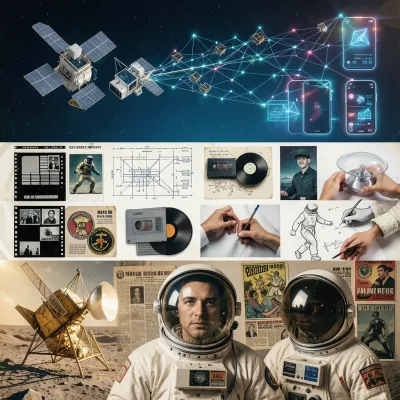
"Space Artifacts: How Exploration Shaped Culture, Design, and Media" offers a comprehensive cultural history of space exploration from the Apollo 11 moon landing to the modern era of Starlink. The book argues that space artifacts, encompassing not just physical hardware but also images, design languages, narratives, and everyday objects, are not mere byproducts of technology but active shapers of culture. It explores how these artifacts encode values, travel across borders, and influence public perceptions of science, national prestige, corporate branding, and environmental care.
The early chapters establish the visual and narrative canon of the Space Age, examining how events like the Moon landing (Chapter 1) were staged for television, transforming a technical feat into a planetary spectacle. It analyzes iconic imagery such as "Earthrise" and the "Blue Marble" (Chapter 2), demonstrating how these photographs reshaped our understanding of Earth as a fragile, unified planet and fostered early environmental consciousness. The book delves into the semiotics of mission patches (Chapter 3) as symbols of belonging and identity, and dissects the "NASA Aesthetic" (Chapter 4), contrasting the "meatball" and "worm" logos as reflections of different eras of modernism and public design. It further explores how rockets for children (Chapter 5) in the form of toys and kits, and Space Age aesthetics in home appliances and furniture (Chapter 6), brought the future into everyday life, influencing aspirations and domestic design. The evolution of the spacesuit (Chapter 7) is presented as a study in fashioning astronauts' identity and future, while the transition from toggle to touch in interface design (Chapter 8) showcases how user experience has evolved from Mercury to SpaceX.
Middle chapters continue to track the transformation of design languages and infrastructures, moving into cinematic portrayals of space (Chapter 9) from *2001: A Space Odyssey* to *Gravity*, and exploring how "The Right Stuff" (Chapter 10) constructed a national myth of heroism on screen and page. The book examines the fascinating intersection of "Star Wars" (the film) and "Star Wars" (SDI rhetoric) (Chapter 11), illustrating the policy feedback between sci-fi spectacle and national defense. It also highlights the Voyager Golden Record (Chapter 12) as humanity's profound act of self-reflection to an extraterrestrial audience, and "Hubble’s Eye" (Chapter 13) as a groundbreaking example of image processing, color, and the public cosmos. Martian dreams (Chapter 14) are explored through the lens of rovers and robotics, emphasizing remote presence and anthropomorphism, while "The View from Above" (Chapter 15) discusses satellites, surveillance, and the concept of an "Open Earth."
Later chapters address how new commercial actors, legal regimes, and artistic practices are reshaping our view of the sky. This includes discussions on gender, race, and the cosmonaut imaginary (Chapter 16), and the emergence of Afrofuturisms and Indigenous Skies (Chapter 17) as alternative astronomies. The book analyzes "Cosmodromes and Company Towns" (Chapter 18) to reveal how launch infrastructures impact everyday life, and chronicles "The Commercial Turn" (Chapter 19) with NewSpace companies rebranding risk and exploration. It investigates "Branding the Void" (Chapter 20) through logos, memes, and the social media rocket, and addresses the impact of "Constellations Below" (Chapter 21) like Starlink on connectivity and the night sky. The pressing issue of "Planetary Commons" (Chapter 22) covers law, property, and orbital debris, underscoring space as a shared but threatened resource. Finally, "Museums, Monuments, and Memory" (Chapter 23) explores how the Space Age is curated, while "Artists in Microgravity" (Chapter 24) examines performance, installations, and SciArt. The concluding chapter, "After Apollo" (Chapter 25), reflects on climate change, crisis, and the evolving ethics of space expansion, challenging readers to consider more equitable, sustainable, and meaningful trajectories for humanity.
What You'll Find Inside:
- How space artifacts like mission patches, television broadcasts, and spacecraft interfaces actively shape cultural narratives and public perception of exploration.
- The evolution of space-related design from NASA's 'meatball' and 'worm' logos to contemporary commercial space branding and its cultural implications.
- How media - from Apollo-era television to modern social media - transforms space exploration into shared cultural experiences that influence societal values.
- Examination of inclusivity in space exploration through chapters on gender, race, Afrofuturism, and Indigenous astronomical traditions.
- Analysis of contemporary space issues including orbital debris, satellite constellations' impact on night skies, and the ethics of commercial space expansion.
Who's It For:
This book is ideal for students and scholars in design history, media studies, cultural anthropology, and science and technology studies who seek to understand space exploration as a cultural phenomenon. It will also appeal to general readers fascinated by how space artifacts influence everyday life, from household appliances to social media, and those interested in the social dimensions of space exploration including diversity, environmental concerns, and the interplay between technology and society.
Table of Contents:
- Introduction
- Chapter 1 The Moon on Television: Apollo 11 and the Birth of Planetary Spectacle
- Chapter 2 From Earthrise to the Blue Marble: Re-seeing the Planet
- Chapter 3 Sewn Stories: Mission Patches and the Semiotics of Belonging
- Chapter 4 The NASA Aesthetic: Worms, Meatballs, and Modernism in Public Design
- Chapter 5 Rockets for Children: Toys, Kits, and the Pedagogy of Wonder
- Chapter 6 Space at Home: Appliances, Furniture, and the Jet Age Interior
- Chapter 7 The Silver Suit: Fashioning Astronauts, Identity, and Futures
- Chapter 8 From Toggle to Touch: Interface Design from Mercury to SpaceX
- Chapter 9 Cinematic Orbits: From 2001 to Gravity and Beyond
- Chapter 10 The Right Stuff and the National Myth: Heroism on Screen and Page
- Chapter 11 Star Wars and Star Wars: Sci‑Fi Spectacle, SDI Rhetoric, and Policy Feedback
- Chapter 12 The Voyager Golden Record: Addressing Everyone, Speaking for Earth
- Chapter 13 Hubble’s Eye: Image Processing, Color, and the Public Cosmos
- Chapter 14 Martian Dreams: Rovers, Robotics, and Remote Presence
- Chapter 15 The View from Above: Satellites, Surveillance, and Open Earth
- Chapter 16 Space for All? Gender, Race, and the Cosmonaut Imaginary
- Chapter 17 Afrofuturisms and Indigenous Skies: Alternative Astronomies
- Chapter 18 Cosmodromes and Company Towns: Launch Infrastructures and Everyday Life
- Chapter 19 The Commercial Turn: NewSpace, Unicorns, and the Rebranding of Risk
- Chapter 20 Branding the Void: Logos, Memes, and the Social Media Rocket
- Chapter 21 Constellations Below: Starlink, Connectivity, and the Night Sky
- Chapter 22 Planetary Commons: Law, Property, and the Problem of Orbital Debris
- Chapter 23 Museums, Monuments, and Memory: Curating the Space Age
- Chapter 24 Artists in Microgravity: Performance, Installations, and SciArt
- Chapter 25 After Apollo: Climate, Crisis, and the Ethics of Expansion
Author:
Published By:
Date Published:
May 3, 2026
Type:
Nonfiction
Language:
English
Word Count:
71,369 words
Reading Time:
5 hours
Sample:
Order:
Order Space Artifacts: How Exploration Shaped Culture, Design, and Media (Hardcover) on MixCache.com:
Buy NowPrint copy is made to order and ships worldwide. Includes the ebook free, ready to read instantly.
$5 account credit for all new MixCache.com accounts, usable toward any ebook purchase!*