
Browse by Category
Fiction
- Action & Adventure
- African American
- Anthologies
- Children's Fiction
- Classics
- Comics & Graphic Novels
- Coming of Age
- Contemporary
- Cultural & Regional
- Drama
- Erotica
- Fantasy
- General
- Historical Fiction
- Horror
- Humor & Satire
- Literary Fiction
- Mystery, Thriller & Suspense
- Poetry
- Religious & Inspirational
- Romance
- Science Fiction
- Short Stories
- War & Military
- Westerns
- Women's Fiction
- Young Adult
Non-Fiction
- Antiques & Collectibles
- Arts & Photography
- Biographies & Memoirs
- Business & Money
- Children's Non-Fiction
-
Computers & Technology
- Artificial Intelligence
- Computer Science
- Cybersecurity & Cryptography
- Data Science & Analytics
- Databases & Big Data
- Game Development & Design
- General
- Hardware & DIY
- Mobile App Development
- Networking & Cloud Computing
- Operating Systems
- Programming
- Robotics
- Software
- Software Engineering
- User Experience (UX) & Design
- Web Development & Design
- Cooking, Food & Wine
- Crafts, Hobbies & Home
- Education & Teaching
- Engineering
- General
- Health, Fitness & Dieting
-
History
- African History
- African History - North Africa
- African History - Sub-Saharan Africa
- American History
- American History - 20th Century
- American History - Civil War
- American History - Colonial Period
- Ancient History
- Asian History
- Asian History - China
- Asian History - India
- Asian History - Japan
- Asian History - Southeast Asia
- European History
- European History - Ancient Greece
- European History - Ancient Rome
- European History - Medieval
- European History - Modern
- European History - Renaissance
- General
- Middle Eastern History
- Military History
- Military History - Aviation
- Military History - Naval
- Social & Cultural History
- World History
- Humor & Entertainment
- Industrial Technology
- Language Learning
- Law
- LGBTQ+ Non-Fiction
- Literary Criticism
- Medical Books
- Parenting & Relationships
- Philosophy
- Politics & Social Sciences
- Reference
- Religion & Spirituality
-
Science & Math
- Agricultural Sciences
- Astronomy & Space Science
- Behavioral Sciences
- Biological Sciences
- Botany & Plant Science
- Chemistry
- Earth Sciences
- Engineering - Chemical
- Engineering - Civil
- Engineering - Electrical
- Engineering - Mechanical
- Environment
- General
- Geology
- Mathematics
- Nature & Ecology
- Oceanography
- Paleontology
- Physics
- Statistics
- Self-Help
- Sports & Outdoors
- Study Aids
- Sustainability & Green Living
- Textbooks
- Transportation
- Travel
- True Crime
- Urban Planning & Development
- Veterinary Medicine
- Writing & Publishing
Jump to Section
MixCache.com Total Access
Unlimited reading and audiobooks for every book published by MixCache.com.
Included titles carry the MTA badge.
Learn more →
Voyager's Long Goodbye: Case Studies in Deep Space Mission Design
MTA
Lessons learned from extended missions and surviving the outer solar system environment
About this book:
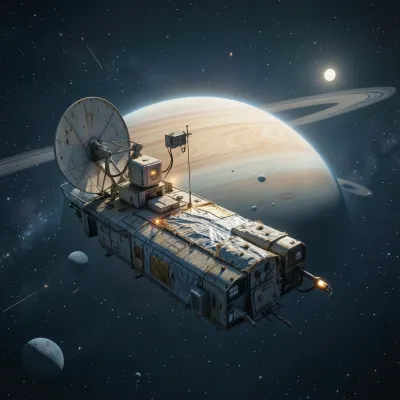
*Voyager’s Long Goodbye: Case Studies in Deep Space Mission Design* provides a comprehensive technical and operational analysis of humanity’s most distant spacecraft, specifically the Pioneer, Voyager, and New Horizons missions. The book frames deep-space engineering as a discipline of patience, where the primary adversary is time rather than complexity. By examining these missions, the text explores how engineers designed systems to survive decades of extreme cold, diminishing power from decaying radioisotope thermoelectric generators (RTGs), and the accumulating effects of radiation. It emphasizes that longevity is not an accident but the result of a "reliability culture" that prioritizes robust, conservative design and the meticulous management of shrinking resources.
The book details the quiet disciplines required to maintain a link across light-hours of space, such as the evolution of the Deep Space Network and the use of sophisticated error-correction codes to extract data from whispers. Key case studies illustrate different architectural philosophies: the "elegant simplicity" and spin-stabilization of the Pioneer probes, the "controlled complexity" of Voyager’s Grand Tour, and the "lean systems engineering" of New Horizons. Significant attention is given to "unknown unknowns," such as the Pioneer Anomaly, and how these missions adapted through software patches, autonomous fault protection, and "graceful degradation"—the staged retirement of instruments to preserve core spacecraft health.
Beyond hardware, the text addresses the critical role of human infrastructure, including knowledge capture and the preservation of legacy software to ensure that missions outlast their original designers. It describes the transition of these probes from planetary explorers to interstellar sentinels, noting how they were repurposed to study the heliopause and the interstellar medium. This operational history serves as a blueprint for future endeavors, showing that the "long goodbye" is a deliberate design requirement rather than a mission epilogue.
The final chapters synthesize these lessons into a roadmap for a dedicated interstellar probe. The book argues that the next half-century of exploration will require revolutionary leaps in power generation, optical communications, and onboard artificial intelligence to manage missions that must function autonomously for centuries. By distilling the lived experience of the first outer-solar-system explorers, the book equips future mission designers to build spacecraft capable of enduring the vast temporal and spatial gaps of the cosmic void.
What You'll Find Inside:
- Designing for decades requires explicit requirements that anticipate aging, radiation, thermal cycling, and power decay, embedding margins and derating as core constraints rather than afterthoughts.
- Radioisotope Thermoelectric Generators (RTGs) provide both power and waste heat, and successful missions treat them as a declining resource that must be carefully budgeted, with load‑shedding sequences and instrument retirements staged to match the falling output.
- Thermal control beyond the frost line turns waste heat into a precious asset; strategies include using RTG heat to keep propellant lines warm, employing multi‑layer insulation, and managing heater duty cycles to survive the deep cold.
- Maintaining a usable communications link across light‑hours demands evolving link budgets, adaptive error‑correcting codes, antenna pointing precision, and ground‑segment upgrades such as arraying and cryogenic receivers to pull ever‑weaker signals from the noise.
- Autonomy and fault protection are essential when help is hours away; spacecraft must detect anomalies, reconfigure power buses, enter safe modes, and execute pre‑programmed load‑shedding or hibernation sequences without ground intervention.
Who's It For:
This book is intended for mission designers, systems engineers, spacecraft operators, and graduate students who are involved in planning or executing deep‑space missions expected to operate for decades. Readers will benefit from the detailed case studies of Voyager, Pioneer, and New Horizons, which illustrate how to engineer for power descent, thermal extremes, long‑delay communications, and autonomous fault tolerance in the outer solar system.
Table of Contents:
- Introduction
- Chapter 1 The Outer Edge: Why Missions Must Endure
- Chapter 2 Design for Decades: Requirements and Reliability Culture
- Chapter 3 RTGs and Power-Limited Architectures
- Chapter 4 Cold and Dark: Thermal Control Beyond the Frost Line
- Chapter 5 Speaking Across Light‑Hours: DSN, Antennas, and Link Budgets
- Chapter 6 Navigation at the Fringes: Trajectories, Assists, and Ephemerides
- Chapter 7 Autonomy and Fault Protection When Nobody Is Home
- Chapter 8 Commanding the Distant: Sequencing, Timing, and Contingencies
- Chapter 9 Data at a Dribble: Compression, Prioritization, and Storage
- Chapter 10 Radiation and Aging: Hardening, Derating, and Wearout
- Chapter 11 Pioneer’s Pathfinders: Architecture and Operations from Jupiter Outward
- Chapter 12 The Pioneer Anomaly: Measurement, Modeling, and Mission Impacts
- Chapter 13 Spin‑Stabilization and the Art of Simplicity
- Chapter 14 The Grand Tour: Voyager’s Once‑in‑Centuries Design Opportunity
- Chapter 15 Surviving the Planetary Gauntlet: Faults, Fixes, and Foresight
- Chapter 16 Power Descent Management: Load Shedding and Instrument Lifecycles
- Chapter 17 Keeping the Link: High‑Gain Antennas and DSN Upgrades
- Chapter 18 Beyond the Heliopause: Voyager in Interstellar Space
- Chapter 19 Fast and Light: New Horizons’ Lean System Engineering
- Chapter 20 Hibernation as a System: Sleeping a Spacecraft for Years
- Chapter 21 Flyby at 14 km/s: Operations for Pluto and Arrokoth
- Chapter 22 Propellant Husbandry: Attitude Control Without Reaction Wheels
- Chapter 23 Software for the Long Haul: Patching, Emulation, and Obsolescence
- Chapter 24 Designing for Unknown Unknowns: Margins, Monitors, and Graceful Degradation
- Chapter 25 Toward the Interstellar Probe: A Roadmap for the Next Half‑Century
Author:
Published By:
Date Published:
May 3, 2026
Type:
Nonfiction
Language:
English
Word Count:
54,272 words
Reading Time:
3 hours 48 minutes
Sample:
MixCache.com Total Access
Get unlimited access to this book + all books published by MixCache.com for $11.99/month
Subscribe to MTAOr purchase this book individually below
Order:
Buy the Voyager's Long Goodbye: Case Studies in Deep Space Mission Design ebook on MixCache.com:
Buy Now
Full ebook will be available immediately
- read online or download as a PDF file.
$5 account credit for all new MixCache.com accounts, usable toward any ebook purchase!*


Ratings & Reviews
Ask Questions About This Book
Have a question about the content? Ask our AI assistant!
Start by asking a question about "Voyager's Long Goodbye: Case Studies in Deep Space Mission Design"
Example: "Does this book mention William Shakespeare?"
Thinking...