
Browse by Category
Fiction
- Action & Adventure
- African American
- Anthologies
- Children's Fiction
- Classics
- Comics & Graphic Novels
- Coming of Age
- Contemporary
- Cultural & Regional
- Drama
- Erotica
- Fantasy
- General
- Historical Fiction
- Horror
- Humor & Satire
- Literary Fiction
- Mystery, Thriller & Suspense
- Poetry
- Religious & Inspirational
- Romance
- Science Fiction
- Short Stories
- War & Military
- Westerns
- Women's Fiction
- Young Adult
Non-Fiction
- Antiques & Collectibles
- Arts & Photography
- Biographies & Memoirs
- Business & Money
- Children's Non-Fiction
-
Computers & Technology
- Artificial Intelligence
- Computer Science
- Cybersecurity & Cryptography
- Data Science & Analytics
- Databases & Big Data
- Game Development & Design
- General
- Hardware & DIY
- Mobile App Development
- Networking & Cloud Computing
- Operating Systems
- Programming
- Robotics
- Software
- Software Engineering
- User Experience (UX) & Design
- Web Development & Design
- Cooking, Food & Wine
- Crafts, Hobbies & Home
- Education & Teaching
- Engineering
- General
- Health, Fitness & Dieting
-
History
- African History
- African History - North Africa
- African History - Sub-Saharan Africa
- American History
- American History - 20th Century
- American History - Civil War
- American History - Colonial Period
- Ancient History
- Asian History
- Asian History - China
- Asian History - India
- Asian History - Japan
- Asian History - Southeast Asia
- European History
- European History - Ancient Greece
- European History - Ancient Rome
- European History - Medieval
- European History - Modern
- European History - Renaissance
- General
- Middle Eastern History
- Military History
- Military History - Aviation
- Military History - Naval
- Social & Cultural History
- World History
- Humor & Entertainment
- Industrial Technology
- Language Learning
- Law
- LGBTQ+ Non-Fiction
- Literary Criticism
- Medical Books
- Parenting & Relationships
- Philosophy
- Politics & Social Sciences
- Reference
- Religion & Spirituality
-
Science & Math
- Agricultural Sciences
- Astronomy & Space Science
- Behavioral Sciences
- Biological Sciences
- Botany & Plant Science
- Chemistry
- Earth Sciences
- Engineering - Chemical
- Engineering - Civil
- Engineering - Electrical
- Engineering - Mechanical
- Environment
- General
- Geology
- Mathematics
- Nature & Ecology
- Oceanography
- Paleontology
- Physics
- Statistics
- Self-Help
- Sports & Outdoors
- Study Aids
- Sustainability & Green Living
- Textbooks
- Transportation
- Travel
- True Crime
- Urban Planning & Development
- Veterinary Medicine
- Writing & Publishing
Jump to Section
MixCache.com Total Access
Unlimited reading and audiobooks for every book published by MixCache.com.
Included titles carry the MTA badge.
Learn more →
Orbital Debris Management
MTA
Solutions, technologies, and policies to mitigate the growing space junk crisis
About this book:
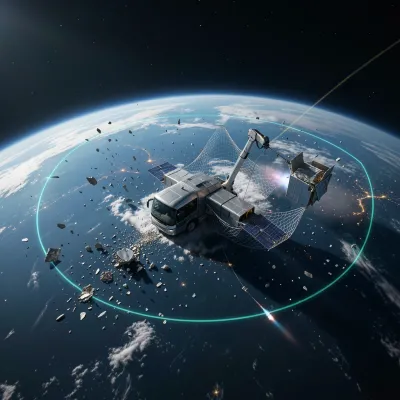
*Orbital Debris Management* provides a comprehensive technical, legal, and economic framework for addressing the escalating crisis of space junk. The book establishes that the orbital environment is not a uniform void but a collection of distinct regimes—LEO, MEO, and GEO—each governed by different physical dynamics and requiring tailored mitigation strategies. It details the fundamental physics of orbital mechanics and atmospheric drag, which dictate how fragments from explosions and collisions evolve over time, potentially leading to the catastrophic "Kessler Syndrome" of self-sustaining debris cascades.
The text shifts from theoretical risk to operational practice, examining the vital roles of Space Situational Awareness (SSA) and Space Traffic Management (STM). It describes the global network of ground- and space-based sensors used to track objects, the importance of standardized data formats like CDMs and TLEs, and the mathematical modeling required for conjunction assessment and collision-probability calculations. The author emphasizes that as mega-constellations proliferate, traditional manual oversight must give way to automated, AI-driven coordination to handle the sheer volume of close-approach alerts and maneuver planning.
The book also evaluates engineering solutions and preventative design, such as "design for demise" to ensure satellites burn up upon reentry, and the passivation of spent rocket stages to prevent on-orbit explosions. It transitions into the maturing fields of Active Debris Removal (ADR) and on-orbit servicing, detailing concepts like robotic grapples, harpoons, and lasers. While these technologies offer a way to remediate existing hazards, the text acknowledges that their implementation is currently hindered by high costs, the lack of standardized interfaces, and complex legal questions regarding ownership and dual-use security concerns.
In its final chapters, the book argues that debris management is ultimately a governance and economic challenge. It reviews international treaties, national licensing regulations (such as those from the FCC), and voluntary guidelines like those from the IADC. The author proposes a global roadmap that utilizes insurance premiums, orbital bonds, and shared metrics to internalize the costs of debris creation. By aligning commercial incentives with long-term environmental stewardship, the book suggests that the orbital commons can be preserved as a sustainable resource for future scientific and commercial exploration.
What You'll Find Inside:
- Comprehensive overview of the orbital debris problem including its scale, dynamics, and distribution across LEO, MEO, and GEO orbital regimes
- Technical fundamentals of orbital mechanics, impact physics, and shielding design for effective debris mitigation strategies
- Operational practices covering conjunction assessment, collision probability modeling, maneuver planning, and end-of-life disposal techniques
- Regulatory frameworks, international standards (IADC, ISO 24113), and policy approaches for debris mitigation across national and international jurisdictions
- Emerging technologies (drag augmentation, AI for SSA, active debris removal), economic considerations, and a global roadmap for sustainable space operations implementation
Who's It For:
This book is essential for satellite operators, spacecraft engineers, space traffic managers, regulators, and insurance professionals who need practical guidance on mitigating orbital debris risks. It provides actionable insights for those involved in planning, building, operating, licensing, and insuring spacecraft, helping them navigate the technical, operational, and policy challenges of preserving the orbital commons for sustainable space activities.
Table of Contents:
- Introduction
- Chapter 1 The Orbital Debris Problem: Scale, Dynamics, and Trends
- Chapter 2 Fundamentals of Orbital Mechanics for Debris Evolution
- Chapter 3 The Debris Environment Across LEO, MEO, and GEO
- Chapter 4 Sensing and Tracking: Ground- and Space-Based SSA
- Chapter 5 Catalogs and Data Standards: From TLEs to OMM and CCSDS
- Chapter 6 Conjunction Assessment and Collision-Probability Modeling
- Chapter 7 Impact Physics, Shielding, and Consequence Analysis
- Chapter 8 Design for Demise, Passivation, and Breakup Prevention
- Chapter 9 End-of-Life Disposal: Controlled Reentry and Graveyard Orbits
- Chapter 10 Mega-Constellations: Architectures, Traffic, and Risk Multipliers
- Chapter 11 Launch Vehicle Stages: Venting, Safing, and Long-Lived Objects
- Chapter 12 Operational Risk Management: Maneuver Planning and Autonomy
- Chapter 13 Atmosphere, Space Weather, and Decay/Reentry Prediction
- Chapter 14 Active Debris Removal: Concepts, Demonstrations, and Readiness
- Chapter 15 On-Orbit Servicing and Refueling as Preventative Mitigation
- Chapter 16 Mitigation Standards: IADC, ISO 24113, and Best Practices
- Chapter 17 National Regulations and Licensing: FCC, ESA, and Beyond
- Chapter 18 International Law and Norms: UN Treaties and LTS Guidelines
- Chapter 19 Space Traffic Coordination and STM Architectures
- Chapter 20 Data Sharing, CDMs, and Transparency Mechanisms
- Chapter 21 Economics and Insurance: Incentives, Costs, and Externalities
- Chapter 22 Legal, Ethical, and Security Considerations
- Chapter 23 Emerging Technologies: Drag Augmentation, Lasers, and AI for SSA/STM
- Chapter 24 Scenario Modeling: Kessler Cascades, Monte Carlo, and Stress Tests
- Chapter 25 A Global Roadmap: Governance, Metrics, and Implementation Pathways
Author:
Published By:
Date Published:
May 3, 2026
Type:
Nonfiction
Language:
English
Word Count:
62,366 words
Reading Time:
4 hours 22 minutes
Sample:
MixCache.com Total Access
Get unlimited access to this book + all books published by MixCache.com for $11.99/month
Subscribe to MTAOr purchase this book individually below
Order:
Buy the Orbital Debris Management ebook on MixCache.com:
Buy Now
Full ebook will be available immediately
- read online or download as a PDF file.
$5 account credit for all new MixCache.com accounts, usable toward any ebook purchase!*





Ratings & Reviews
Ask Questions About This Book
Have a question about the content? Ask our AI assistant!
Start by asking a question about "Orbital Debris Management"
Example: "Does this book mention William Shakespeare?"
Thinking...