
Browse by Category
Fiction
- Action & Adventure
- African American
- Anthologies
- Children's Fiction
- Classics
- Comics & Graphic Novels
- Coming of Age
- Contemporary
- Cultural & Regional
- Drama
- Erotica
- Fantasy
- General
- Historical Fiction
- Horror
- Humor & Satire
- Literary Fiction
- Mystery, Thriller & Suspense
- Poetry
- Religious & Inspirational
- Romance
- Science Fiction
- Short Stories
- War & Military
- Westerns
- Women's Fiction
- Young Adult
Non-Fiction
- Antiques & Collectibles
- Arts & Photography
- Biographies & Memoirs
- Business & Money
- Children's Non-Fiction
-
Computers & Technology
- Artificial Intelligence
- Computer Science
- Cybersecurity & Cryptography
- Data Science & Analytics
- Databases & Big Data
- Game Development & Design
- General
- Hardware & DIY
- Mobile App Development
- Networking & Cloud Computing
- Operating Systems
- Programming
- Robotics
- Software
- Software Engineering
- User Experience (UX) & Design
- Web Development & Design
- Cooking, Food & Wine
- Crafts, Hobbies & Home
- Education & Teaching
- Engineering
- General
- Health, Fitness & Dieting
-
History
- African History
- African History - North Africa
- African History - Sub-Saharan Africa
- American History
- American History - 20th Century
- American History - Civil War
- American History - Colonial Period
- Ancient History
- Asian History
- Asian History - China
- Asian History - India
- Asian History - Japan
- Asian History - Southeast Asia
- European History
- European History - Ancient Greece
- European History - Ancient Rome
- European History - Medieval
- European History - Modern
- European History - Renaissance
- General
- Middle Eastern History
- Military History
- Military History - Aviation
- Military History - Naval
- Social & Cultural History
- World History
- Humor & Entertainment
- Industrial Technology
- Language Learning
- Law
- LGBTQ+ Non-Fiction
- Literary Criticism
- Medical Books
- Parenting & Relationships
- Philosophy
- Politics & Social Sciences
- Reference
- Religion & Spirituality
-
Science & Math
- Agricultural Sciences
- Astronomy & Space Science
- Behavioral Sciences
- Biological Sciences
- Botany & Plant Science
- Chemistry
- Earth Sciences
- Engineering - Chemical
- Engineering - Civil
- Engineering - Electrical
- Engineering - Mechanical
- Environment
- General
- Geology
- Mathematics
- Nature & Ecology
- Oceanography
- Paleontology
- Physics
- Statistics
- Self-Help
- Sports & Outdoors
- Study Aids
- Sustainability & Green Living
- Textbooks
- Transportation
- Travel
- True Crime
- Urban Planning & Development
- Veterinary Medicine
- Writing & Publishing
Jump to Section
MixCache.com Total Access
Unlimited reading and audiobooks for every book published by MixCache.com.
Included titles carry the MTA badge.
Learn more →
Privateers of the Final Frontier
MTA
How private companies reshaped launch, satellite services, and lunar commerce
About this book:
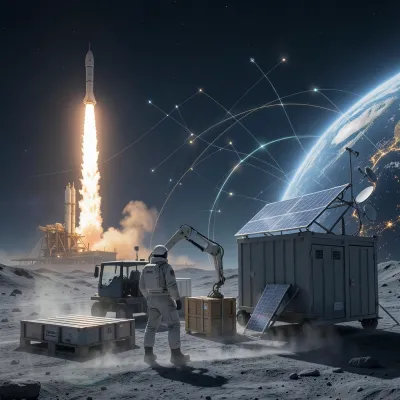
*Privateers of the Final Frontier* chronicles the transition of space from a government-monopolized arena of national prestige to a dynamic, commercially-driven marketplace. The book details how the "reusability revolution," spearheaded by private launch companies, fundamentally altered the economics of orbit by shifting the paradigm from expendable hardware to rapidly turnable assets. This cost reduction acted as a catalyst for a burgeoning ecosystem of small-form-factor satellites (smallsats), standardized CubeSats, and rideshare aggregators, which collectively lowered the barrier to entry for entrepreneurs, researchers, and emerging spacefaring nations.
The narrative explores how value chains are being rewired across diverse sectors, including Earth observation, global broadband mega-constellations, and "Space as a Service." As orbital infrastructure matures, the focus has shifted from the physics of launch to the logistics of data, with APIs and cloud platforms becoming the primary interfaces for customers. The book also examines the rise of orbital logistics, such as space tugs and life-extension servicing, which treat satellites as upgradable platforms rather than disposable artifacts. This maturation, however, brings new complexities, including the critical need for debris mitigation, spectrum management, and a robust insurance market to price the inherent risks of a congested orbital commons.
Central to the book is the evolving relationship between the private sector and government agencies like NASA and the DoD. By shifting from traditional "cost-plus" procurement to milestone-based service contracts, governments have become "keystone customers" that de-risk new markets—most notably in lunar commerce. The text details the scramble for lunar logistics, where commercial landers and power systems are laying the groundwork for a sustained presence. This expansion is currently navigating a labyrinth of legal and ethical challenges, including ITAR export controls, property rights on celestial bodies, and the environmental impact of light pollution and orbital overcrowding.
The final chapters offer an "entrepreneur’s playbook" for finding product-market fit in space and project three potential scenarios for 2035: the emergence of "Utility Provider" giants that offer end-to-end space infrastructure, a fragmented market of "Specialized Innovators," or a "Geo-Constellation" future dominated by nationalistic, state-aligned blocs. Ultimately, the book argues that while the technical hurdles of space remain immense, the future of the frontier will be decided by the ability of privateers to manage the economic, regulatory, and ethical frictions of a multi-planetary economy.
What You'll Find Inside:
- Reusable rockets dramatically reduced launch costs, transforming access to space from rare, expensive events into frequent, scheduled services that enabled downstream markets
- Small satellites and CubeSats standardized satellite development, lowering costs and barriers to entry while enabling data-as-a-service business models
- Mega-constellations pursuing global broadband require massive capital investment but aim to revolutionize terrestrial connectivity through space-based networks
- Space as a Service models commoditized ground segments, data platforms, and APIs, allowing satellite operators to focus on core missions while outsourcing infrastructure
- Lunar commerce is emerging with commercial landers delivering cargo, power, and services, extending Earth orbit's commercial logic to the Moon's surface and cislunar space
Who's It For:
This book is for builders (entrepreneurs and engineers), investors, policymakers, and curious readers who want to understand how private companies transformed space from government-led endeavors into dynamic markets. It provides grounded insights into where commercial opportunities exist in launch, satellite services, and lunar commerce, while detailing the technical, financial, and regulatory frictions that still shape the industry's evolution.
Table of Contents:
- Introduction
- Chapter 1 The Privatization Wave: From Monopolies to Markets
- Chapter 2 Reusability Revolution: Bending the Cost Curve
- Chapter 3 The New Launch Landscape: Entrants, Economics, and Competition
- Chapter 4 Small Is Beautiful: Smallsats, CubeSats, and Supply Chains
- Chapter 5 The Rideshare Economy: Aggregators and Orbital Logistics
- Chapter 6 Mega-Constellations: Broadband Ambitions and Capital Intensity
- Chapter 7 Imaging Earth Every Day: Commercial EO Business Models
- Chapter 8 Space as a Service: Ground Segments, Data Platforms, and APIs
- Chapter 9 Tugs and Tow Trucks: Orbital Transfer and Servicing
- Chapter 10 Debris and Traffic: Managing the Orbital Commons
- Chapter 11 Spectrum and the Sky: Licensing, Interference, and Standards
- Chapter 12 Insurance and Reliability: Pricing Risk in Orbit
- Chapter 13 Government as Keystone Customer: NASA, DoD, and Allies
- Chapter 14 Procurement 2.0: Milestone Contracts, CLPS, and Services
- Chapter 15 Toward the Moon: Commercial Landers, Cargo, and Power
- Chapter 16 Manufacturing in Microgravity: Materials, Biotech, and Myths
- Chapter 17 Stations and Habitats: LEO Destinations after the ISS
- Chapter 18 Propulsion Frontiers: Methalox, Electric, and Nuclear Options
- Chapter 19 Factories of Fire: Additive Manufacturing and Integration
- Chapter 20 Funding the Frontier: VC, SPACs, and Project Finance
- Chapter 21 Global Competition: China, Europe, and the Rest
- Chapter 22 Law Beyond Borders: Liability, ITAR/EAR, and Property Rights
- Chapter 23 Ethics and Externalities: Privacy, Light Pollution, Culture
- Chapter 24 The Entrepreneur’s Playbook: Finding Product–Market Fit in Orbit
- Chapter 25 Scenarios to 2035: Who Captures Value Next
Author:
Published By:
Date Published:
May 3, 2026
Type:
Nonfiction
Language:
English
Word Count:
72,459 words
Reading Time:
5 hours 4 minutes
Sample:
Order:
Order Privateers of the Final Frontier (Hardcover) on MixCache.com:
Buy NowPrint copy is made to order and ships worldwide. Includes the ebook free, ready to read instantly.
$5 account credit for all new MixCache.com accounts, usable toward any ebook purchase!*


