Browse by Category
Fiction
- Action & Adventure
- African American
- Anthologies
- Children's Fiction
- Classics
- Comics & Graphic Novels
- Coming of Age
- Contemporary
- Cultural & Regional
- Drama
- Erotica
- Fantasy
- General
- Historical Fiction
- Horror
- Humor & Satire
- Literary Fiction
- Mystery, Thriller & Suspense
- Poetry
- Religious & Inspirational
- Romance
- Science Fiction
- Short Stories
- War & Military
- Westerns
- Women's Fiction
- Young Adult
Non-Fiction
- Antiques & Collectibles
- Arts & Photography
- Biographies & Memoirs
- Business & Money
- Children's Non-Fiction
-
Computers & Technology
- Artificial Intelligence
- Computer Science
- Cybersecurity & Cryptography
- Data Science & Analytics
- Databases & Big Data
- Game Development & Design
- General
- Hardware & DIY
- Mobile App Development
- Networking & Cloud Computing
- Operating Systems
- Programming
- Robotics
- Software
- Software Engineering
- User Experience (UX) & Design
- Web Development & Design
- Cooking, Food & Wine
- Crafts, Hobbies & Home
- Education & Teaching
- Engineering
- General
- Health, Fitness & Dieting
-
History
- African History
- African History - North Africa
- African History - Sub-Saharan Africa
- American History
- American History - 20th Century
- American History - Civil War
- American History - Colonial Period
- Ancient History
- Asian History
- Asian History - China
- Asian History - India
- Asian History - Japan
- Asian History - Southeast Asia
- European History
- European History - Ancient Greece
- European History - Ancient Rome
- European History - Medieval
- European History - Modern
- European History - Renaissance
- General
- Middle Eastern History
- Military History
- Military History - Aviation
- Military History - Naval
- Social & Cultural History
- World History
- Humor & Entertainment
- Industrial Technology
- Language Learning
- Law
- LGBTQ+ Non-Fiction
- Literary Criticism
- Medical Books
- Parenting & Relationships
- Philosophy
- Politics & Social Sciences
- Reference
- Religion & Spirituality
-
Science & Math
- Agricultural Sciences
- Astronomy & Space Science
- Behavioral Sciences
- Biological Sciences
- Botany & Plant Science
- Chemistry
- Earth Sciences
- Engineering - Chemical
- Engineering - Civil
- Engineering - Electrical
- Engineering - Mechanical
- Environment
- General
- Geology
- Mathematics
- Nature & Ecology
- Oceanography
- Paleontology
- Physics
- Statistics
- Self-Help
- Sports & Outdoors
- Study Aids
- Sustainability & Green Living
- Textbooks
- Transportation
- Travel
- True Crime
- Urban Planning & Development
- Veterinary Medicine
- Writing & Publishing
Jump to Section
MixCache.com Total Access
Unlimited reading and audiobooks for every book published by MixCache.com.
Included titles carry the MTA badge.
Learn more →
Steel Beasts: The Evolution of Tank Warfare 1939–1945
MTA
Design, doctrine, and decisive armored battles across multiple fronts
About this book:
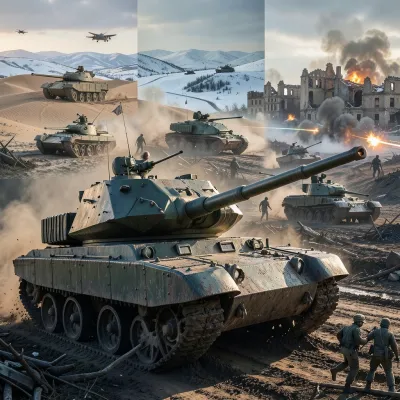
*Steel Beasts: The Evolution of Tank Warfare 1939–1945* provides a comprehensive analysis of how armored technology and operational doctrine transformed from the experimental theories of the interwar period into the decisive force of World War II. The book traces the trajectory of tank warfare from the early successes of German *Blitzkrieg* in Poland and France to the massive attritional struggles on the Eastern Front and the challenging terrains of Italy and the Pacific. It emphasizes that victory was rarely the result of technical superiority alone, but rather a complex "feedback loop" between industrial capacity, crew proficiency, and the integration of combined-arms support.
The narrative details the mechanical and tactical "arms race" that drove the development of iconic vehicles like the Soviet T-34, the German Panther and Tiger, and the American M4 Sherman. By comparing national philosophies, the text illustrates how different armies balanced the "holy trinity" of firepower, protection, and mobility. While the Germans often pursued optical excellence and heavy armor, the Soviets prioritized mass production and durability, and the Americans emphasized mechanical reliability and a robust global logistical network facilitated by Lend-Lease. These design choices were tested in diverse environments, from the open deserts of North Africa to the claustrophobic hedgerows of Normandy and the deadly urban ruins of Stalingrad and Berlin.
Crucially, the book looks beyond the "steel beasts" themselves to the human and systemic factors that enabled their success. It explores the "invisible weapons" of control—such as the universal integration of two-way radios and mission-oriented command (Auftragstaktik)—which allowed for dynamic battlefield adaptation. Furthermore, it highlights the unglamorous but vital roles of maintenance, recovery, and logistics, arguing that a tank’s operational reach was ultimately dictated by its supply chain. The study concludes by examining the enduring legacy of these wartime lessons, which laid the foundation for the modern Main Battle Tank and contemporary mechanized doctrine.
What You'll Find Inside:
- Tank design evolved through a constant trade‑off between firepower, protection, and mobility, shaped by each nation’s industrial base, terrain, and doctrinal priorities.
- German Blitzkrieg succeeded by concentrating armored forces, employing Auftragstaktik (mission command), and integrating tanks with tactical air power and motorized infantry for rapid exploitation.
- Soviet survival and eventual victory hinged on the T‑34 and KV tanks’ sloped armor and powerful guns, combined with massive factory relocation and simplified mass production that outpaced German output.
- Effective radio communication, combined‑arms coordination, and robust logistics (fuel, spare parts, recovery) proved as decisive as shock action in determining operational tempo and sustainability.
- Combat across diverse theaters—desert maneuver, Eastern Front deep battle, Normandy bocage, and urban fighting—demonstrated that tanks must continually adapt tactics and equipment to terrain and enemy defenses.
Who's It For:
This book is intended for military historians, defense analysts, and armed forces professionals seeking a comprehensive understanding of World War II armored warfare. It will also benefit students of military science, wargame designers, and anyone interested in how technology, doctrine, and human factors interact in mechanized combat.
Table of Contents:
- Introduction
- Chapter 1 From Interwar Theories to War: The Armored Idea, 1918–1939
- Chapter 2 Poland 1939: Proof and Propaganda of Blitzkrieg
- Chapter 3 France 1940: Operational Breakthrough and Collapse
- Chapter 4 Britain Adapts: The Desert Learning Curve, 1940–1941
- Chapter 5 Afrika Korps vs Eighth Army: Maneuver in the Open
- Chapter 6 Barbarossa: Shock, Overreach, and Soviet Survival
- Chapter 7 The Soviet Response: T-34, KV, and Factory Mobilization
- Chapter 8 Doctrine Divides: Auftragstaktik and Deep Battle
- Chapter 9 Radios and Command: The Invisible Weapon of Control
- Chapter 10 Training the Crew: Skills, Stress, and Cohesion
- Chapter 11 Firepower: Guns, Ammunition, and Ballistics
- Chapter 12 Protection and Survivability: Armor, Angling, and Vulnerabilities
- Chapter 13 Mobility and Reliability: Engines, Tracks, and Terrain
- Chapter 14 Reconnaissance and Security: Eyes for the Spearhead
- Chapter 15 Logistics and Maintenance: Fuel, Spares, and Recovery
- Chapter 16 Lend-Lease and Global Production Networks
- Chapter 17 The Eastern Front, 1942–1943: From Stalingrad to the Steppe
- Chapter 18 Kursk 1943: The Clash of Armored Masses
- Chapter 19 Italy and the Mediterranean: Armor in Broken Country
- Chapter 20 Normandy and Beyond: Hedgerows, Bocage, and Breakout
- Chapter 21 The Race Across France: From Cobra to the Siegfried Line
- Chapter 22 The Ardennes, 1944–1945: Counteroffensive and Counterattack
- Chapter 23 Urban and Close Terrain: Cities, Forests, and Rivers
- Chapter 24 The Pacific and Asia: Tanks in Secondary Theaters
- Chapter 25 War’s End and Aftermath: Legacies and Postwar Evolution
Author:
Published By:
Date Published:
April 13, 2026
Type:
Nonfiction
Language:
English
Word Count:
43,459 words
Reading Time:
3 hours 3 minutes
Sample:
Order:
Order Steel Beasts: The Evolution of Tank Warfare 1939–1945 (Hardcover) on MixCache.com:
Buy NowPrint copy is made to order and ships worldwide. Includes the ebook free, ready to read instantly.
$5 account credit for all new MixCache.com accounts, usable toward any ebook purchase!*