
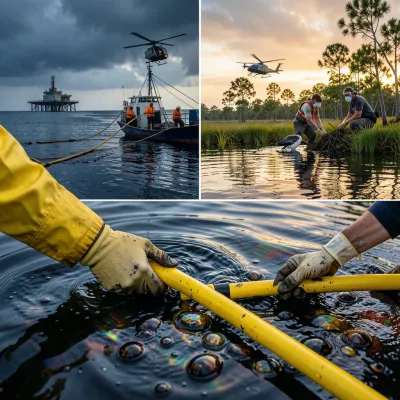
The following is an excerpt from “Oil Spills and Emergency Response in Marine Environments” by Willie Johnson, available on MixCache.com.
Introduction
Oil spills at sea remain among the most visible and consequential technological hazards confronting coastal societies. When petroleum enters a dynamic marine environment, it moves, weathers, and transforms in ways that expose shorelines, fisheries, wildlife, infrastructure, and communities to cascading risks. Responding effectively requires more than equipment on hand; it demands a shared language, disciplined coordination, science‑based tactics, and an ethical commitment to protect both ecosystems and people. This book is a practical manual for responders and planners who must make high‑consequence decisions in uncertain, time‑compressed conditions.
At its core, the manual integrates incident command procedures with the best available science on oil behavior and countermeasures. Readers will find clear guidance on how to establish Unified Command, build common operating pictures, and translate situational awareness into prioritized operational objectives. We explain how trajectory models, surveillance data, and field observations inform strategy selection, and how structured decision frameworks—such as Spill Impact Mitigation Assessment—help weigh tradeoffs among mechanical recovery, dispersion, in‑situ burning, and shoreline protection. The aim is to equip teams to act decisively while documenting the rationale behind each choice.
Operational success also depends on mastering the details. Containment and recovery hinge on understanding hydrodynamics, encounter rates, and safe operating envelopes for booms, skimmers, and temporary storage. Dispersant use requires a grasp of droplet physics, application windows, monitoring protocols, and ecological risk considerations. Shoreline cleanup demands the discipline of SCAT, linking geomorphology, oiling conditions, and cultural resources to targeted tactics that minimize collateral damage. Wildlife response, waste management, and responder safety are treated as core, not peripheral, missions.
Yet response is only part of the story. Spills are social events as much as environmental ones. Communities experience disruption, uncertainty, and loss; trust is earned through transparency, empathy, and timely, accurate information. We discuss methods for engaging local leaders, indigenous rights‑holders, and fishery stakeholders; incorporating traditional ecological knowledge; and addressing environmental justice concerns. The book underscores that sustained legitimacy depends on inviting affected people into the planning and decision process, not merely informing them after the fact.
Learning from the past sharpens readiness for the future. We distill lessons from major offshore and tanker incidents, examining where systems faltered, where innovation emerged, and how organizations converted experience into durable capability. These case studies illustrate that preparedness is a living practice: exercises, after‑action reviews, and continuous improvement convert plans into performance. Throughout, checklists, templates, and decision aids are provided to accelerate planning cycles and standardize high‑reliability behaviors.
Finally, we look beyond immediate response to recovery and restoration. Natural Resource Damage Assessment, long‑term monitoring, and adaptive management connect emergency actions to ecological outcomes over years or decades. By aligning metrics with realistic endpoints—habitat function, species recovery, and community well‑being—responders and trustees can demonstrate progress, adjust tactics, and sustain funding and public support. The closing chapters scan the horizon: climate change, Arctic access, emerging fuels and lubricants, autonomy and remote sensing, and the data systems that will define tomorrow’s common operating picture.
Taken together, these pages offer a coherent pathway from preparedness to containment to ecological restoration after offshore pollution events. The manual is designed to be used: in planning rooms, aboard command posts, on vessels, and along shorelines. Whether you are new to spill response or a seasoned practitioner, the objective is the same—to help you minimize ecological and social impacts when every hour counts.
Read “Oil Spills and Emergency Response in Marine Environments” on MixCache.com →
Please log in or create an account to leave a comment.
No comments yet. Be the first to say something.