
Browse by Category
Fiction
- Action & Adventure
- African American
- Anthologies
- Children's Fiction
- Classics
- Comics & Graphic Novels
- Coming of Age
- Contemporary
- Cultural & Regional
- Drama
- Erotica
- Fantasy
- General
- Historical Fiction
- Horror
- Humor & Satire
- Literary Fiction
- Mystery, Thriller & Suspense
- Poetry
- Religious & Inspirational
- Romance
- Science Fiction
- Short Stories
- War & Military
- Westerns
- Women's Fiction
- Young Adult
Non-Fiction
- Antiques & Collectibles
- Arts & Photography
- Biographies & Memoirs
- Business & Money
- Children's Non-Fiction
-
Computers & Technology
- Artificial Intelligence
- Computer Science
- Cybersecurity & Cryptography
- Data Science & Analytics
- Databases & Big Data
- Game Development & Design
- General
- Hardware & DIY
- Mobile App Development
- Networking & Cloud Computing
- Operating Systems
- Programming
- Robotics
- Software
- Software Engineering
- User Experience (UX) & Design
- Web Development & Design
- Cooking, Food & Wine
- Crafts, Hobbies & Home
- Education & Teaching
- Engineering
- General
- Health, Fitness & Dieting
-
History
- African History
- African History - North Africa
- African History - Sub-Saharan Africa
- American History
- American History - 20th Century
- American History - Civil War
- American History - Colonial Period
- Ancient History
- Asian History
- Asian History - China
- Asian History - India
- Asian History - Japan
- Asian History - Southeast Asia
- European History
- European History - Ancient Greece
- European History - Ancient Rome
- European History - Medieval
- European History - Modern
- European History - Renaissance
- General
- Middle Eastern History
- Military History
- Military History - Aviation
- Military History - Naval
- Social & Cultural History
- World History
- Humor & Entertainment
- Industrial Technology
- Language Learning
- Law
- LGBTQ+ Non-Fiction
- Literary Criticism
- Medical Books
- Parenting & Relationships
- Philosophy
- Politics & Social Sciences
- Reference
- Religion & Spirituality
-
Science & Math
- Agricultural Sciences
- Astronomy & Space Science
- Behavioral Sciences
- Biological Sciences
- Botany & Plant Science
- Chemistry
- Earth Sciences
- Engineering - Chemical
- Engineering - Civil
- Engineering - Electrical
- Engineering - Mechanical
- Environment
- General
- Geology
- Mathematics
- Nature & Ecology
- Oceanography
- Paleontology
- Physics
- Statistics
- Self-Help
- Sports & Outdoors
- Study Aids
- Sustainability & Green Living
- Textbooks
- Transportation
- Travel
- True Crime
- Urban Planning & Development
- Veterinary Medicine
- Writing & Publishing
Jump to Section
MixCache.com Total Access
Unlimited reading and audiobooks for every book published by MixCache.com.
Included titles carry the MTA badge.
Learn more →
Oil Spills and Emergency Response in Marine Environments
MTA
Preparedness, containment, and ecological restoration after offshore pollution events
About this book:
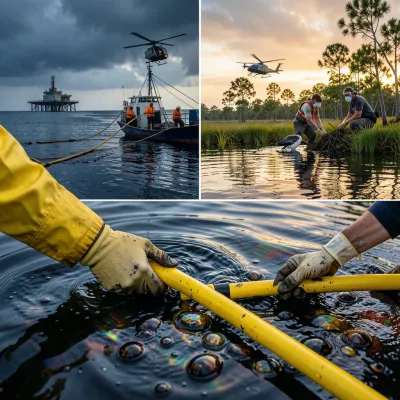
This comprehensive manual details the multifaceted challenge of managing marine oil spills, integrating physical science, technical operations, and socio-legal frameworks. It begins by establishing the "life cycle" of a spill, tracing how petroleum weathers and transforms in seawater through processes like emulsification and biodegradation. The text emphasizes that effective response is rooted in rigorous preparedness, utilizing risk assessments and contingency planning to bridge the gap between initial notification and the mobilization of resources under a disciplined Incident Command System.
The book provides an in-depth technical survey of the primary response tactics: containment via booming and herding agents; mechanical recovery using diverse skimming and pumping technologies; and the controversial but decisive roles of chemical dispersants and in-situ burning. It transitions from open-water operations to the complexities of shoreline cleanup, highlighting the Shoreline Cleanup Assessment Technique (SCAT) as a vital tool for tailoring tactics to sensitive coastal geomorphologies. Specialized chapters address the logistical "shadow" of response, including the stabilization of oiled wildlife and the massive requirements for decontamination and hazardous waste management.
Beyond technical execution, the manual underscores the human and ethical dimensions of pollution events. It explores the legal obligations mandated by international conventions like MARPOL and national laws such as OPA 90, while advocating for the central importance of environmental justice and Indigenous rights. The text argues that community trust and transparent risk communication are as critical to a successful response as mechanical efficiency, ensuring that the social fabric is preserved alongside ecological health.
The final section focuses on the transition from emergency response to long-term recovery. It details the processes of Natural Resource Damage Assessment (NRDA) and adaptive management, which use long-term monitoring to ensure ecosystems return to functional baselines. The book concludes by analyzing historical case studies, such as *Deepwater Horizon* and *Exxon Valdez*, to distill organizational lessons and prepare responders for future challenges, including the complications of climate change, the emergence of alternative marine fuels, and the integration of autonomous digital technologies in spill surveillance and modeling.
What You'll Find Inside:
- Comprehensive analysis of marine oil spill sources, pathways, weathering processes, and ecological/social impacts
- Integrated preparedness and response framework featuring Incident Command System, Unified Command, and contingency planning
- Detailed tactical options including containment, mechanical recovery, dispersants, in-situ burning, and shoreline cleanup techniques
- Specialized response components covering wildlife assessment, waste management, responder health/safety, and community engagement strategies
- Broader context addressing legal frameworks, environmental justice, Natural Resource Damage Assessment, long-term monitoring, and emerging challenges
Who's It For:
This book is essential for oil spill responders, emergency planners, environmental managers, and maritime operations personnel who need practical guidance for managing offshore pollution events. It serves both newcomers seeking foundational knowledge and experienced practitioners looking to enhance their decision-making capabilities in high-pressure situations. Government agencies, industry professionals, and environmental consultants involved in spill preparedness, response, or restoration will find valuable insights for minimizing ecological and social impacts.
Table of Contents:
- Introduction
- Chapter 1 The Marine Oil Spill Problem: Sources, Pathways, and Impacts
- Chapter 2 Properties and Weathering of Petroleum in Seawater
- Chapter 3 Risk Assessment and Prevention for Offshore Operations
- Chapter 4 Preparedness and Contingency Planning
- Chapter 5 Legal and Regulatory Frameworks: MARPOL, OPA 90, and OPRC
- Chapter 6 Incident Command System and Unified Command Afloat
- Chapter 7 Detection and Surveillance: Remote Sensing and Field Reconnaissance
- Chapter 8 Trajectory Modeling and Decision Support Tools
- Chapter 9 Initial Actions: Notifications, Prioritization, and Mobilization
- Chapter 10 Containment Strategies: Booming, Barriers, and Herding Agents
- Chapter 11 Mechanical Recovery: Skimming, Pumping, and Temporary Storage
- Chapter 12 Dispersants: Chemistry, Efficacy, and Environmental Tradeoffs
- Chapter 13 In‑Situ Burning: Operations, Safety, and Emissions Management
- Chapter 14 Shoreline Cleanup Assessment Technique (SCAT) and Tactics
- Chapter 15 Wildlife Assessment, Stabilization, and Rehabilitation
- Chapter 16 Waste Management, Decontamination, and Disposal Pathways
- Chapter 17 Health, Safety, and Human Factors for Responders
- Chapter 18 Community Engagement and Risk Communication
- Chapter 19 Environmental Justice and Indigenous Rights in Spill Response
- Chapter 20 Logistics and Remote Operations in Challenging Environments
- Chapter 21 Case Studies: Deepwater Horizon, Exxon Valdez, and Other Major Spills
- Chapter 22 Lessons Learned: Failure Analysis and Organizational Learning
- Chapter 23 Natural Resource Damage Assessment and Restoration Planning
- Chapter 24 Long‑Term Monitoring, Metrics, and Adaptive Management
- Chapter 25 Future Challenges: Climate Change, New Fuels, and Digital Response
Author:
Published By:
Date Published:
May 4, 2026
Type:
Nonfiction
Language:
English
Word Count:
56,888 words
Reading Time:
3 hours 59 minutes
Sample:
MixCache.com Total Access
Get unlimited access to this book + all books published by MixCache.com for $11.99/month
Subscribe to MTAOr purchase this book individually below
Order:
Buy the Oil Spills and Emergency Response in Marine Environments ebook on MixCache.com:
Buy Now
Full ebook will be available immediately
- read online or download as a PDF file.
$5 account credit for all new MixCache.com accounts, usable toward any ebook purchase!*



Ratings & Reviews
Ask Questions About This Book
Have a question about the content? Ask our AI assistant!
Start by asking a question about "Oil Spills and Emergency Response in Marine Environments"
Example: "Does this book mention William Shakespeare?"
Thinking...