Browse by Category
Fiction
- Action & Adventure
- African American
- Anthologies
- Children's Fiction
- Classics
- Comics & Graphic Novels
- Coming of Age
- Contemporary
- Cultural & Regional
- Drama
- Erotica
- Fantasy
- General
- Historical Fiction
- Horror
- Humor & Satire
- Literary Fiction
- Mystery, Thriller & Suspense
- Poetry
- Religious & Inspirational
- Romance
- Science Fiction
- Short Stories
- War & Military
- Westerns
- Women's Fiction
- Young Adult
Non-Fiction
- Antiques & Collectibles
- Arts & Photography
- Biographies & Memoirs
- Business & Money
- Children's Non-Fiction
-
Computers & Technology
- Artificial Intelligence
- Computer Science
- Cybersecurity & Cryptography
- Data Science & Analytics
- Databases & Big Data
- Game Development & Design
- General
- Hardware & DIY
- Mobile App Development
- Networking & Cloud Computing
- Operating Systems
- Programming
- Robotics
- Software
- Software Engineering
- User Experience (UX) & Design
- Web Development & Design
- Cooking, Food & Wine
- Crafts, Hobbies & Home
- Education & Teaching
- Engineering
- General
- Health, Fitness & Dieting
-
History
- African History
- African History - North Africa
- African History - Sub-Saharan Africa
- American History
- American History - 20th Century
- American History - Civil War
- American History - Colonial Period
- Ancient History
- Asian History
- Asian History - China
- Asian History - India
- Asian History - Japan
- Asian History - Southeast Asia
- European History
- European History - Ancient Greece
- European History - Ancient Rome
- European History - Medieval
- European History - Modern
- European History - Renaissance
- General
- Middle Eastern History
- Military History
- Military History - Aviation
- Military History - Naval
- Social & Cultural History
- World History
- Humor & Entertainment
- Industrial Technology
- Language Learning
- Law
- LGBTQ+ Non-Fiction
- Literary Criticism
- Medical Books
- Parenting & Relationships
- Philosophy
- Politics & Social Sciences
- Reference
- Religion & Spirituality
-
Science & Math
- Agricultural Sciences
- Astronomy & Space Science
- Behavioral Sciences
- Biological Sciences
- Botany & Plant Science
- Chemistry
- Earth Sciences
- Engineering - Chemical
- Engineering - Civil
- Engineering - Electrical
- Engineering - Mechanical
- Environment
- General
- Geology
- Mathematics
- Nature & Ecology
- Oceanography
- Paleontology
- Physics
- Statistics
- Self-Help
- Sports & Outdoors
- Study Aids
- Sustainability & Green Living
- Textbooks
- Transportation
- Travel
- True Crime
- Urban Planning & Development
- Veterinary Medicine
- Writing & Publishing
Jump to Section

Want unlimited access to all books published by MixCache.com (plus their audiobooks)? Try MixCache.com Total Access. Look for the MTA badge on book covers to identify included titles.
Access to infinite ebooks: Don't see the book you want? Suggest it and we'll create it (free!) for you from scratch with our powerful AI book writer. Then read it with MTA - besides profiting from any sales it makes!
Oceans and Climate Change: Past, Present, and Future Interactions
MTA
A synthesis of ocean-climate feedbacks, sea-level rise, and carbon cycling for policymakers and scientists
About this book:
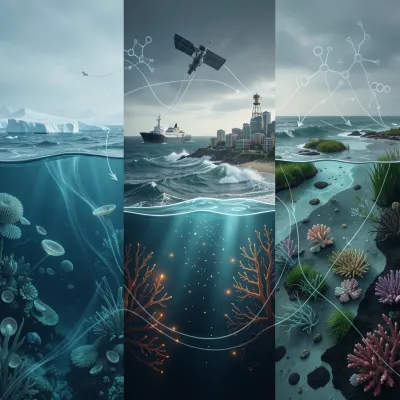
"Oceans and Climate Change: Past, Present, and Future Interactions" synthesizes extensive scientific evidence to illustrate the ocean's fundamental role in regulating Earth's climate and its vulnerability to anthropogenic change. The book traces ocean-climate feedbacks from deep geological history through glacial-interglacial cycles and abrupt events, utilizing marine paleoclimate archives to establish context for current and projected changes. It then examines the industrial era, detailing how modern observations from ships, satellites, and autonomous systems have unequivocally documented accelerating trends in ocean heat uptake, sea-level rise through thermal expansion and ice melt, and the profound chemical shift of ocean acidification, alongside deoxygenation.
The book delves into the intricate mechanisms of the ocean-climate system, explaining how large-scale circulation patterns like the Atlantic Meridional Overturning Circulation (AMOC) and wind-driven gyres redistribute heat and carbon, and how these systems are being altered by warming and freshwater inputs. It also explores the critical roles of air-sea CO2 exchange, the solubility pump, and the biological pump in governing the ocean's capacity to absorb atmospheric carbon. The text further highlights the increasing frequency and intensity of marine heatwaves, storms, and compound coastal extremes, demonstrating how these events are reshaping marine ecosystems, fisheries, and biodiversity, threatening species distributions, and impacting human livelihoods.
Crucially, the book translates global processes into regional and local impacts, focusing on "hotspots" like the Arctic, small island states, and vulnerable coastal cities, where the consequences of ocean change are most acutely felt. It analyzes the complex interplay of sea-level rise, land subsidence, and extreme weather in these areas, outlining various urban adaptation pathways from hard engineering to nature-based solutions and managed retreat. Finally, it explores ocean-based mitigation strategies, including offshore renewable energy, blue carbon ecosystem restoration, and emerging carbon removal technologies, alongside the complex interplay of risk, economics, governance, and financing needed to implement resilient solutions.
The concluding chapters synthesize these elements, presenting plausible future scenarios for 2050 and 2100 that underscore the profound trade-offs inherent in different emissions pathways. It emphasizes that while some level of ocean change is already "locked in" due to past emissions, ambitious mitigation efforts remain the most powerful lever to limit future impacts. The book advocates for integrated action agendas that combine robust scientific observation and modeling with flexible governance, innovative finance, and equitable decision-making, recognizing the ocean's long memory and its pivotal, yet increasingly strained, role in sustaining a habitable planet.
What You'll Find Inside:
- The ocean's role as Earth's primary climate regulator through heat uptake, carbon cycling, and circulation patterns, and how these systems are being altered by anthropogenic climate change.
- Evidence from marine paleoclimate archives revealing how ocean-climate feedbacks have operated across glacial-interglacial cycles and abrupt events, providing context for current changes.
- Contemporary observations and projections of key ocean changes including warming, sea-level rise, acidification, deoxygenation, and their regional patterns and impacts.
- Impacts on marine ecosystems, fisheries, and coastal communities, including compound extremes and biodiversity loss under changing ocean conditions.
- Ocean-based mitigation and adaptation strategies, from nature-based solutions like blue carbon ecosystems to technological options and governance approaches for resilient ocean-climate futures.
Who's It For:
This book is designed for policymakers and climate scientists who need a comprehensive synthesis of ocean-climate interactions. Decision-makers will find actionable insights connected to risk management, financing, and implementation tools, while researchers and students will benefit from consolidated current understanding, identification of open questions, and guidance on advances in observation and modeling. The work bridges scientific knowledge with practical applications for coastal and global stakeholders seeking to move from awareness to durable action in the face of ocean climate change.
Author:
Published By:
Date Published:
May 4, 2026
Type:
Nonfiction
Language:
English
Word Count:
60,709 words
Reading Time:
4 hours 15 minutes
Sample:
Order:
Order Oceans and Climate Change: Past, Present, and Future Interactions (Paperback) on MixCache.com:
Buy NowPrint copy is made to order and ships worldwide. Includes the ebook free, ready to read instantly.
$5 account credit for all new MixCache.com accounts, usable toward any ebook purchase!*