Browse by Category
Fiction
- Action & Adventure
- African American
- Anthologies
- Children's Fiction
- Classics
- Comics & Graphic Novels
- Coming of Age
- Contemporary
- Cultural & Regional
- Drama
- Erotica
- Fantasy
- General
- Historical Fiction
- Horror
- Humor & Satire
- Literary Fiction
- Mystery, Thriller & Suspense
- Poetry
- Religious & Inspirational
- Romance
- Science Fiction
- Short Stories
- War & Military
- Westerns
- Women's Fiction
- Young Adult
Non-Fiction
- Antiques & Collectibles
- Arts & Photography
- Biographies & Memoirs
- Business & Money
- Children's Non-Fiction
-
Computers & Technology
- Artificial Intelligence
- Computer Science
- Cybersecurity & Cryptography
- Data Science & Analytics
- Databases & Big Data
- Game Development & Design
- General
- Hardware & DIY
- Mobile App Development
- Networking & Cloud Computing
- Operating Systems
- Programming
- Robotics
- Software
- Software Engineering
- User Experience (UX) & Design
- Web Development & Design
- Cooking, Food & Wine
- Crafts, Hobbies & Home
- Education & Teaching
- Engineering
- General
- Health, Fitness & Dieting
-
History
- African History
- African History - North Africa
- African History - Sub-Saharan Africa
- American History
- American History - 20th Century
- American History - Civil War
- American History - Colonial Period
- Ancient History
- Asian History
- Asian History - China
- Asian History - India
- Asian History - Japan
- Asian History - Southeast Asia
- European History
- European History - Ancient Greece
- European History - Ancient Rome
- European History - Medieval
- European History - Modern
- European History - Renaissance
- General
- Middle Eastern History
- Military History
- Military History - Aviation
- Military History - Naval
- Social & Cultural History
- World History
- Humor & Entertainment
- Industrial Technology
- Language Learning
- Law
- LGBTQ+ Non-Fiction
- Literary Criticism
- Medical Books
- Parenting & Relationships
- Philosophy
- Politics & Social Sciences
- Reference
- Religion & Spirituality
-
Science & Math
- Agricultural Sciences
- Astronomy & Space Science
- Behavioral Sciences
- Biological Sciences
- Botany & Plant Science
- Chemistry
- Earth Sciences
- Engineering - Chemical
- Engineering - Civil
- Engineering - Electrical
- Engineering - Mechanical
- Environment
- General
- Geology
- Mathematics
- Nature & Ecology
- Oceanography
- Paleontology
- Physics
- Statistics
- Self-Help
- Sports & Outdoors
- Study Aids
- Sustainability & Green Living
- Textbooks
- Transportation
- Travel
- True Crime
- Urban Planning & Development
- Veterinary Medicine
- Writing & Publishing
Jump to Section
MixCache.com Total Access
Unlimited reading and audiobooks for every book published by MixCache.com.
Included titles carry the MTA badge.
Learn more →
Education In Switzerland
MTA
A Comprehensive Overview from Early Childhood to Higher Education
About this book:
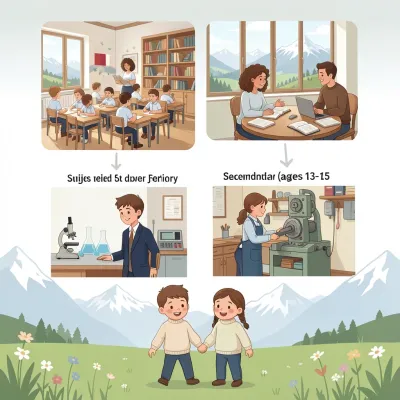
Switzerland’s education system is characterized by a strong federalist structure that grants significant autonomy to its 26 cantons while promoting national harmonization through bodies like the EDK/CDIP and agreements such as HarmoS. This decentralization allows curricula, school organization, and language instruction to reflect local linguistic and cultural contexts, yet intercantonal cooperation ensures quality, permeability, and mutual recognition of qualifications. Compulsory schooling spans eleven years, typically beginning with two years of kindergarten, followed by six years of primary education and three years of lower secondary schooling, during which students are streamed into academic or vocational pathways based on ability and interest.
The Swiss model places a high value on both academic excellence and practical vocational training. Approximately two‑thirds of adolescents choose the dual Vocational Education and Training (VET) system, which combines classroom instruction at vocational schools with paid apprenticeships in companies, leading to nationally recognized Federal VET Diplomas or Certificates. The academic route culminates in the Gymnasium and the Matura examination, granting direct access to universities and Federal Institutes of Technology. Permeability is a hallmark: VET graduates can pursue a Federal Vocational Baccalaureate to enter universities of applied sciences, and with additional qualifications, even traditional universities. Specialized middle schools offer a blended general‑professional education leading to a specialized baccalaureate for universities of applied sciences, while inclusive practices and early intervention support students with special needs across all levels.
Higher education comprises traditional universities, the Federal Institutes of Technology (ETH Zurich and EPFL), universities of applied sciences, and universities of teacher education, all underpinned by rigorous quality assurance and a strong link between research, innovation, and industry. Multilingualism is emphasized from early schooling, with students learning at least two national languages plus English, preparing them for a globalized workforce. Teacher training is university‑level, continuous professional development is expected, and educators enjoy high societal status. Adult education and lifelong learning are well‑developed, offering upskilling, reskilling, and validation of acquired competencies. Despite challenges—balancing cantonal autonomy with national coherence, integrating digitalization, funding pressures, and teacher recruitment—the system’s strengths lie in its flexibility, permeability, high standards, dual academic‑vocational esteem, and strong community and parental engagement, making it a globally admired model of education.
What You'll Find Inside:
- The Swiss federalist structure and how cantonal autonomy shapes education policy while harmonization efforts ensure national quality and permeability
- The globally renowned Vocational Education and Training (VET) dual system combining apprenticeships with classroom instruction, serving two-thirds of Swiss youth
- Educational permeability - how students can transition between academic and vocational pathways throughout their education with qualifications like the Federal Vocational Baccalaureate
- Switzerland's commitment to multilingualism through early foreign language instruction in multiple national languages plus English, preparing students for global engagement
- The strong connection between higher education, research, and innovation that drives Switzerland's economic success and global competitiveness
Who's It For:
This book is ideal for educators, policymakers, researchers, and students seeking a comprehensive understanding of one of the world's most successful education systems. It will also benefit international observers, education administrators, and anyone interested in comparative education models who want insights into Switzerland's distinctive approach to balancing academic excellence with vocational training, federalism with harmonization, and tradition with innovation.
Table of Contents:
- Introduction
- Chapter 1: The Swiss Educational Landscape: An Overview
- Chapter 2: Historical Development of Swiss Education
- Chapter 3: Federalism and Education: Cantonal Autonomy and Harmonization
- Chapter 4: Early Childhood Education: Nurseries, Kindergartens, and Pre-School
- Chapter 5: The Structure of Primary Education in Switzerland
- Chapter 6: Curriculum and Pedagogy in Primary Schools
- Chapter 7: Assessment and Evaluation in Primary Education
- Chapter 8: Transition from Primary to Secondary Education
- Chapter 9: Lower Secondary Education: Types and Pathways
- Chapter 10: Vocational Education and Training (VET): A Dual System
- Chapter 11: Apprenticeships: Structure, Content, and Importance
- Chapter 12: Upper Secondary General Education: Gymnasien and Baccalaureate
- Chapter 13: Matura and University Entrance Qualifications
- Chapter 14: Specialized Middle Schools and Vocational Baccalaureate
- Chapter 15: Higher Education Institutions: Universities and Universities of Applied Sciences
- Chapter 16: Research and Innovation in Swiss Higher Education
- Chapter 17: Funding and Governance of Higher Education
- Chapter 18: Adult Education and Lifelong Learning
- Chapter 19: Special Needs Education and Inclusive Practices
- Chapter 20: Language Diversity and Multilingualism in Swiss Schools
- Chapter 21: The Role of Teachers: Training, Professional Development, and Status
- Chapter 22: Parental Involvement and Community Engagement in Education
- Chapter 23: Internationalization of Swiss Education
- Chapter 24: Challenges and Future Trends in Swiss Education
- Chapter 25: Key Strengths and Distinctive Features of the Swiss Education System
Author:
Published By:
Date Published:
July 5, 2026
Type:
Nonfiction
Language:
English
Word Count:
39,361 words
Reading Time:
2 hours 45 minutes
Sample:
Order:
Order Education In Switzerland (Hardcover) on MixCache.com:
Buy NowPrint copy is made to order and ships worldwide. Includes the ebook free, ready to read instantly.
$5 account credit for all new MixCache.com accounts, usable toward any ebook purchase!*