
Browse by Category
Fiction
- Action & Adventure
- African American
- Anthologies
- Children's Fiction
- Classics
- Comics & Graphic Novels
- Coming of Age
- Contemporary
- Cultural & Regional
- Drama
- Erotica
- Fantasy
- General
- Historical Fiction
- Horror
- Humor & Satire
- Literary Fiction
- Mystery, Thriller & Suspense
- Poetry
- Religious & Inspirational
- Romance
- Science Fiction
- Short Stories
- War & Military
- Westerns
- Women's Fiction
- Young Adult
Non-Fiction
- Antiques & Collectibles
- Arts & Photography
- Biographies & Memoirs
- Business & Money
- Children's Non-Fiction
-
Computers & Technology
- Artificial Intelligence
- Computer Science
- Cybersecurity & Cryptography
- Data Science & Analytics
- Databases & Big Data
- Game Development & Design
- General
- Hardware & DIY
- Mobile App Development
- Networking & Cloud Computing
- Operating Systems
- Programming
- Robotics
- Software
- Software Engineering
- User Experience (UX) & Design
- Web Development & Design
- Cooking, Food & Wine
- Crafts, Hobbies & Home
- Education & Teaching
- Engineering
- General
- Health, Fitness & Dieting
-
History
- African History
- African History - North Africa
- African History - Sub-Saharan Africa
- American History
- American History - 20th Century
- American History - Civil War
- American History - Colonial Period
- Ancient History
- Asian History
- Asian History - China
- Asian History - India
- Asian History - Japan
- Asian History - Southeast Asia
- European History
- European History - Ancient Greece
- European History - Ancient Rome
- European History - Medieval
- European History - Modern
- European History - Renaissance
- General
- Middle Eastern History
- Military History
- Military History - Aviation
- Military History - Naval
- Social & Cultural History
- World History
- Humor & Entertainment
- Industrial Technology
- Language Learning
- Law
- LGBTQ+ Non-Fiction
- Literary Criticism
- Medical Books
- Parenting & Relationships
- Philosophy
- Politics & Social Sciences
- Reference
- Religion & Spirituality
-
Science & Math
- Agricultural Sciences
- Astronomy & Space Science
- Behavioral Sciences
- Biological Sciences
- Botany & Plant Science
- Chemistry
- Earth Sciences
- Engineering - Chemical
- Engineering - Civil
- Engineering - Electrical
- Engineering - Mechanical
- Environment
- General
- Geology
- Mathematics
- Nature & Ecology
- Oceanography
- Paleontology
- Physics
- Statistics
- Self-Help
- Sports & Outdoors
- Study Aids
- Sustainability & Green Living
- Textbooks
- Transportation
- Travel
- True Crime
- Urban Planning & Development
- Veterinary Medicine
- Writing & Publishing
Jump to Section
MixCache.com Total Access
Unlimited reading and audiobooks for every book published by MixCache.com.
Included titles carry the MTA badge.
Learn more →
Turning Point in the Jungle
The Tet Offensive and its Impact on the Vietnam War
About this book:


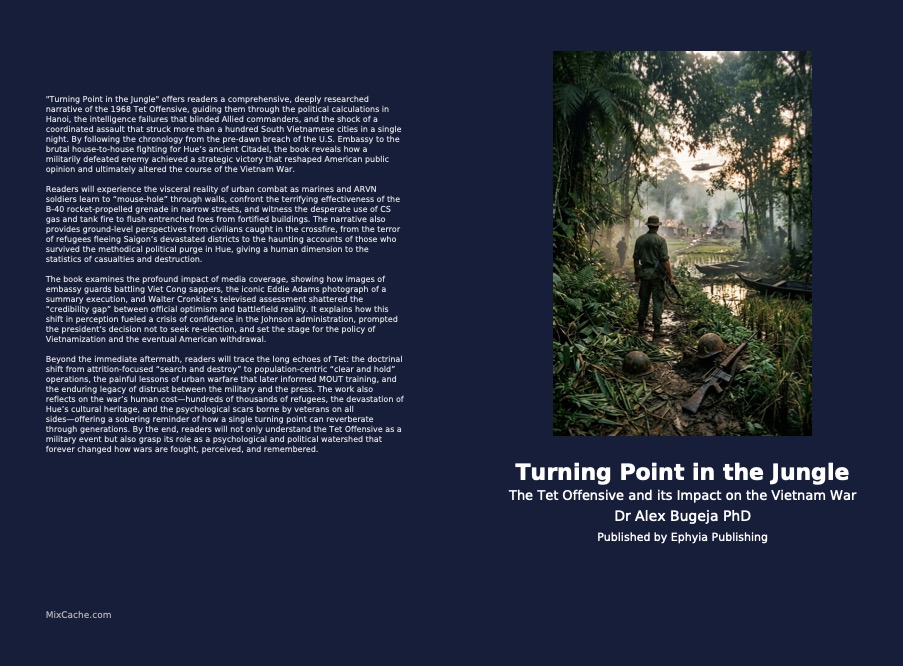
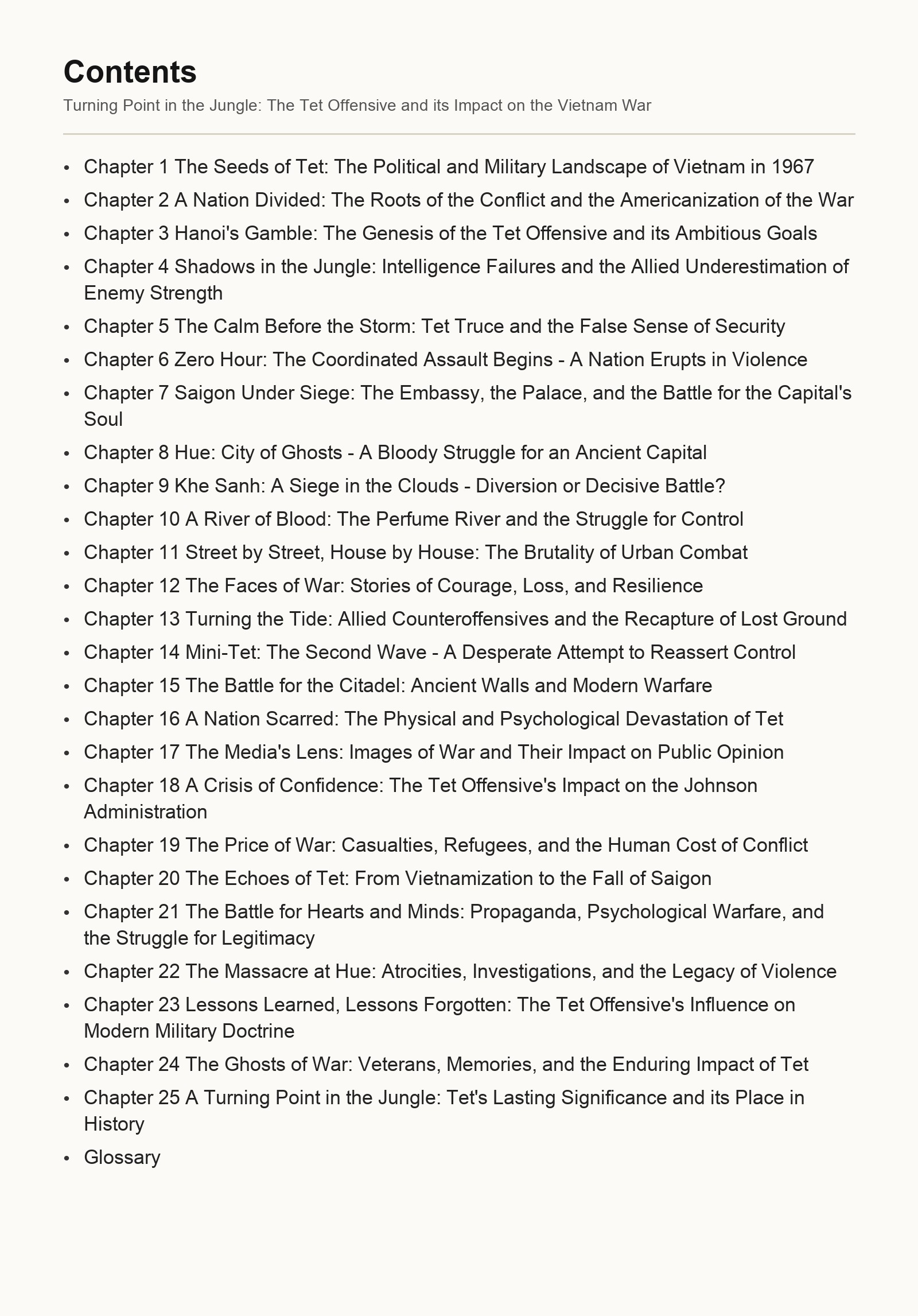
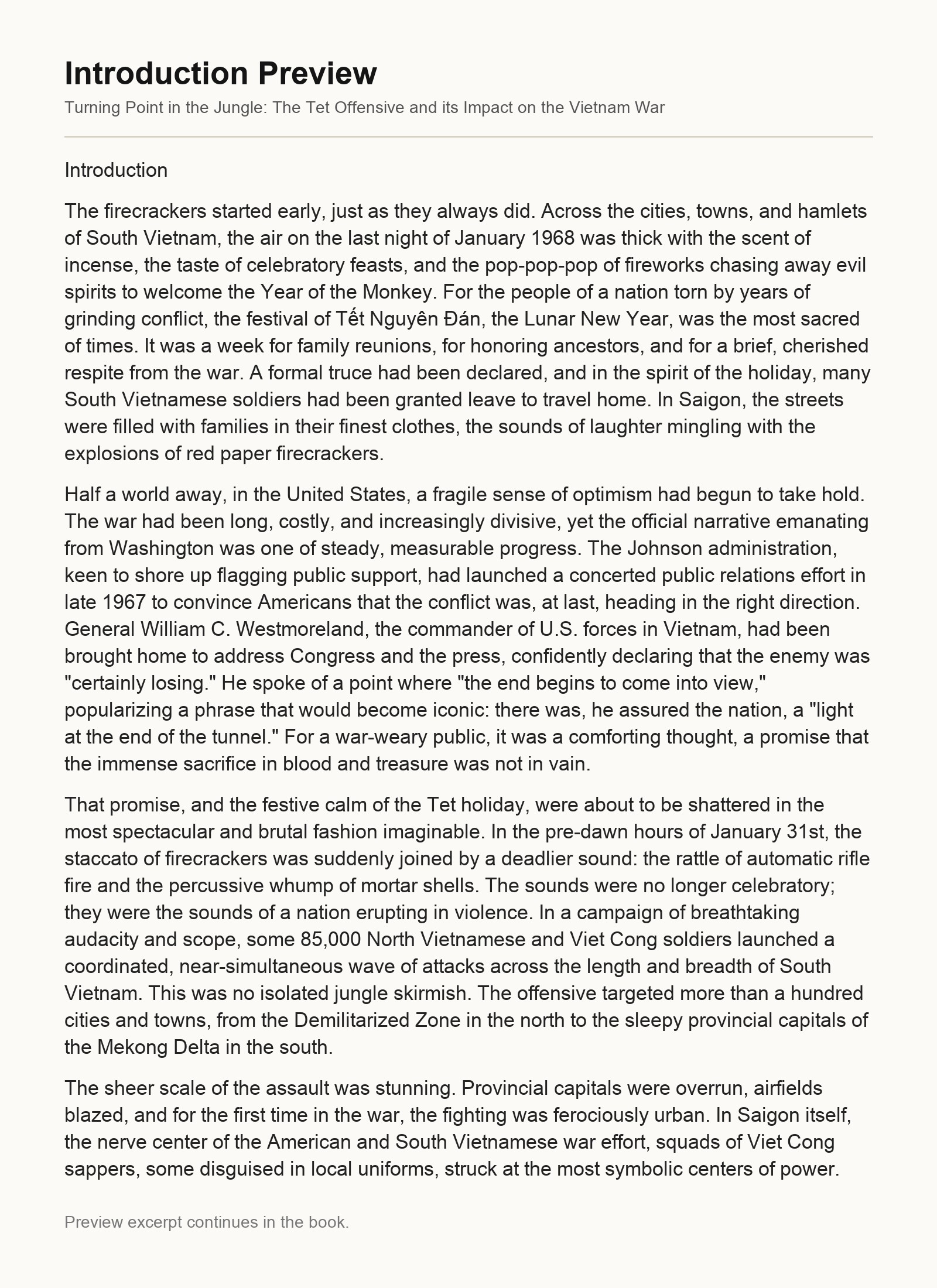
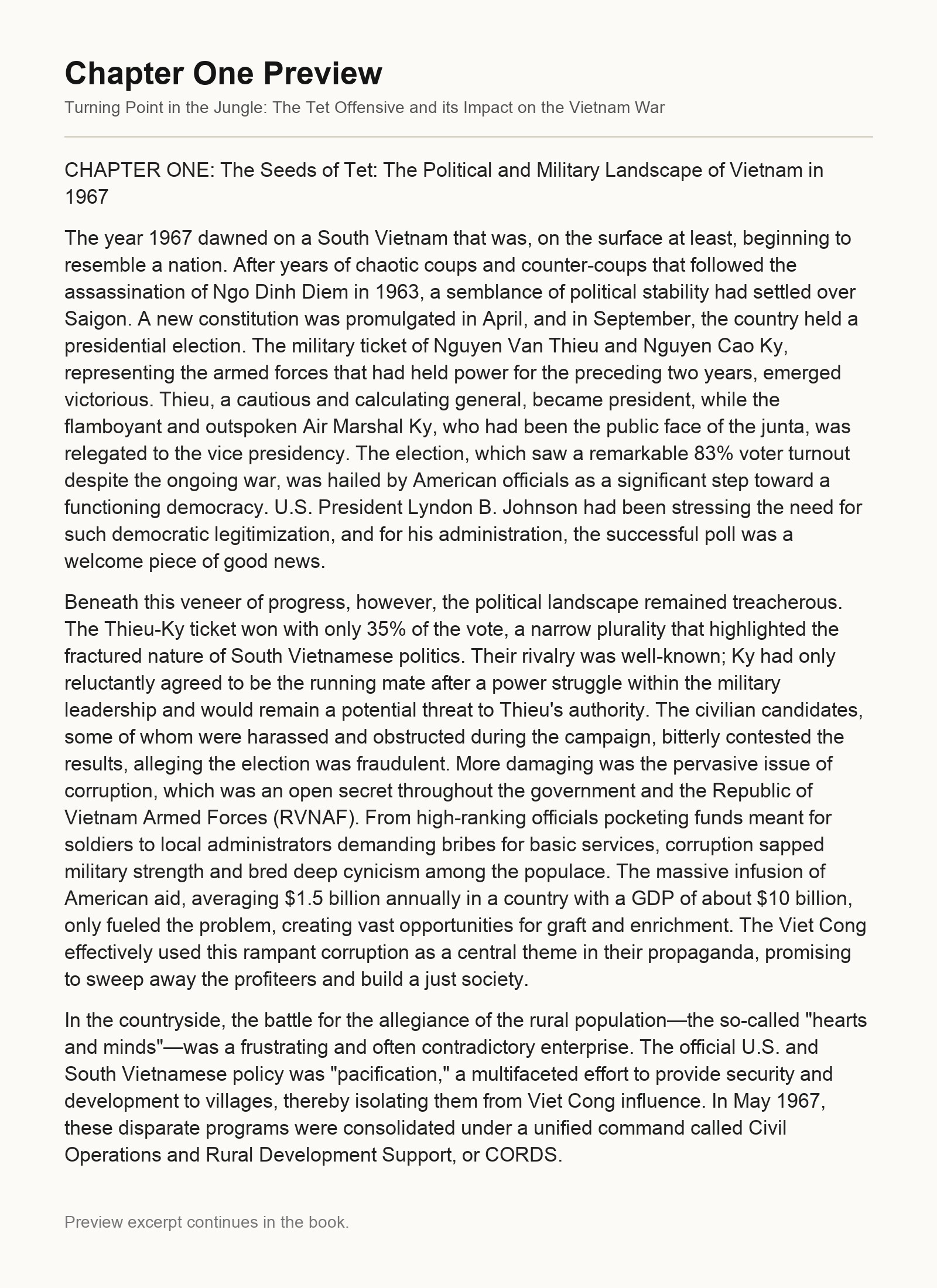
"Turning Point in the Jungle" offers readers a comprehensive, deeply researched narrative of the 1968 Tet Offensive, guiding them through the political calculations in Hanoi, the intelligence failures that blinded Allied commanders, and the shock of a coordinated assault that struck more than a hundred South Vietnamese cities in a single night. By following the chronology from the pre‑dawn breach of the U.S. Embassy to the brutal house‑to‑house fighting for Hue’s ancient Citadel, the book reveals how a militarily defeated enemy achieved a strategic victory that reshaped American public opinion and ultimately altered the course of the Vietnam War.
Readers will experience the visceral reality of urban combat as marines and ARVN soldiers learn to “mouse‑hole” through walls, confront the terrifying effectiveness of the B‑40 rocket‑propelled grenade in narrow streets, and witness the desperate use of CS gas and tank fire to flush entrenched foes from fortified buildings. The narrative also provides ground‑level perspectives from civilians caught in the crossfire, from the terror of refugees fleeing Saigon’s devastated districts to the haunting accounts of those who survived the methodical political purge in Hue, giving a human dimension to the statistics of casualties and destruction.
The book examines the profound impact of media coverage, showing how images of embassy guards battling Viet Cong sappers, the iconic Eddie Adams photograph of a summary execution, and Walter Cronkite’s televised assessment shattered the “credibility gap” between official optimism and battlefield reality. It explains how this shift in perception fueled a crisis of confidence in the Johnson administration, prompted the president’s decision not to seek re‑election, and set the stage for the policy of Vietnamization and the eventual American withdrawal.
Beyond the immediate aftermath, readers will trace the long echoes of Tet: the doctrinal shift from attrition‑focused “search and destroy” to population‑centric “clear and hold” operations, the painful lessons of urban warfare that later informed MOUT training, and the enduring legacy of distrust between the military and the press. The work also reflects on the war’s human cost—hundreds of thousands of refugees, the devastation of Hue’s cultural heritage, and the psychological scars borne by veterans on all sides—offering a sobering reminder of how a single turning point can reverberate through generations. By the end, readers will not only understand the Tet Offensive as a military event but also grasp its role as a psychological and political watershed that forever changed how wars are fought, perceived, and remembered.
What You'll Find Inside:
- The Tet Offensive launched a coordinated assault on over 100 South Vietnamese cities and towns, exposing the fragility of Allied security and the boldness of Hanoi's gamble.
- Systemic intelligence failures and optimism bias prevented Allied commanders from anticipating the offensive's scale, despite numerous warning signs.
- The offensive shattered American public confidence, fueled by graphic media coverage and the growing credibility gap between official optimism and battlefield reality.
- The human toll included massive military casualties, a refugee crisis of hundreds of thousands, and atrocities such as the Hue massacre that left deep psychological scars.
- Tet forced a strategic shift: the demise of attrition warfare, the rise of Vietnamization, and enduring lessons—both learned and forgotten—about counterinsurgency and media relations.
Who's It For:
This book is suited for students and scholars of modern military history, Vietnam War enthusiasts, and policymakers interested in the interplay between warfare, media, and public opinion. It also offers valuable insights for military professionals studying counterinsurgency, intelligence failures, and the psychological dimensions of conflict. General readers seeking a nuanced, comprehensive account of a pivotal 20th‑century turning point will find it both informative and compelling.
Author:
Published By:
Date Published:
May 20, 2026
Type:
Nonfiction
Language:
English
Also Available In:
Word Count:
49,305 words
Reading Time:
3 hours 27 minutes
Sample:
Order:
Order Turning Point in the Jungle (Hardcover) on MixCache.com:
Buy NowPrint copy is made to order and ships worldwide. Includes the ebook free, ready to read instantly.
$5 account credit for all new MixCache.com accounts, usable toward any ebook purchase!*


 Includes Audiobook


