Browse by Category
Fiction
- Action & Adventure
- African American
- Anthologies
- Children's Fiction
- Classics
- Comics & Graphic Novels
- Coming of Age
- Contemporary
- Cultural & Regional
- Drama
- Erotica
- Fantasy
- General
- Historical Fiction
- Horror
- Humor & Satire
- Literary Fiction
- Mystery, Thriller & Suspense
- Poetry
- Religious & Inspirational
- Romance
- Science Fiction
- Short Stories
- War & Military
- Westerns
- Women's Fiction
- Young Adult
Non-Fiction
- Antiques & Collectibles
- Arts & Photography
- Biographies & Memoirs
- Business & Money
- Children's Non-Fiction
-
Computers & Technology
- Artificial Intelligence
- Computer Science
- Cybersecurity & Cryptography
- Data Science & Analytics
- Databases & Big Data
- Game Development & Design
- General
- Hardware & DIY
- Mobile App Development
- Networking & Cloud Computing
- Operating Systems
- Programming
- Robotics
- Software
- Software Engineering
- User Experience (UX) & Design
- Web Development & Design
- Cooking, Food & Wine
- Crafts, Hobbies & Home
- Education & Teaching
- Engineering
- General
- Health, Fitness & Dieting
-
History
- African History
- African History - North Africa
- African History - Sub-Saharan Africa
- American History
- American History - 20th Century
- American History - Civil War
- American History - Colonial Period
- Ancient History
- Asian History
- Asian History - China
- Asian History - India
- Asian History - Japan
- Asian History - Southeast Asia
- European History
- European History - Ancient Greece
- European History - Ancient Rome
- European History - Medieval
- European History - Modern
- European History - Renaissance
- General
- Middle Eastern History
- Military History
- Military History - Aviation
- Military History - Naval
- Social & Cultural History
- World History
- Humor & Entertainment
- Industrial Technology
- Language Learning
- Law
- LGBTQ+ Non-Fiction
- Literary Criticism
- Medical Books
- Parenting & Relationships
- Philosophy
- Politics & Social Sciences
- Reference
- Religion & Spirituality
-
Science & Math
- Agricultural Sciences
- Astronomy & Space Science
- Behavioral Sciences
- Biological Sciences
- Botany & Plant Science
- Chemistry
- Earth Sciences
- Engineering - Chemical
- Engineering - Civil
- Engineering - Electrical
- Engineering - Mechanical
- Environment
- General
- Geology
- Mathematics
- Nature & Ecology
- Oceanography
- Paleontology
- Physics
- Statistics
- Self-Help
- Sports & Outdoors
- Study Aids
- Sustainability & Green Living
- Textbooks
- Transportation
- Travel
- True Crime
- Urban Planning & Development
- Veterinary Medicine
- Writing & Publishing
Jump to Section
MixCache.com Total Access
Unlimited reading and audiobooks for every book published by MixCache.com.
Included titles carry the MTA badge.
Learn more →A History of Cameroon
About this book:
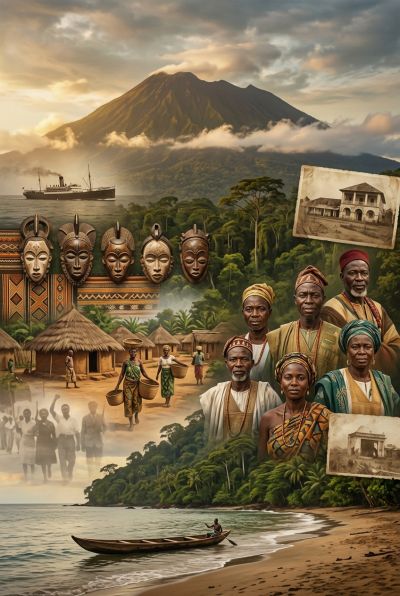
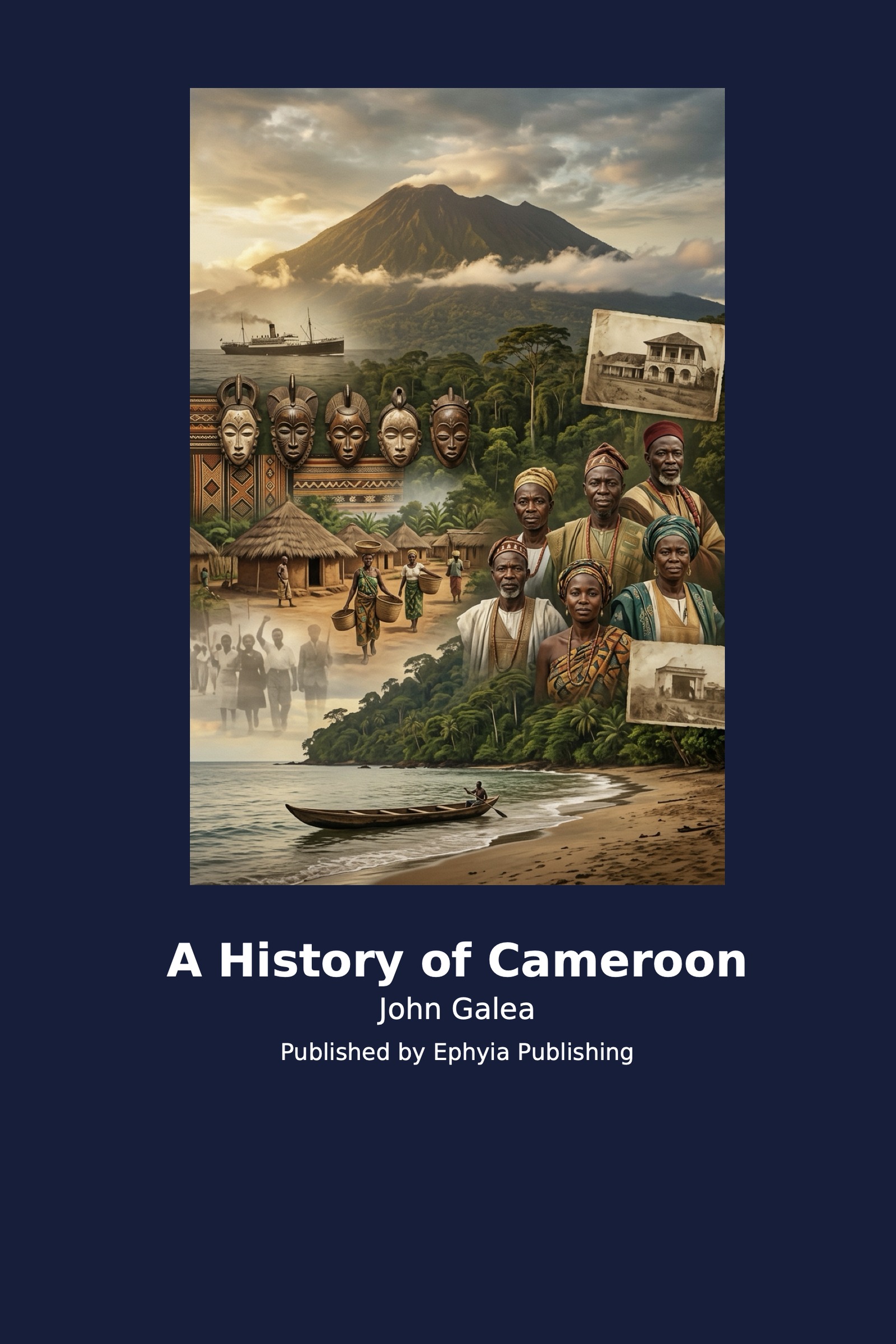
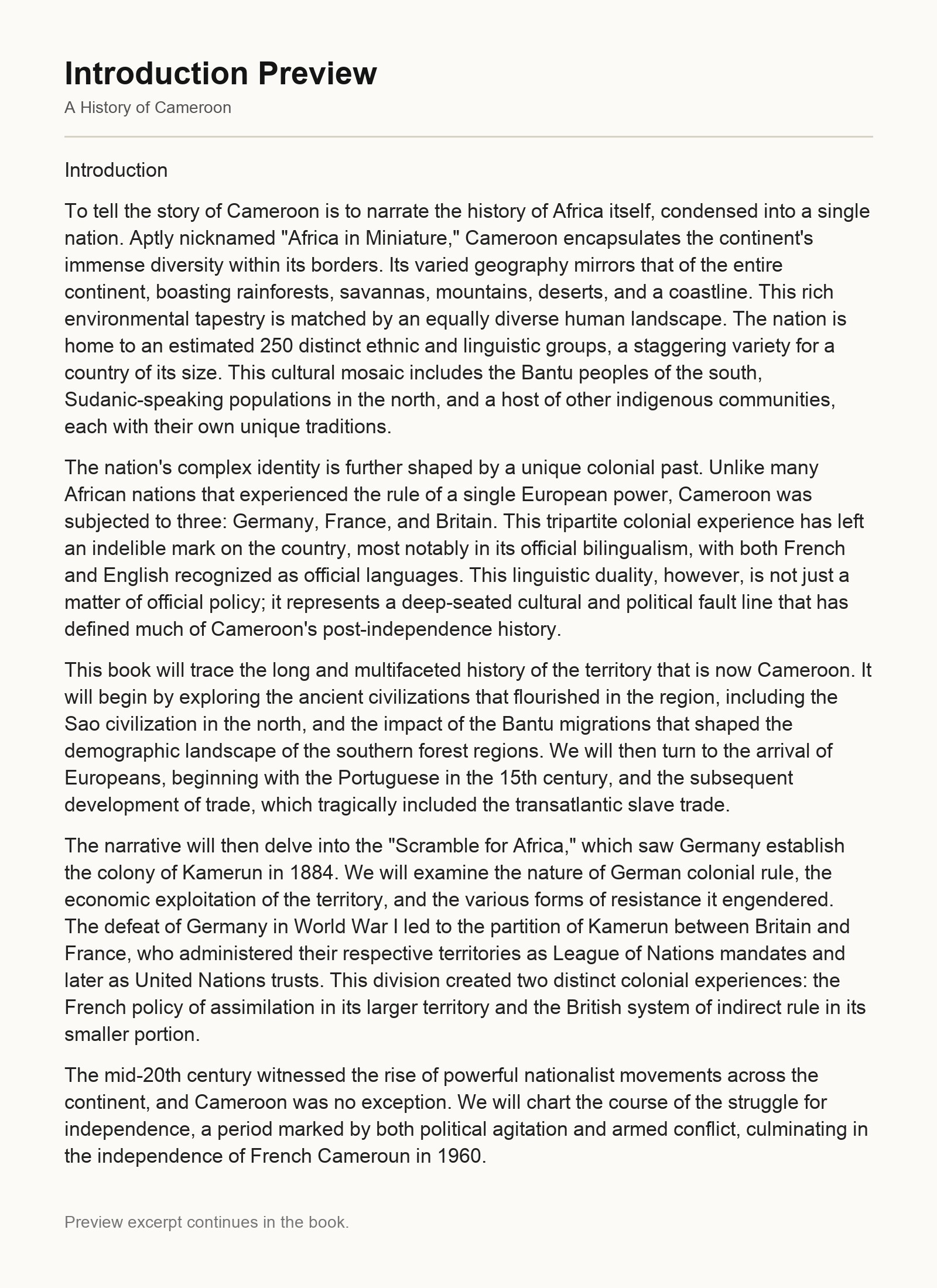
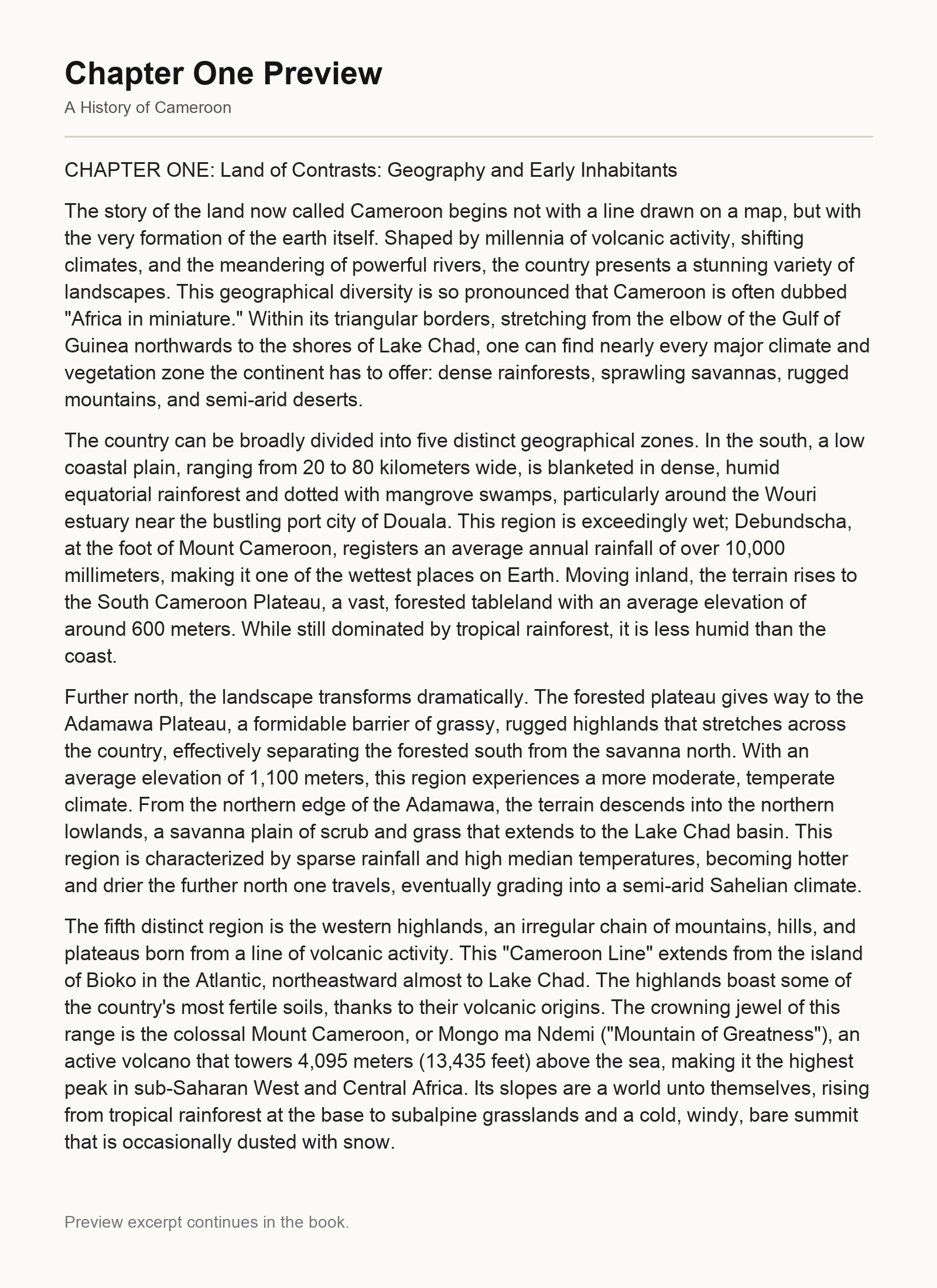
A History of Cameroon offers readers a sweeping journey through one of Africa’s most complex and fascinating nations, revealing how a single country encapsulates the continent’s vast diversity. From the mist‑shrouded rainforests of the south to the Sahelian fringes near Lake Chad, the book opens with Cameroon’s striking geography—its volcanoes, rivers, and varied climate zones—and then traces the earliest human footprints, from the forest‑dwelling Baka and Bagyeli peoples to the enigmatic Sao civilization that left its mark in terracotta and ironwork across the northern plains.
The narrative continues with the arrival of Portuguese sailors who named the land after prawns, the rise of a brutal transatlantic slave trade that turned coastal kingdoms into ruthless middlemen, and the dramatic Scramble for Africa that saw Germany plant its flag on the Wouri estuary in 1884. Readers will follow the imposition of German colonial rule, the fierce resistance of groups like the Bakweri and the Bulu, the devastating World War I campaign that ended German control, and the subsequent partition of the territory between Britain and France under the League of Nations mandate system, a division that sowed the seeds of a lasting linguistic and political fault line.
Moving into the mid‑twentieth century, the book details the birth of Cameroonian nationalism, the radical Union des Populations du Cameroun, the violent struggle for independence, and the carefully managed transfer of power to Ahmadou Ahidjo in 1960. It explores the turbulent reunification with the southern British Cameroons at the Foumban Conference, the uneasy federal experiment, and Ahidjo’s gradual consolidation of a unitary state that suppressed dissent while pursuing economic development through oil, agriculture, and foreign investment. The rise of Paul Biya, the 1984 coup attempt, the shift to multiparty politics, and the ensuing economic crises are examined with clear insight into how internal power struggles and external pressures have shaped the nation’s trajectory.
The latter sections bring the story into the twenty‑first century, illuminating the Anglophone crisis that erupted from decades of marginalization, the Boko Haram insurgency spilling over from Nigeria, and the humanitarian strains caused by refugee influxes from the Central African Republic. At the same time, the book celebrates Cameroon’s vibrant cultural life—its music ranging from makossa and bikutsi to Afrobeats, its thriving film and literary scenes, the passion for football, and the inventive street language Camfranglais that captures the youthful, hybrid identity of a nation constantly negotiating tradition and modernity.
By the end of this comprehensive history, readers will have gained a deep understanding of the forces—geography, ethnicity, colonial legacy, resistance, leadership, and global economics—that have forged Cameroon’s unique path. They will appreciate the country’s resilience amid division, grasp the roots of its contemporary challenges, and come away with a nuanced perspective on what lies ahead for a nation that truly embodies Africa in miniature.
What You'll Find Inside:
- Cameroon's remarkable geographic and ethnic diversity, earning it the nickname 'Africa in Miniature' and shaping its complex social fabric.
- The legacy of three colonial rulers—Germany, France, and Britain—on language, administration, and economic structures, creating enduring linguistic and cultural fault lines.
- The rise of nationalist movements like the UPC, their violent suppression, and the tumultuous path to independence, reunification, and the formation of a federal state.
- The centralization of power under Ahmadou Ahidjo and Paul Biya, transitioning from a federal republic to a unitary authoritarian state marked by patronage and repression.
- 21st‑century challenges including the Anglophone crisis, Boko Haram insurgency, economic dependency on commodities, and governance struggles that define Cameroon's current trajectory.
Who's It For:
This book is ideal for undergraduate and graduate students of African history, political science, and post‑colonial studies who seek a comprehensive yet accessible overview of Cameroon’s past. It will also benefit researchers, development practitioners, and policymakers needing historical context for contemporary issues such as conflict resolution, governance reform, and regional security in Central Africa. General readers with an interest in how geography, colonialism, and nationalism intertwine to shape a nation will find the narrative both informative and engaging.
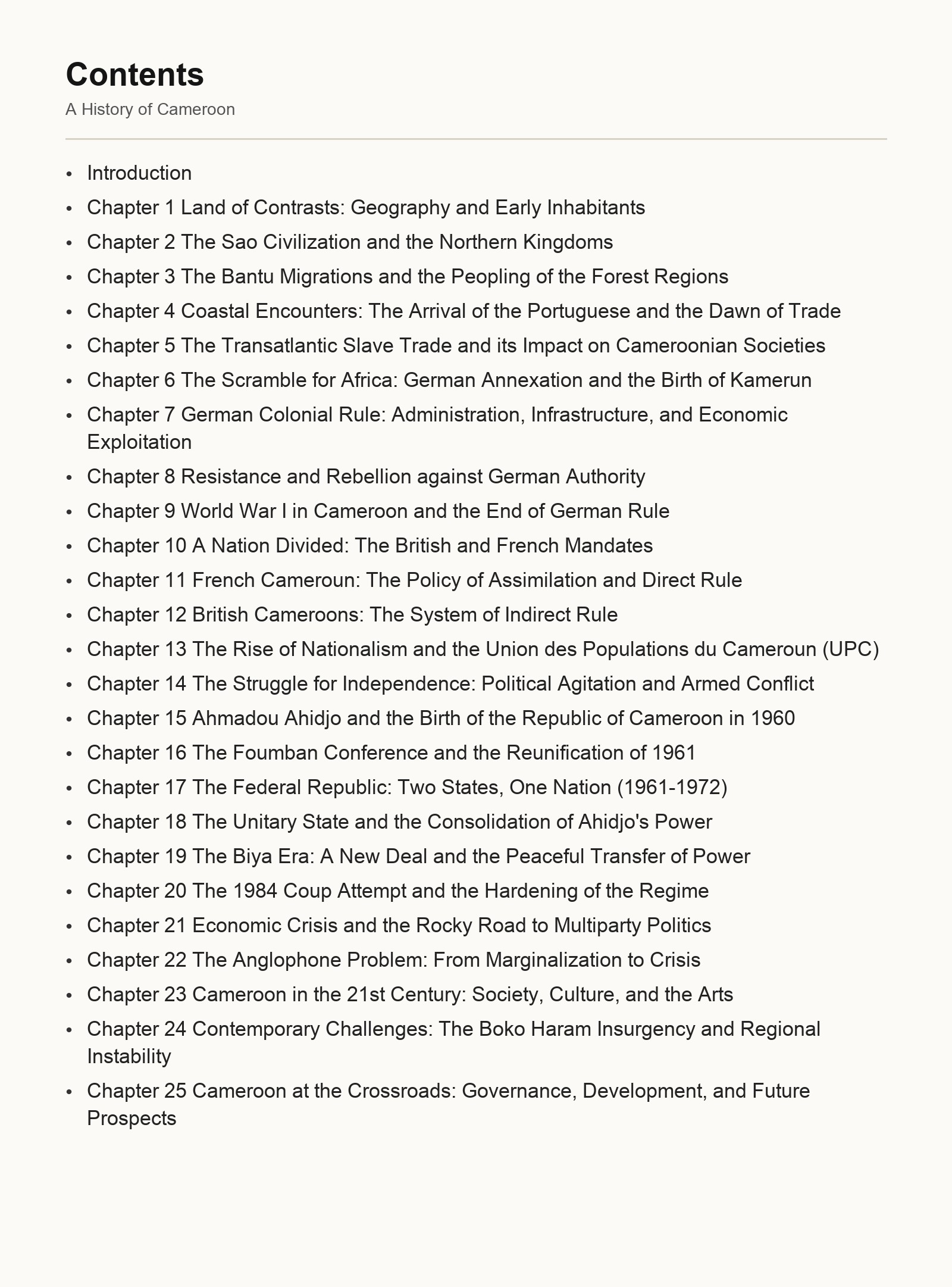
Table of Contents:
- Introduction
- Chapter 1 Land of Contrasts: Geography and Early Inhabitants
- Chapter 2 The Sao Civilization and the Northern Kingdoms
- Chapter 3 The Bantu Migrations and the Peopling of the Forest Regions
- Chapter 4 Coastal Encounters: The Arrival of the Portuguese and the Dawn of Trade
- Chapter 5 The Transatlantic Slave Trade and its Impact on Cameroonian Societies
- Chapter 6 The Scramble for Africa: German Annexation and the Birth of Kamerun
- Chapter 7 German Colonial Rule: Administration, Infrastructure, and Economic Exploitation
- Chapter 8 Resistance and Rebellion against German Authority
- Chapter 9 World War I in Cameroon and the End of German Rule
- Chapter 10 A Nation Divided: The British and French Mandates
- Chapter 11 French Cameroun: The Policy of Assimilation and Direct Rule
- Chapter 12 British Cameroons: The System of Indirect Rule
- Chapter 13 The Rise of Nationalism and the Union des Populations du Cameroun (UPC)
- Chapter 14 The Struggle for Independence: Political Agitation and Armed Conflict
- Chapter 15 Ahmadou Ahidjo and the Birth of the Republic of Cameroon in 1960
- Chapter 16 The Foumban Conference and the Reunification of 1961
- Chapter 17 The Federal Republic: Two States, One Nation (1961-1972)
- Chapter 18 The Unitary State and the Consolidation of Ahidjo's Power
- Chapter 19 The Biya Era: A New Deal and the Peaceful Transfer of Power
- Chapter 20 The 1984 Coup Attempt and the Hardening of the Regime
- Chapter 21 Economic Crisis and the Rocky Road to Multiparty Politics
- Chapter 22 The Anglophone Problem: From Marginalization to Crisis
- Chapter 23 Cameroon in the 21st Century: Society, Culture, and the Arts
- Chapter 24 Contemporary Challenges: The Boko Haram Insurgency and Regional Instability
- Chapter 25 Cameroon at the Crossroads: Governance, Development, and Future Prospects
Author:
Published By:
Date Published:
May 20, 2026
Type:
Nonfiction
Language:
English
Also Available In:
Word Count:
37,310 words
Reading Time:
2 hours 37 minutes
Sample:
Order:
Order A History of Cameroon (Paperback) on MixCache.com:
Buy NowPrint copy is made to order and ships worldwide. Includes the ebook free, ready to read instantly.
$5 account credit for all new MixCache.com accounts, usable toward any ebook purchase!*