Browse by Category
Fiction
- Action & Adventure
- African American
- Anthologies
- Children's Fiction
- Classics
- Comics & Graphic Novels
- Coming of Age
- Contemporary
- Cultural & Regional
- Drama
- Erotica
- Fantasy
- General
- Historical Fiction
- Horror
- Humor & Satire
- Literary Fiction
- Mystery, Thriller & Suspense
- Poetry
- Religious & Inspirational
- Romance
- Science Fiction
- Short Stories
- War & Military
- Westerns
- Women's Fiction
- Young Adult
Non-Fiction
- Antiques & Collectibles
- Arts & Photography
- Biographies & Memoirs
- Business & Money
- Children's Non-Fiction
-
Computers & Technology
- Artificial Intelligence
- Computer Science
- Cybersecurity & Cryptography
- Data Science & Analytics
- Databases & Big Data
- Game Development & Design
- General
- Hardware & DIY
- Mobile App Development
- Networking & Cloud Computing
- Operating Systems
- Programming
- Robotics
- Software
- Software Engineering
- User Experience (UX) & Design
- Web Development & Design
- Cooking, Food & Wine
- Crafts, Hobbies & Home
- Education & Teaching
- Engineering
- General
- Health, Fitness & Dieting
-
History
- African History
- African History - North Africa
- African History - Sub-Saharan Africa
- American History
- American History - 20th Century
- American History - Civil War
- American History - Colonial Period
- Ancient History
- Asian History
- Asian History - China
- Asian History - India
- Asian History - Japan
- Asian History - Southeast Asia
- European History
- European History - Ancient Greece
- European History - Ancient Rome
- European History - Medieval
- European History - Modern
- European History - Renaissance
- General
- Middle Eastern History
- Military History
- Military History - Aviation
- Military History - Naval
- Social & Cultural History
- World History
- Humor & Entertainment
- Industrial Technology
- Language Learning
- Law
- LGBTQ+ Non-Fiction
- Literary Criticism
- Medical Books
- Parenting & Relationships
- Philosophy
- Politics & Social Sciences
- Reference
- Religion & Spirituality
-
Science & Math
- Agricultural Sciences
- Astronomy & Space Science
- Behavioral Sciences
- Biological Sciences
- Botany & Plant Science
- Chemistry
- Earth Sciences
- Engineering - Chemical
- Engineering - Civil
- Engineering - Electrical
- Engineering - Mechanical
- Environment
- General
- Geology
- Mathematics
- Nature & Ecology
- Oceanography
- Paleontology
- Physics
- Statistics
- Self-Help
- Sports & Outdoors
- Study Aids
- Sustainability & Green Living
- Textbooks
- Transportation
- Travel
- True Crime
- Urban Planning & Development
- Veterinary Medicine
- Writing & Publishing
Jump to Section
MixCache.com Total Access
Unlimited reading and audiobooks for every book published by MixCache.com.
Included titles carry the MTA badge.
Learn more →
The Monroe Doctrine
Empire, Influence, and America’s Unfinished Policy
About this book:



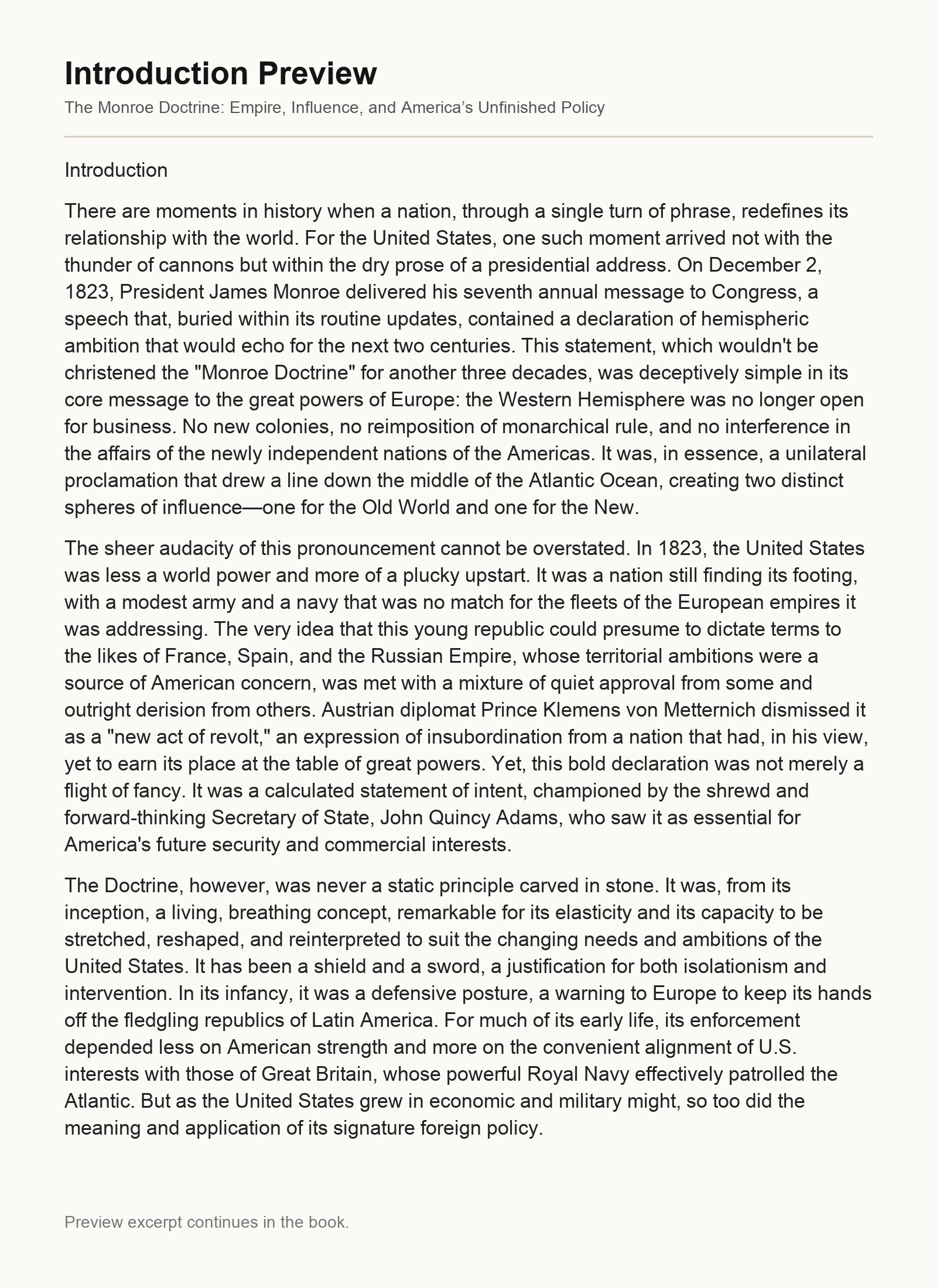
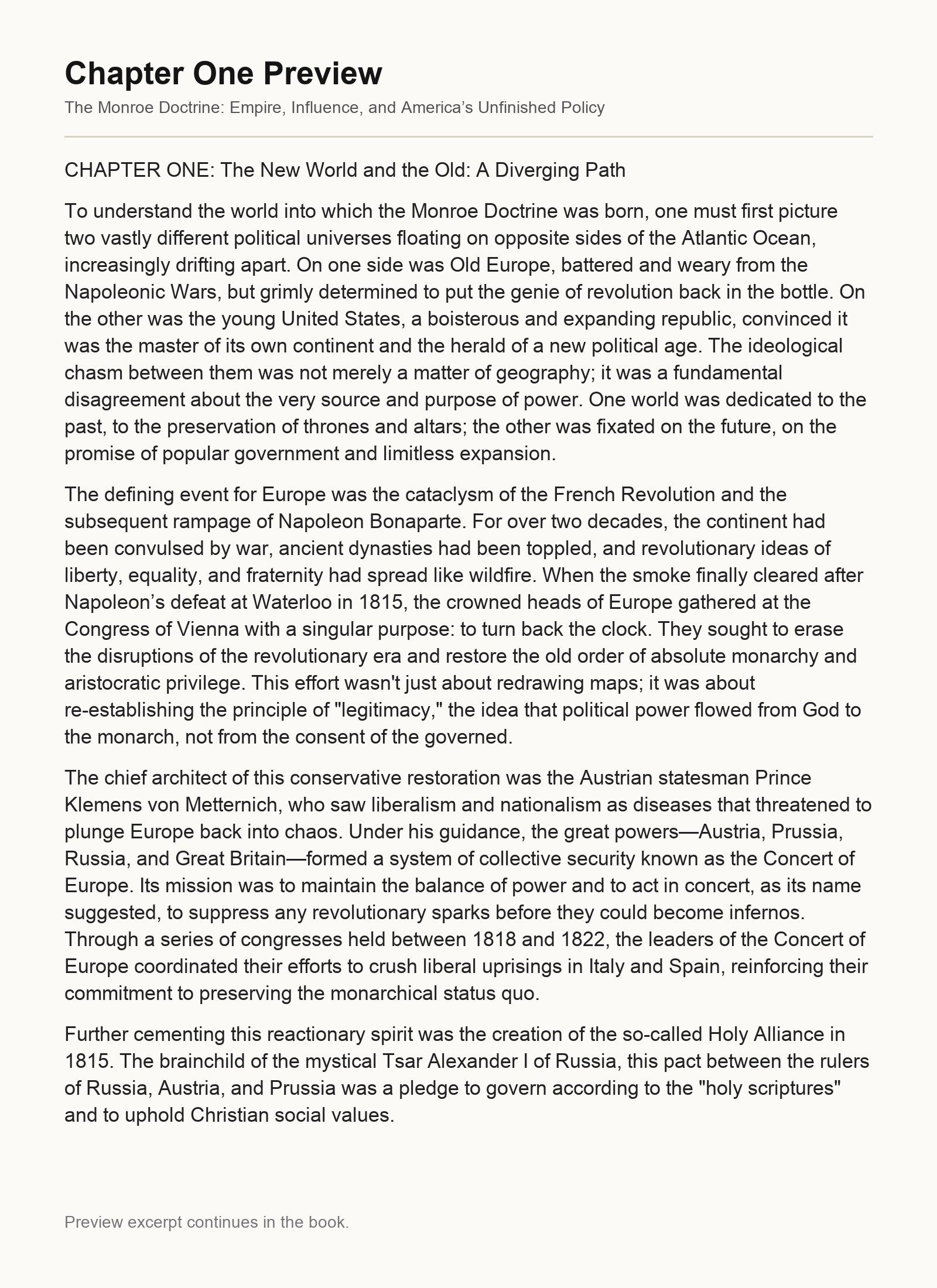
The Monroe Doctrine offers a sweeping two‑century tour of how a single presidential proclamation grew into the cornerstone of American hemispheric policy. Readers will follow the idea from its uneasy birth in 1823—when a fledgling republic dared to tell Europe to stay out of the New World—through its many reinterpretations as a shield for westward expansion, a justification for military interventions, and a tool of ideological containment during the Cold War. Each chapter unpacks the doctrine’s shifting meaning, showing how presidents from James Monroe to Theodore Roosevelt, from Franklin D. Roosevelt to Ronald Reagan, and beyond have bent its words to match the strategic, economic, and political challenges of their eras.
Through meticulous research and vivid storytelling, the book reveals the inner workings of key moments such as the French intervention in Mexico, the Venezuelan border crisis that birthed the Olney Corollary, the Roosevelt Corollary’s “big stick” diplomacy, the covert coups in Guatemala and Chile, and the Cuban Missile Crisis that brought the doctrine to the brink of nuclear war. Readers will see how economic interests—from the United Fruit Company’s banana empires to modern sanctions on Venezuelan oil—have repeatedly intertwined with the doctrine’s rhetoric, turning a principle of non‑colonization into a lever for American commercial and financial advantage.
The narrative also gives voice to the nations that lived in the doctrine’s shadow, tracing Latin American perspectives from early gratitude to deep‑seated resentment. By examining figures like Simón Bolívar, Diego Portales, Augusto César Sandino, and Fidel Castro, the book illustrates how the same policy that promised hemispheric security often became a pretext for domination, leaving a legacy of suspicion that still colors inter‑American relations today. This dual view helps readers understand why the Monroe Doctrine is simultaneously celebrated as a bold assertion of American exceptionalism and condemned as a vehicle of neocolonialism.
Finally, the work brings the doctrine into the twenty‑first century, showing how renewed great‑power competition with China and Russia has revived its language, while new challenges—transnational crime, migration, and technological rivalry—continue to test its relevance. Readers will come away with a clear grasp of how an idea born in a wooden sailing ship era can still shape debates over sanctions, alliances, and the very definition of America’s sphere of influence, and they will be equipped to assess whether the Monroe Doctrine remains a vital guide or an anachronistic relic in a globalized world.
What You'll Find Inside:
- The Monroe Doctrine's true intellectual foundation was laid by John Quincy Adams, whose vision of American hemispheric dominance and non-colonization principles formed the core later attributed to Monroe's 1823 proclamation.
- The Doctrine evolved from a defensive warning to Europe into justification for U.S. intervention, most dramatically with Theodore Roosevelt's Corollary claiming hemispheric police power to intervene in Latin American affairs.
- Latin American perspectives reveal a legacy of resentment as the Doctrine shifted from protection to pretext for American economic and political hegemony, fueling anti-imperialist movements throughout the region.
- The Doctrine was repeatedly repurposed to meet changing threats - from European monarchies and Soviet communism to 21st-century economic influence from China and Russia - demonstrating remarkable elasticity.
- Modern applications show the Doctrine's enduring relevance, from Cold War interventions to economic sanctions against Venezuela framed as hemispheric defense against extra-hemispheric powers.
Who's It For:
This book is essential reading for students and scholars of American foreign policy, international relations, and Latin American studies who seek to understand how a 200-year-old policy declaration has shaped hemispheric relations. It will also benefit policy makers, diplomats, and historically-minded readers interested in the roots of contemporary U.S. approaches to regional challenges, offering crucial context for debates about American power and intervention in the Western Hemisphere.
Table of Contents:
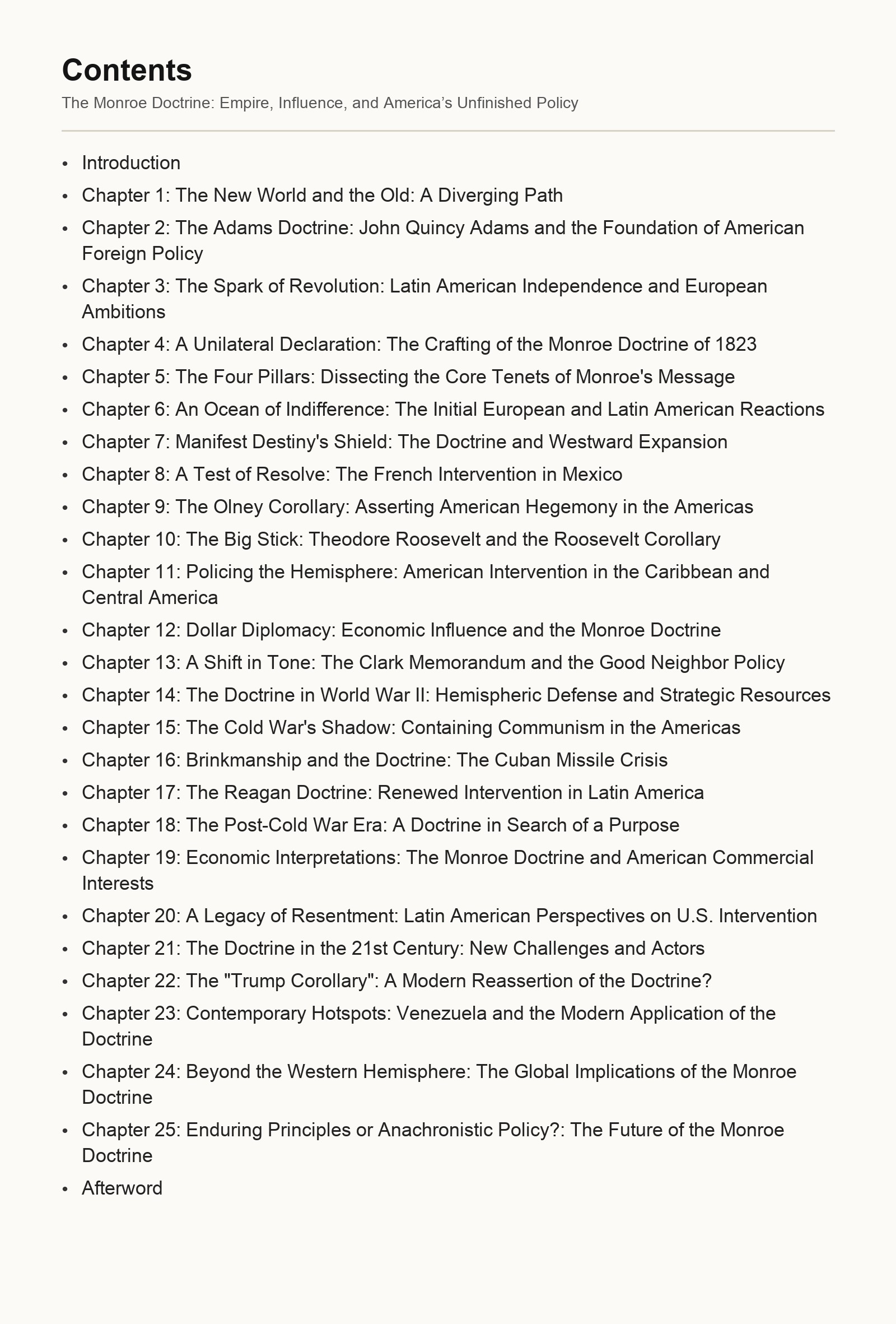
- Introduction
- Chapter 1: The New World and the Old: A Diverging Path
- Chapter 2: The Adams Doctrine: John Quincy Adams and the Foundation of American Foreign Policy
- Chapter 3: The Spark of Revolution: Latin American Independence and European Ambitions
- Chapter 4: A Unilateral Declaration: The Crafting of the Monroe Doctrine of 1823
- Chapter 5: The Four Pillars: Dissecting the Core Tenets of Monroe's Message
- Chapter 6: An Ocean of Indifference: The Initial European and Latin American Reactions
- Chapter 7: Manifest Destiny's Shield: The Doctrine and Westward Expansion
- Chapter 8: A Test of Resolve: The French Intervention in Mexico
- Chapter 9: The Olney Corollary: Asserting American Hegemony in the Americas
- Chapter 10: The Big Stick: Theodore Roosevelt and the Roosevelt Corollary.
- Chapter 11: Policing the Hemisphere: American Intervention in the Caribbean and Central America
- Chapter 12: Dollar Diplomacy: Economic Influence and the Monroe Doctrine
- Chapter 13: A Shift in Tone: The Clark Memorandum and the Good Neighbor Policy.
- Chapter 14: The Doctrine in World War II: Hemispheric Defense and Strategic Resources.
- Chapter 15: The Cold War's Shadow: Containing Communism in the Americas
- Chapter 16: Brinkmanship and the Doctrine: The Cuban Missile Crisis.
- Chapter 17: The Reagan Doctrine: Renewed Intervention in Latin America
- Chapter 18: The Post-Cold War Era: A Doctrine in Search of a Purpose
- Chapter 19: Economic Interpretations: The Monroe Doctrine and American Commercial Interests
- Chapter 20: A Legacy of Resentment: Latin American Perspectives on U.S. Intervention
- Chapter 21: The Doctrine in the 21st Century: New Challenges and Actors
- Chapter 22: The "Trump Corollary": A Modern Reassertion of the Doctrine?.
- Chapter 23: Contemporary Hotspots: Venezuela and the Modern Application of the Doctrine.
- Chapter 24: Beyond the Western Hemisphere: The Global Implications of the Monroe Doctrine
- Chapter 25: Enduring Principles or Anachronistic Policy?: The Future of the Monroe Doctrine
- Afterword
Author:
Published By:
Date Published:
May 19, 2026
Type:
Nonfiction
Language:
English
Also Available In:
Word Count:
53,285 words
Reading Time:
3 hours 44 minutes
Sample:
Order:
Order The Monroe Doctrine (Hardcover) on MixCache.com:
Buy NowPrint copy is made to order and ships worldwide. Includes the ebook free, ready to read instantly.
$5 account credit for all new MixCache.com accounts, usable toward any ebook purchase!*