Browse by Category
Fiction
- Action & Adventure
- African American
- Anthologies
- Children's Fiction
- Classics
- Comics & Graphic Novels
- Coming of Age
- Contemporary
- Cultural & Regional
- Drama
- Erotica
- Fantasy
- General
- Historical Fiction
- Horror
- Humor & Satire
- Literary Fiction
- Mystery, Thriller & Suspense
- Poetry
- Religious & Inspirational
- Romance
- Science Fiction
- Short Stories
- War & Military
- Westerns
- Women's Fiction
- Young Adult
Non-Fiction
- Antiques & Collectibles
- Arts & Photography
- Biographies & Memoirs
- Business & Money
- Children's Non-Fiction
-
Computers & Technology
- Artificial Intelligence
- Computer Science
- Cybersecurity & Cryptography
- Data Science & Analytics
- Databases & Big Data
- Game Development & Design
- General
- Hardware & DIY
- Mobile App Development
- Networking & Cloud Computing
- Operating Systems
- Programming
- Robotics
- Software
- Software Engineering
- User Experience (UX) & Design
- Web Development & Design
- Cooking, Food & Wine
- Crafts, Hobbies & Home
- Education & Teaching
- Engineering
- General
- Health, Fitness & Dieting
-
History
- African History
- African History - North Africa
- African History - Sub-Saharan Africa
- American History
- American History - 20th Century
- American History - Civil War
- American History - Colonial Period
- Ancient History
- Asian History
- Asian History - China
- Asian History - India
- Asian History - Japan
- Asian History - Southeast Asia
- European History
- European History - Ancient Greece
- European History - Ancient Rome
- European History - Medieval
- European History - Modern
- European History - Renaissance
- General
- Middle Eastern History
- Military History
- Military History - Aviation
- Military History - Naval
- Social & Cultural History
- World History
- Humor & Entertainment
- Industrial Technology
- Language Learning
- Law
- LGBTQ+ Non-Fiction
- Literary Criticism
- Medical Books
- Parenting & Relationships
- Philosophy
- Politics & Social Sciences
- Reference
- Religion & Spirituality
-
Science & Math
- Agricultural Sciences
- Astronomy & Space Science
- Behavioral Sciences
- Biological Sciences
- Botany & Plant Science
- Chemistry
- Earth Sciences
- Engineering - Chemical
- Engineering - Civil
- Engineering - Electrical
- Engineering - Mechanical
- Environment
- General
- Geology
- Mathematics
- Nature & Ecology
- Oceanography
- Paleontology
- Physics
- Statistics
- Self-Help
- Sports & Outdoors
- Study Aids
- Sustainability & Green Living
- Textbooks
- Transportation
- Travel
- True Crime
- Urban Planning & Development
- Veterinary Medicine
- Writing & Publishing
Jump to Section
MixCache.com Total Access
Unlimited reading and audiobooks for every book published by MixCache.com.
Included titles carry the MTA badge.
Learn more →
A History of Communism
The Real Story of Socialism's Greatest Experiment
About this book:



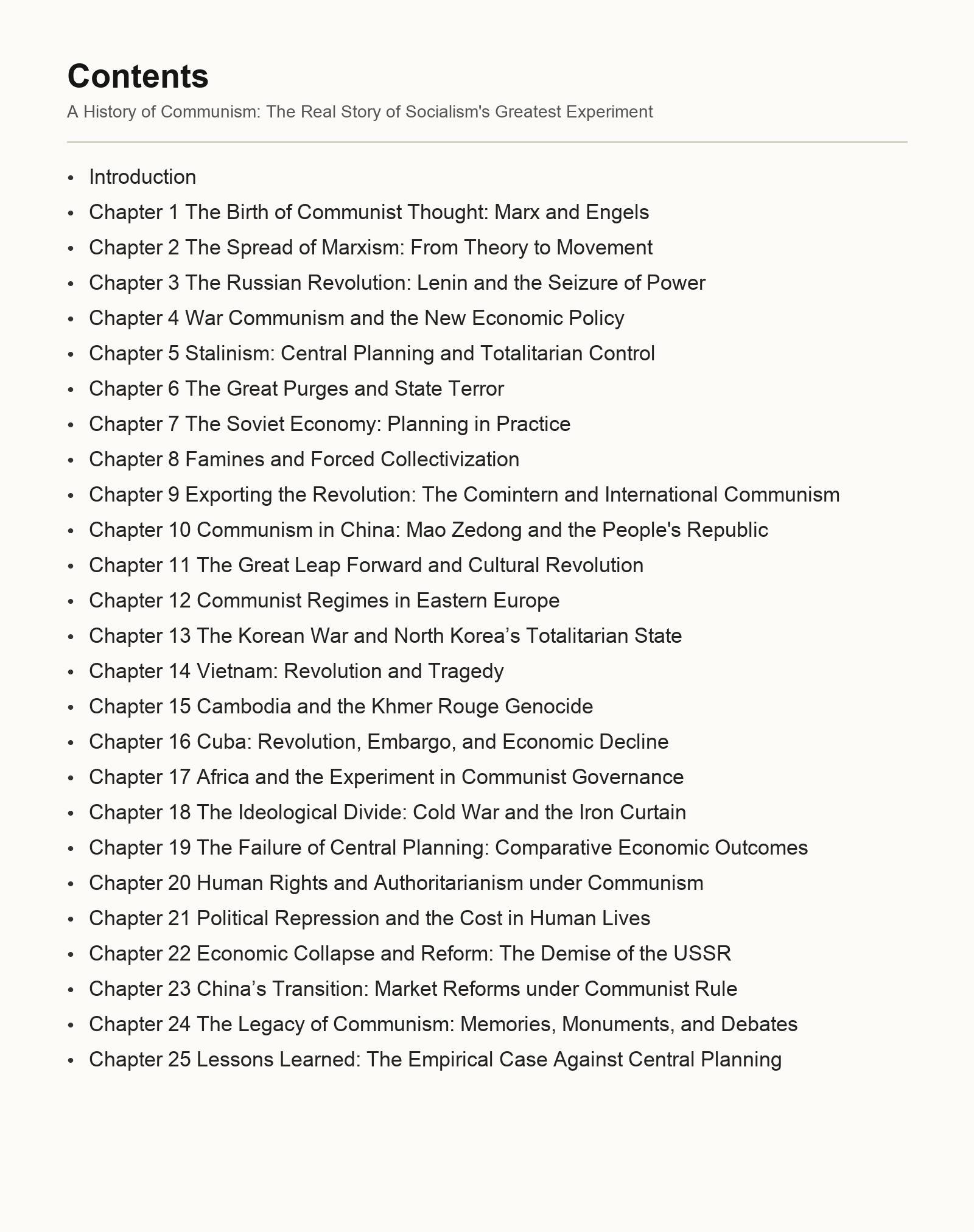
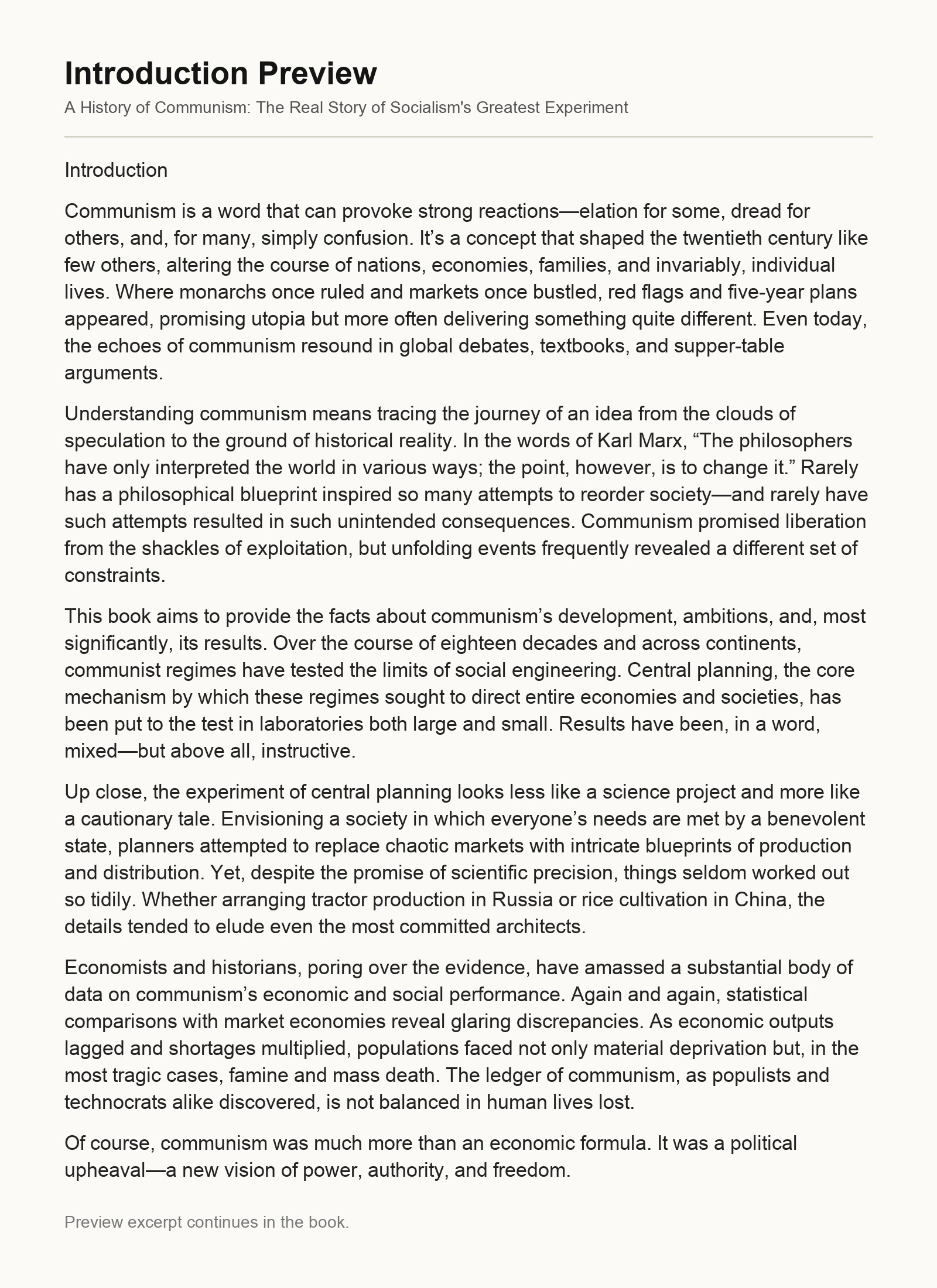
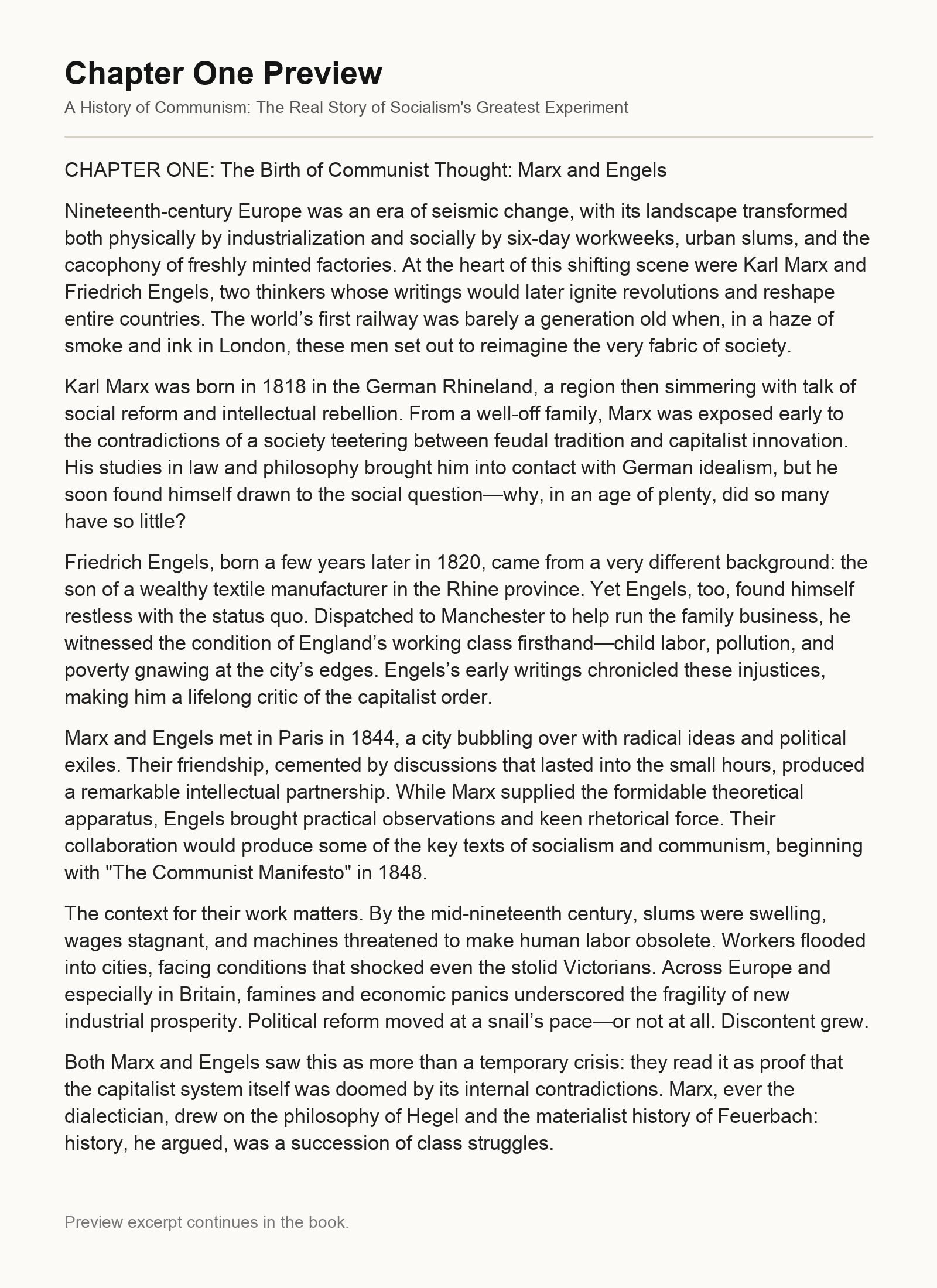
Readers of "A History of Communism" will gain a comprehensive understanding of one of the most influential and consequential ideologies of the modern era. Rather than presenting a polemical critique or a nostalgic defense, Robert Mann traces the development of communist thought from its philosophical roots in the writings of Marx and Engels through its explosive global implementation and eventual decline. The book follows communism's journey from theoretical speculation to concrete historical reality across continents, examining how ideas transformed into policies and what those policies actually produced in practice.
Throughout this detailed historical account, readers will learn about the stark contrast between communism's utopian promises and its often-devastating realities. The book examines key episodes like the Russian Revolution and Lenin's seizure of power, Stalin's brutal campaign of collectivization and terror, Mao's Great Leap Forward and Cultural Revolution in China, and the Khmer Rouge genocide in Cambodia. Each chapter provides carefully documented evidence of economic outcomes, human costs, and the recurring patterns of authoritarianism that emerged when communist regimes attempted to transform society through centralized control.
What distinguishes this work is its commitment to letting the historical record speak for itself through comparative analysis and empirical evidence. Readers will discover how central planning—the core economic mechanism of communist regimes—consistently failed to deliver the abundance and equality it promised, instead producing chronic shortages, declining living standards, and suppressed innovation when compared to market economies. The book presents substantial data on GDP growth, life expectancy, agricultural output, and industrial production across different systems, allowing readers to see the measurable consequences of different economic approaches.
Beyond economic metrics, the book delves into the human dimension of communist rule, exploring how political repression, surveillance, and the erosion of personal freedoms became nearly universal features of these systems. Readers will understand the tremendous human cost measured not just in economic statistics but in lives lost to famine, forced labor camps, purges, and state terror. The narrative balances acknowledgment of occasional genuine achievements in areas like literacy and healthcare with the overwhelming evidence of systemic failure and suffering that characterized most communist experiments.
By the conclusion, readers will have gained valuable insights into why communist regimes, despite their revolutionary ideals and initial popular support, so often devolved into authoritarian states marked by economic stagnation and human rights abuses. The book identifies structural flaws in central planning—such as the absence of price signals, misaligned incentives, and the inability to process complex economic information—that repeatedly led to the same disappointing outcomes across different cultural and historical contexts. This historical perspective provides readers with a nuanced understanding of one of the twentieth century's defining experiments and its enduring lessons for contemporary debates about economic systems, political freedom, and the pursuit of social justice.
What You'll Find Inside:
- Origins of communist ideology: Marx and Engels’ theoretical foundations and the early gap between revolutionary theory and practical governance.
- The Russian Revolution and Bolshevik seizure of power: Lenin’s vanguard party, the establishment of the USSR, and the inception of war communism and the New Economic Policy.
- Stalinism’s central planning and terror: Five‑Year Plans, forced collectivization, the Gulag, and the human cost of rapid industrialization and purges.
- Global communist experiments: variations in China, Cuba, Eastern Europe, Africa, and North Korea, showing recurring patterns of repression, shortages, and ideological rigidity.
- Empirical failure of central planning: comparative data on economic stagnation, innovation lag, chronic shortages, and massive loss of life that led to the collapse of most communist regimes.
Who's It For:
This book is ideal for undergraduate and graduate students of history, political science, and economics who seek a comprehensive, fact‑based overview of communism’s rise, practice, and decline. It also serves general readers interested in 20th‑century ideological conflicts, Cold War dynamics, and the lessons of authoritarian state‑building. Policymakers and scholars looking for a data‑driven assessment of centrally planned economies and their human costs will find the comparative analysis particularly valuable.
Author:
Published By:
Date Published:
May 17, 2026
Type:
Nonfiction
Language:
English
Also Available In:
Word Count:
66,653 words
Reading Time:
4 hours 40 minutes
Sample:
Order:
Order A History of Communism (Paperback) on MixCache.com:
Buy NowPrint copy is made to order and ships worldwide. Includes the ebook free, ready to read instantly.
$5 account credit for all new MixCache.com accounts, usable toward any ebook purchase!*