Browse by Category
Fiction
- Action & Adventure
- African American
- Anthologies
- Children's Fiction
- Classics
- Comics & Graphic Novels
- Coming of Age
- Contemporary
- Cultural & Regional
- Drama
- Erotica
- Fantasy
- General
- Historical Fiction
- Horror
- Humor & Satire
- Literary Fiction
- Mystery, Thriller & Suspense
- Poetry
- Religious & Inspirational
- Romance
- Science Fiction
- Short Stories
- War & Military
- Westerns
- Women's Fiction
- Young Adult
Non-Fiction
- Antiques & Collectibles
- Arts & Photography
- Biographies & Memoirs
- Business & Money
- Children's Non-Fiction
-
Computers & Technology
- Artificial Intelligence
- Computer Science
- Cybersecurity & Cryptography
- Data Science & Analytics
- Databases & Big Data
- Game Development & Design
- General
- Hardware & DIY
- Mobile App Development
- Networking & Cloud Computing
- Operating Systems
- Programming
- Robotics
- Software
- Software Engineering
- User Experience (UX) & Design
- Web Development & Design
- Cooking, Food & Wine
- Crafts, Hobbies & Home
- Education & Teaching
- Engineering
- General
- Health, Fitness & Dieting
-
History
- African History
- African History - North Africa
- African History - Sub-Saharan Africa
- American History
- American History - 20th Century
- American History - Civil War
- American History - Colonial Period
- Ancient History
- Asian History
- Asian History - China
- Asian History - India
- Asian History - Japan
- Asian History - Southeast Asia
- European History
- European History - Ancient Greece
- European History - Ancient Rome
- European History - Medieval
- European History - Modern
- European History - Renaissance
- General
- Middle Eastern History
- Military History
- Military History - Aviation
- Military History - Naval
- Social & Cultural History
- World History
- Humor & Entertainment
- Industrial Technology
- Language Learning
- Law
- LGBTQ+ Non-Fiction
- Literary Criticism
- Medical Books
- Parenting & Relationships
- Philosophy
- Politics & Social Sciences
- Reference
- Religion & Spirituality
-
Science & Math
- Agricultural Sciences
- Astronomy & Space Science
- Behavioral Sciences
- Biological Sciences
- Botany & Plant Science
- Chemistry
- Earth Sciences
- Engineering - Chemical
- Engineering - Civil
- Engineering - Electrical
- Engineering - Mechanical
- Environment
- General
- Geology
- Mathematics
- Nature & Ecology
- Oceanography
- Paleontology
- Physics
- Statistics
- Self-Help
- Sports & Outdoors
- Study Aids
- Sustainability & Green Living
- Textbooks
- Transportation
- Travel
- True Crime
- Urban Planning & Development
- Veterinary Medicine
- Writing & Publishing
Jump to Section
MixCache.com Total Access
Unlimited reading and audiobooks for every book published by MixCache.com.
Included titles carry the MTA badge.
Learn more →
The Fiscal Situation Of The United States
What you need to know about the USA's financial health
About this book:



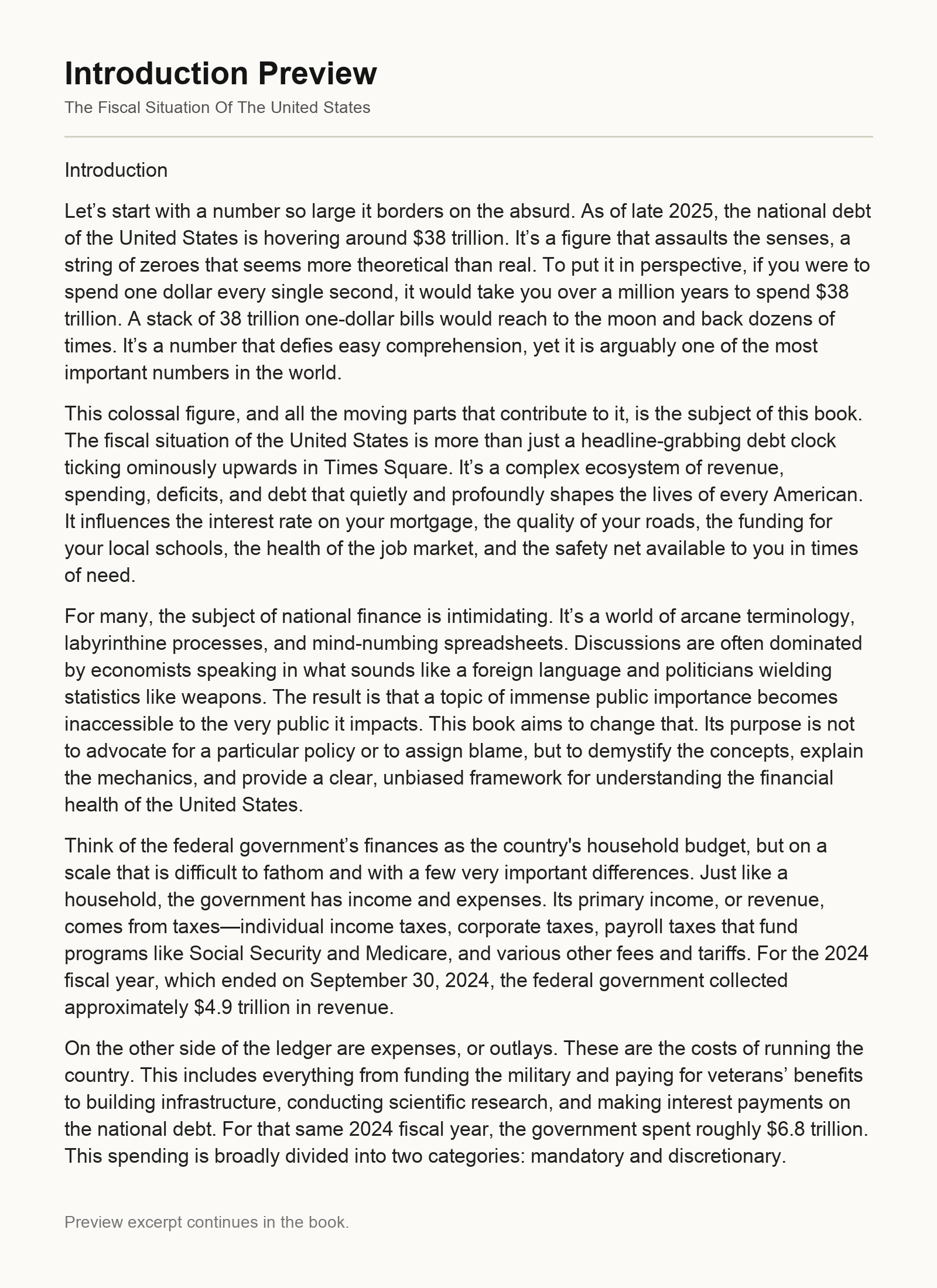
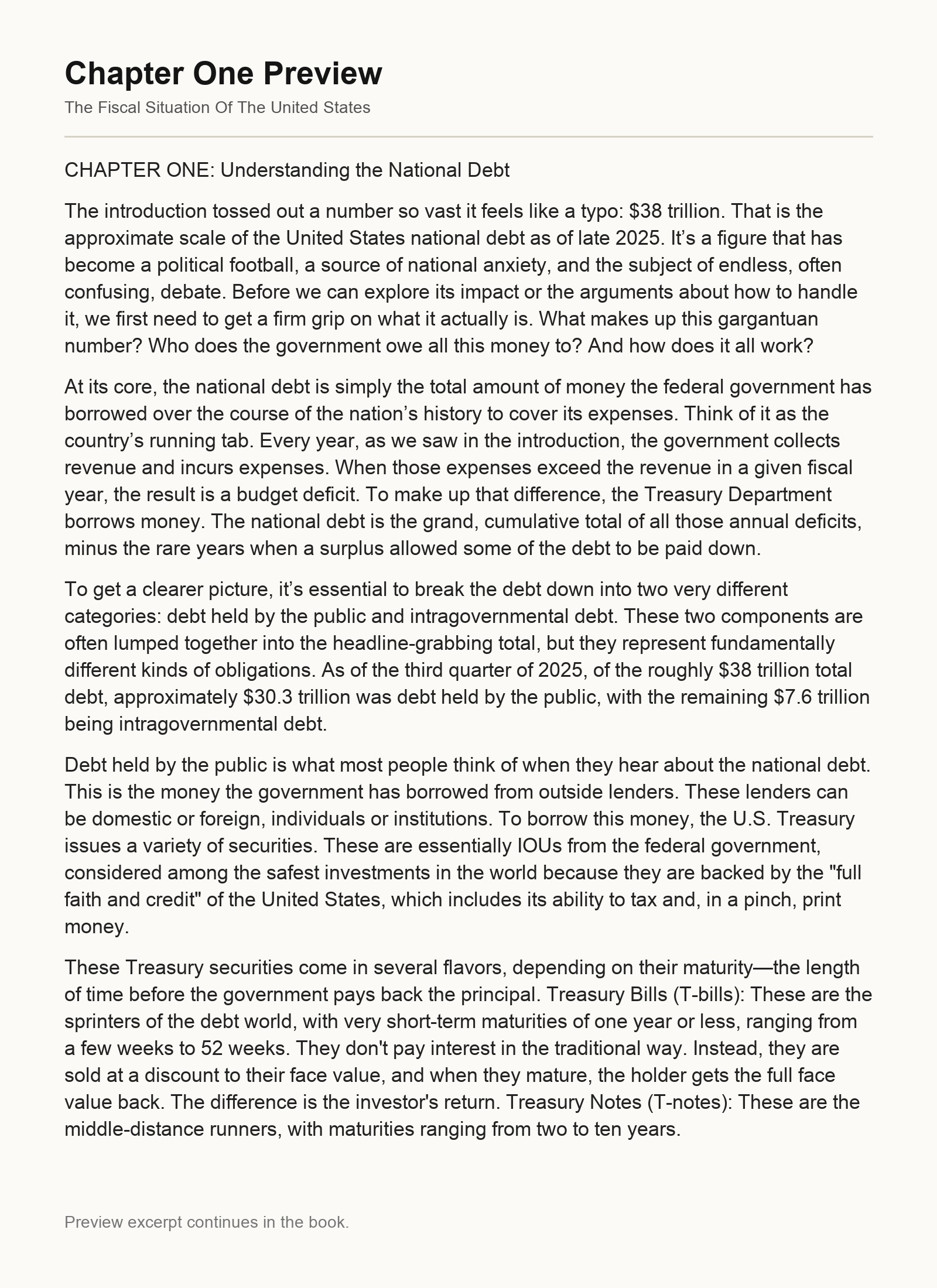
Discover how the United States’ $38 trillion national debt shapes everything from mortgage rates to the strength of the job market, and why understanding these forces matters to every American household. This book walks you through the origins of the debt, explaining the difference between deficits and accumulated borrowing, who holds the nation’s IOUs, and how the Treasury and Federal Reserve interact to finance government spending. By breaking down complex concepts into clear, relatable terms, you’ll gain a solid grasp of the mechanics behind the headlines that dominate financial news.
Explore the inner workings of the federal budget process, from the President’s proposal to Congress’s appropriations battles, continuing resolutions, and the occasional government shutdown. Learn how mandatory programs like Social Security, Medicare, and Medicaid run on autopilot while discretionary spending—especially defense—fuels the annual debate over national priorities. See how interest on the debt has become a fast‑growing budget line item that crowds out other investments, and understand the tools of fiscal and monetary policy that influence inflation, employment, and long‑term growth.
Examine the drivers behind spending and revenue, from the demographic pressures of an aging population and rising healthcare costs to the impact of tax policy, corporate incentives, and global demand for U.S. Treasuries. Gain insight into the long‑term liabilities of entitlement programs, the unfunded obligations that dwarf the current debt, and the structural mismatch between promised benefits and the tax base designed to pay for them. The book also situates America’s fiscal picture within a global context, showing how the dollar’s reserve‑currency status provides both advantages and vulnerabilities.
Finally, see how the nation’s fiscal health translates into personal financial outcomes: the cost of borrowing for a home or car, the stability of retirement savings, the quality of public services, and the intergenerational trade‑offs that will shape future tax burdens and benefit levels. Equipped with this knowledge, you’ll be able to evaluate policy proposals, ask the right questions about how new spending or tax cuts will be paid for, and make informed decisions about your own financial future in an evolving economic landscape.
What You'll Find Inside:
- The structure and ownership of the U.S. national debt, including the difference between debt held by the public and intragovernmental debt
- The federal budget process from presidential proposal to appropriations, including continuing resolutions and reconciliation
- The primary drivers of federal spending: mandatory programs (Social Security, Medicare, Medicaid), discretionary spending (defense and non-defense), and interest on the debt
- Sources of federal revenue including individual income taxes, payroll taxes, corporate taxes, and other revenue streams
- Long-term fiscal challenges from entitlement programs and unfunded liabilities, along with proposed solutions for sustainability
Who's It For:
This book is designed for general readers, concerned citizens, voters, and anyone seeking to understand U.S. fiscal policy without requiring prior economics expertise. It demystifies complex financial concepts to show how national debt, budget deficits, and government spending directly impact personal finances through interest rates, job markets, and retirement security. The unbiased, accessible approach makes it ideal for those wanting to engage in informed civic discussions about America's financial future.
Table of Contents:
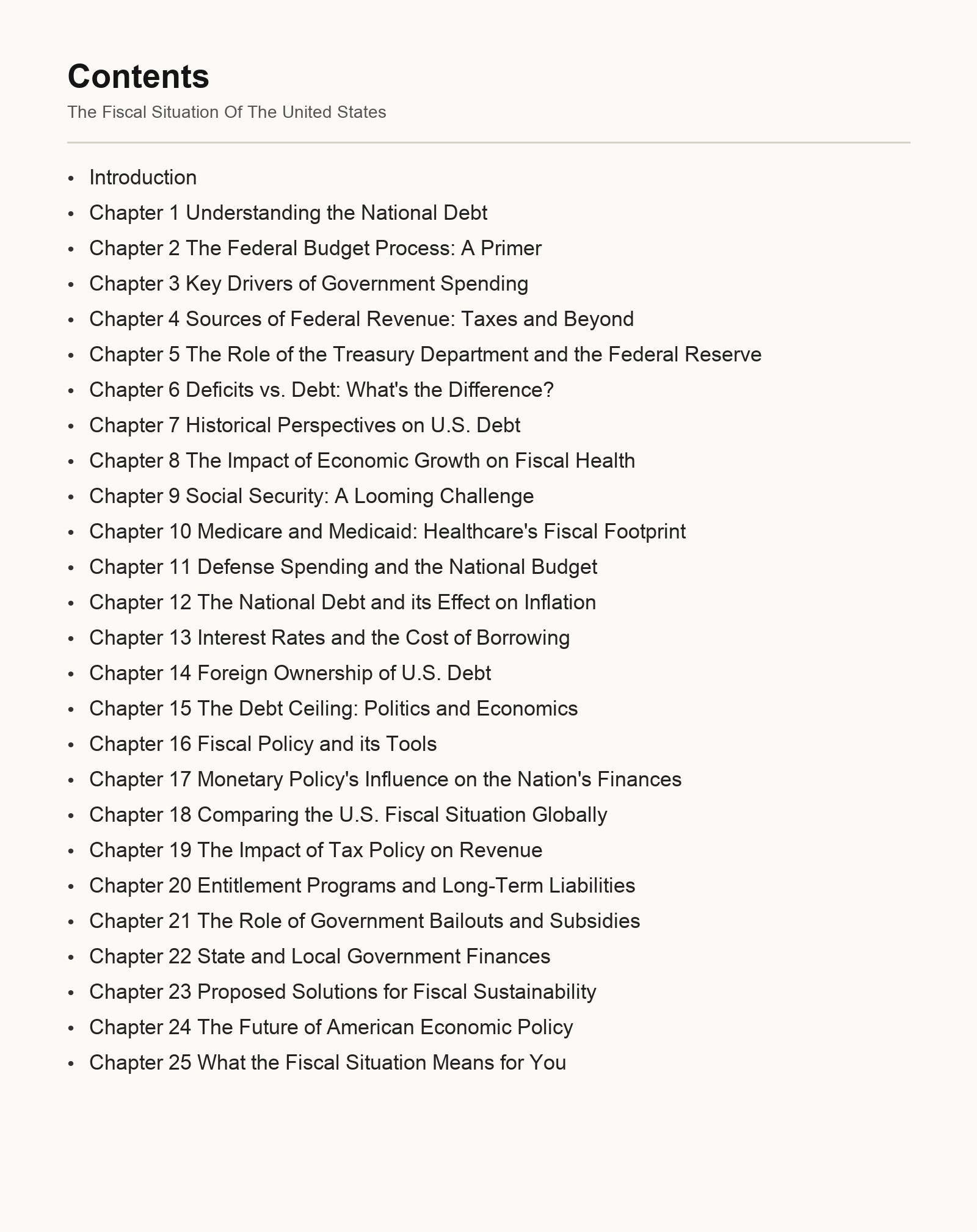
- Introduction
- Chapter 1 Understanding the National Debt
- Chapter 2 The Federal Budget Process: A Primer
- Chapter 3 Key Drivers of Government Spending
- Chapter 4 Sources of Federal Revenue: Taxes and Beyond
- Chapter 5 The Role of the Treasury Department and the Federal Reserve
- Chapter 6 Deficits vs. Debt: What's the Difference?
- Chapter 7 Historical Perspectives on U.S. Debt
- Chapter 8 The Impact of Economic Growth on Fiscal Health
- Chapter 9 Social Security: A Looming Challenge
- Chapter 10 Medicare and Medicaid: Healthcare's Fiscal Footprint
- Chapter 11 Defense Spending and the National Budget
- Chapter 12 The National Debt and its Effect on Inflation
- Chapter 13 Interest Rates and the Cost of Borrowing
- Chapter 14 Foreign Ownership of U.S. Debt
- Chapter 15 The Debt Ceiling: Politics and Economics
- Chapter 16 Fiscal Policy and its Tools
- Chapter 17 Monetary Policy's Influence on the Nation's Finances
- Chapter 18 Comparing the U.S. Fiscal Situation Globally
- Chapter 19 The Impact of Tax Policy on Revenue
- Chapter 20 Entitlement Programs and Long-Term Liabilities
- Chapter 21 The Role of Government Bailouts and Subsidies
- Chapter 22 State and Local Government Finances
- Chapter 23 Proposed Solutions for Fiscal Sustainability
- Chapter 24 The Future of American Economic Policy
- Chapter 25 What the Fiscal Situation Means for You
Author:
Published By:
Date Published:
May 16, 2026
Type:
Nonfiction
Language:
English
Also Available In:
Word Count:
48,718 words
Reading Time:
3 hours 25 minutes
Sample:
Order:
Order The Fiscal Situation Of The United States (Paperback) on MixCache.com:
Buy NowPrint copy is made to order and ships worldwide. Includes the ebook free, ready to read instantly.
$5 account credit for all new MixCache.com accounts, usable toward any ebook purchase!*