
Browse by Category
Fiction
- Action & Adventure
- African American
- Anthologies
- Children's Fiction
- Classics
- Comics & Graphic Novels
- Coming of Age
- Contemporary
- Cultural & Regional
- Drama
- Erotica
- Fantasy
- General
- Historical Fiction
- Horror
- Humor & Satire
- Literary Fiction
- Mystery, Thriller & Suspense
- Poetry
- Religious & Inspirational
- Romance
- Science Fiction
- Short Stories
- War & Military
- Westerns
- Women's Fiction
- Young Adult
Non-Fiction
- Antiques & Collectibles
- Arts & Photography
- Biographies & Memoirs
- Business & Money
- Children's Non-Fiction
-
Computers & Technology
- Artificial Intelligence
- Computer Science
- Cybersecurity & Cryptography
- Data Science & Analytics
- Databases & Big Data
- Game Development & Design
- General
- Hardware & DIY
- Mobile App Development
- Networking & Cloud Computing
- Operating Systems
- Programming
- Robotics
- Software
- Software Engineering
- User Experience (UX) & Design
- Web Development & Design
- Cooking, Food & Wine
- Crafts, Hobbies & Home
- Education & Teaching
- Engineering
- General
- Health, Fitness & Dieting
-
History
- African History
- African History - North Africa
- African History - Sub-Saharan Africa
- American History
- American History - 20th Century
- American History - Civil War
- American History - Colonial Period
- Ancient History
- Asian History
- Asian History - China
- Asian History - India
- Asian History - Japan
- Asian History - Southeast Asia
- European History
- European History - Ancient Greece
- European History - Ancient Rome
- European History - Medieval
- European History - Modern
- European History - Renaissance
- General
- Middle Eastern History
- Military History
- Military History - Aviation
- Military History - Naval
- Social & Cultural History
- World History
- Humor & Entertainment
- Industrial Technology
- Language Learning
- Law
- LGBTQ+ Non-Fiction
- Literary Criticism
- Medical Books
- Parenting & Relationships
- Philosophy
- Politics & Social Sciences
- Reference
- Religion & Spirituality
-
Science & Math
- Agricultural Sciences
- Astronomy & Space Science
- Behavioral Sciences
- Biological Sciences
- Botany & Plant Science
- Chemistry
- Earth Sciences
- Engineering - Chemical
- Engineering - Civil
- Engineering - Electrical
- Engineering - Mechanical
- Environment
- General
- Geology
- Mathematics
- Nature & Ecology
- Oceanography
- Paleontology
- Physics
- Statistics
- Self-Help
- Sports & Outdoors
- Study Aids
- Sustainability & Green Living
- Textbooks
- Transportation
- Travel
- True Crime
- Urban Planning & Development
- Veterinary Medicine
- Writing & Publishing
Jump to Section
MixCache.com Total Access
Unlimited reading and audiobooks for every book published by MixCache.com.
Included titles carry the MTA badge.
Learn more →
Tariffs and Protectionism
How Trade Barriers Shape Economies, Industries, and Global Markets
About this book:



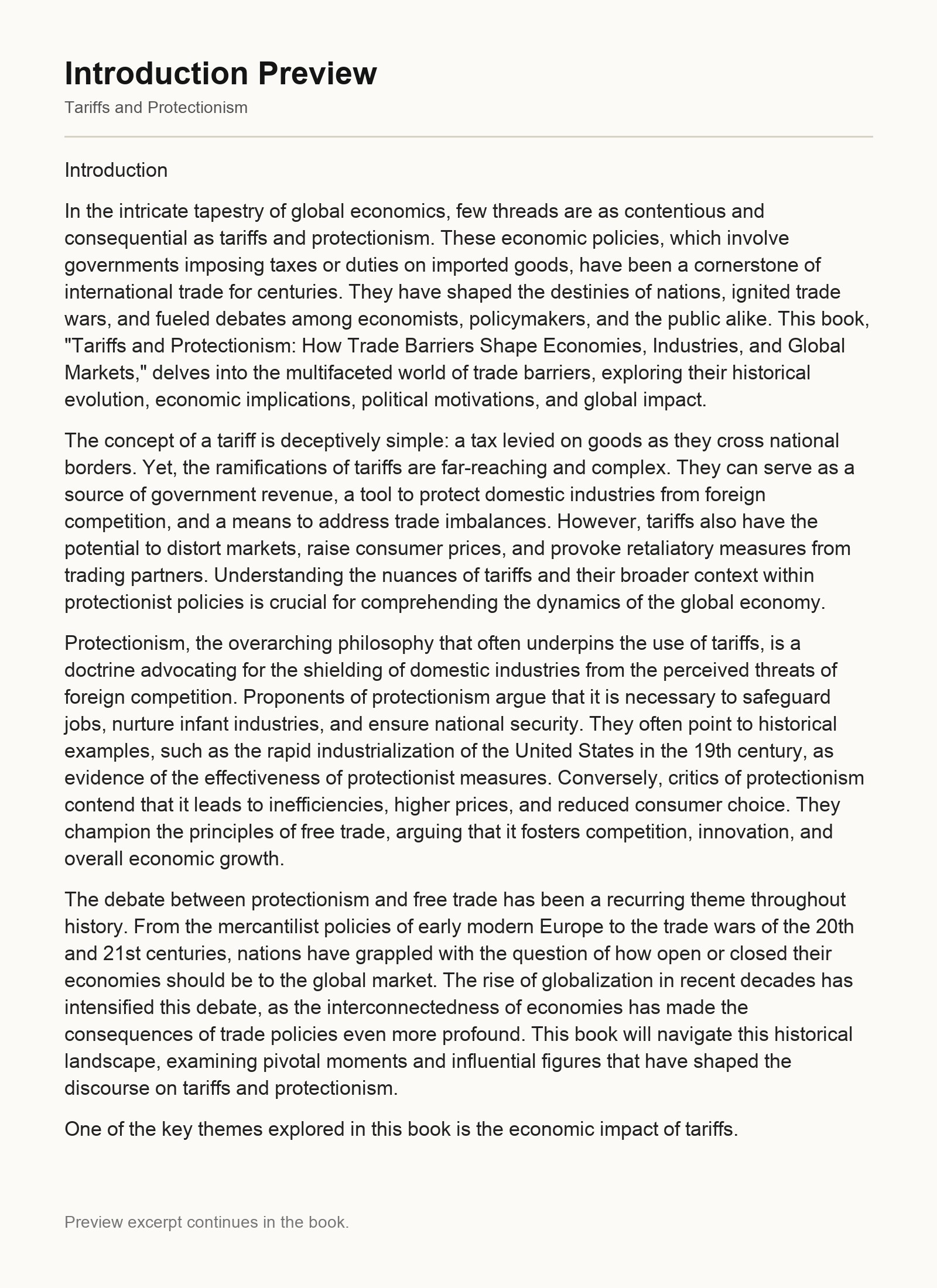
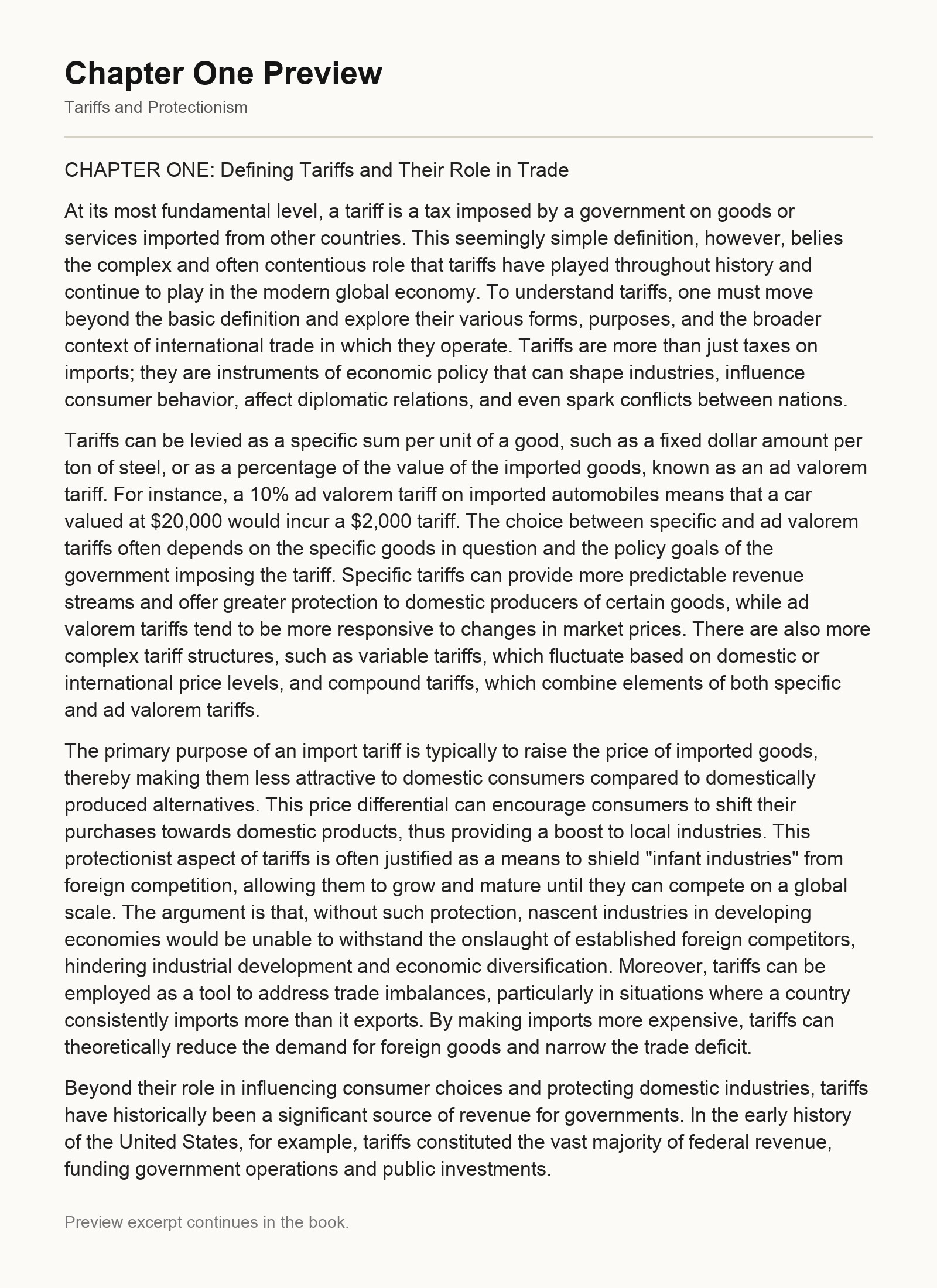
Tariffs and Protectionism: How Trade Barriers Shape Economies, Industries, and Global Markets offers readers a thorough grounding in one of the most consequential tools of international economic policy. By moving beyond simple definitions, the book unpacks the multiple forms tariffs can take—specific, ad valorem, variable, and compound—and explains how they function as revenue generators, protective shields for domestic sectors, and instruments of political leverage. Readers will come away with a clear mental model of how a tax on imported goods ripples through markets, influencing prices, consumer choices, producer incentives, and even diplomatic relations.
The narrative traces the evolution of tariff policy from ancient city‑state levies in Athens and Rome through the mercantilist eras of early modern Europe, the industrial‑policy experiments of Britain and the United States, and the seismic shocks of the Smoot‑Hawley Tariff during the Great Depression. Detailed chapters on Britain’s swing from protectionism to free trade and back again, and on America’s long‑standing reliance on tariffs to nurture infant industries and manage sectional conflicts, provide concrete historical illustrations that help readers see how economic ideas, political pressures, and global events have repeatedly reshaped trade barriers over centuries.
Economic analysis forms the core of the work, guiding readers through the theories that both support and challenge protectionism. Concepts such as infant industry arguments, deadweight loss, optimal tariffs, and the gains from comparative advantage are explained with reference to real‑world data, while sections on non‑tariff barriers, dumping, anti‑dumping duties, and the impact of tariffs on global value chains show how modern production networks complicate traditional predictions. The book also examines who bears the costs—highlighting the often‑regressive effect on low‑income consumers—and who benefits, from protected producers to governments seeking revenue.
Beyond economics, the text delves into the political economy that drives tariff decisions. Readers will learn how lobbying by steel, automobile, and agricultural interests, electoral cycles, and public opinion have repeatedly tilted policy toward protection, even when economic efficiency suffers. The role of the World Trade Organization in setting rules, resolving disputes, and attempting to curb unilateral actions is assessed, alongside the influence of regional agreements like NAFTA, the EU, and the Eurasian Economic Union. Chapters on trade wars, retaliation, and the ethical dimensions of tariffs encourage readers to weigh fairness, national interest, and global welfare when evaluating trade policy.
Ultimately, the book equips readers to interpret current events—from the U.S.–China trade tensions to pandemic‑era supply chain concerns—through a lens informed by history, theory, and institutional analysis. Whether you are a student of economics or international relations, a professional navigating global markets, a policymaker weighing trade options, or an engaged citizen curious about the forces shaping prices and jobs, this work provides the knowledge needed to understand not just what tariffs are, but how they have shaped—and will continue to shape—our interconnected world.
What You'll Find Inside:
- Comprehensive historical analysis of tariffs from ancient civilizations to modern trade policies, showing their evolution and impact on global economic development
- Balanced examination of economic arguments for and against protectionism, including infant industry theory, employment effects, and neoclassical critiques of market inefficiencies
- Analysis of how tariffs disrupt global value chains and modern trade practices, with case studies from major economies like the US, China, and emerging markets
- Exploration of the political economy of tariffs, including lobbying influences, electoral pressures, and how trade barriers can escalate into international trade wars
- Discussion of contemporary trade issues including WTO regulations, US-China trade tensions, and the future of tariffs in an era of economic nationalism and technological change
Who's It For:
This book is ideal for economics students, international trade professionals, policy makers, and researchers seeking a comprehensive understanding of trade barriers. It provides both theoretical foundations and practical insights into how tariffs shape economies, industries, and global markets, making valuable reading for anyone involved in or affected by international trade policy.
Table of Contents:
-
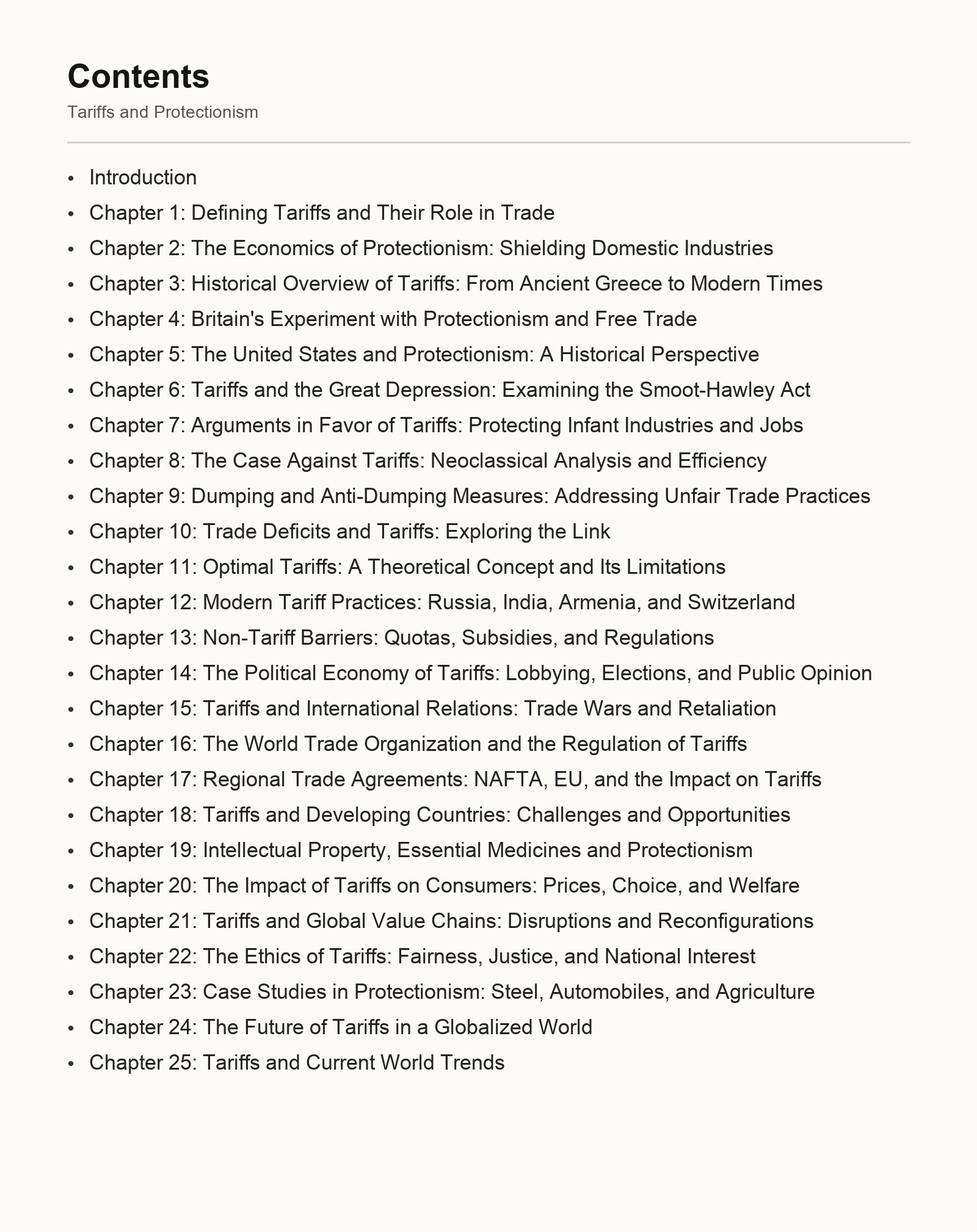
Introduction
-
Chapter 1: Defining Tariffs and Their Role in Trade
-
Chapter 2: The Economics of Protectionism: Shielding Domestic Industries
-
Chapter 3: Historical Overview of Tariffs: From Ancient Greece to Modern Times
-
Chapter 4: Britain's Experiment with Protectionism and Free Trade
-
Chapter 5: The United States and Protectionism: A Historical Perspective
-
Chapter 6: Tariffs and the Great Depression: Examining the Smoot-Hawley Act
-
Chapter 7: Arguments in Favor of Tariffs: Protecting Infant Industries and Jobs
-
Chapter 8: The Case Against Tariffs: Neoclassical Analysis and Efficiency
-
Chapter 9: Dumping and Anti-Dumping Measures: Addressing Unfair Trade Practices
-
Chapter 10: Trade Deficits and Tariffs: Exploring the Link
-
Chapter 11: Optimal Tariffs: A Theoretical Concept and Its Limitations
-
Chapter 12: Modern Tariff Practices: Russia, India, Armenia, and Switzerland
-
Chapter 13: Non-Tariff Barriers: Quotas, Subsidies, and Regulations
-
Chapter 14: The Political Economy of Tariffs: Lobbying, Elections, and Public Opinion
-
Chapter 15: Tariffs and International Relations: Trade Wars and Retaliation
-
Chapter 16: The World Trade Organization and the Regulation of Tariffs
-
Chapter 17: Regional Trade Agreements: NAFTA, EU, and the Impact on Tariffs
-
Chapter 18: Tariffs and Developing Countries: Challenges and Opportunities
-
Chapter 19: Intellectual Property, Essential Medicines and Protectionism
-
Chapter 20: The Impact of Tariffs on Consumers: Prices, Choice, and Welfare
-
Chapter 21: Tariffs and Global Value Chains: Disruptions and Reconfigurations
-
Chapter 22: The Ethics of Tariffs: Fairness, Justice, and National Interest
-
Chapter 23: Case Studies in Protectionism: Steel, Automobiles, and Agriculture
-
Chapter 24: The Future of Tariffs in a Globalized World
-
Chapter 25: Tariffs and Current World Trends
Author:
Published By:
Date Published:
May 16, 2026
Type:
Nonfiction
Language:
English
Also Available In:
Word Count:
54,247 words
Reading Time:
3 hours 48 minutes
Sample:
Order:
Buy the Tariffs and Protectionism ebook on MixCache.com:
Buy NowThe full ebook will be available immediately to read instantly on any device.
$5 account credit for all new MixCache.com accounts, usable toward any ebook purchase!*





Ratings & Reviews
Ask Questions About This Book
Have a question about the content? Ask our AI assistant!
Start by asking a question about "Tariffs and Protectionism"
Example: "Does this book mention William Shakespeare?"
Thinking...