Browse by Category
Fiction
- Action & Adventure
- African American
- Anthologies
- Children's Fiction
- Classics
- Comics & Graphic Novels
- Coming of Age
- Contemporary
- Cultural & Regional
- Drama
- Erotica
- Fantasy
- General
- Historical Fiction
- Horror
- Humor & Satire
- Literary Fiction
- Mystery, Thriller & Suspense
- Poetry
- Religious & Inspirational
- Romance
- Science Fiction
- Short Stories
- War & Military
- Westerns
- Women's Fiction
- Young Adult
Non-Fiction
- Antiques & Collectibles
- Arts & Photography
- Biographies & Memoirs
- Business & Money
- Children's Non-Fiction
-
Computers & Technology
- Artificial Intelligence
- Computer Science
- Cybersecurity & Cryptography
- Data Science & Analytics
- Databases & Big Data
- Game Development & Design
- General
- Hardware & DIY
- Mobile App Development
- Networking & Cloud Computing
- Operating Systems
- Programming
- Robotics
- Software
- Software Engineering
- User Experience (UX) & Design
- Web Development & Design
- Cooking, Food & Wine
- Crafts, Hobbies & Home
- Education & Teaching
- Engineering
- General
- Health, Fitness & Dieting
-
History
- African History
- African History - North Africa
- African History - Sub-Saharan Africa
- American History
- American History - 20th Century
- American History - Civil War
- American History - Colonial Period
- Ancient History
- Asian History
- Asian History - China
- Asian History - India
- Asian History - Japan
- Asian History - Southeast Asia
- European History
- European History - Ancient Greece
- European History - Ancient Rome
- European History - Medieval
- European History - Modern
- European History - Renaissance
- General
- Middle Eastern History
- Military History
- Military History - Aviation
- Military History - Naval
- Social & Cultural History
- World History
- Humor & Entertainment
- Industrial Technology
- Language Learning
- Law
- LGBTQ+ Non-Fiction
- Literary Criticism
- Medical Books
- Parenting & Relationships
- Philosophy
- Politics & Social Sciences
- Reference
- Religion & Spirituality
-
Science & Math
- Agricultural Sciences
- Astronomy & Space Science
- Behavioral Sciences
- Biological Sciences
- Botany & Plant Science
- Chemistry
- Earth Sciences
- Engineering - Chemical
- Engineering - Civil
- Engineering - Electrical
- Engineering - Mechanical
- Environment
- General
- Geology
- Mathematics
- Nature & Ecology
- Oceanography
- Paleontology
- Physics
- Statistics
- Self-Help
- Sports & Outdoors
- Study Aids
- Sustainability & Green Living
- Textbooks
- Transportation
- Travel
- True Crime
- Urban Planning & Development
- Veterinary Medicine
- Writing & Publishing
Jump to Section
MixCache.com Total Access
Unlimited reading and audiobooks for every book published by MixCache.com.
Included titles carry the MTA badge.
Learn more →
Science and State: Technological Innovation in China from the Song Dynasty to the Space Age
MTA
A history of inventions, scientific institutions, and state-sponsored research across eras
About this book:
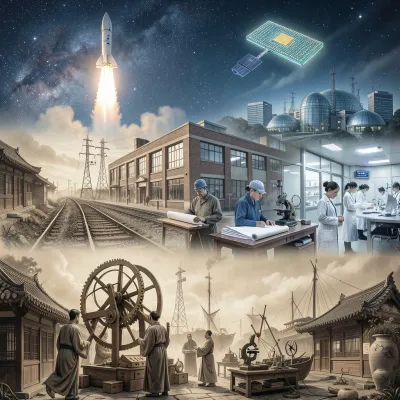
*Science and State* explores the millennium-long relationship between political governance and technological innovation in China, arguing that scientific advancement has consistently been driven by state priorities. From the Song dynasty’s bureaucratic management of salt, iron, and printing to the modern era’s focus on aerospace and artificial intelligence, the book traces how the Chinese state has organized research around the fundamental needs of border defense, fiscal stability, and social control. By examining four anchor domains—cartography, metallurgy, printing, and modern STEM—the narrative reveals a persistent pattern of "dual-use" development where civil infrastructure and military lethality are inextricably linked.
The historical trajectory is marked by periods of intense institutional learning and strategic adaptation. The Song established the blueprint for policy-driven innovation through its civil service and state monopolies, while the Yuan and Qing dynasties demonstrated a pragmatic ability to absorb foreign expertise, such as Islamic astronomy and Jesuit mathematics, to serve imperial sovereignty. The crises of the nineteenth century catalyzed the Self-Strengthening Movement, shifting the state's focus toward industrial arsenals and modern engineering academies. This evolution laid the groundwork for the twentieth century, where the Republic’s institutionalization of research and the People’s Republic’s adoption of the Soviet planning model culminated in the strategic breakthroughs of the "Two Bombs, One Satellite" era.
In the contemporary period, the book highlights how China has transitioned from imitative manufacturing to a leadership role in "big science" through targeted programs like 863 and 973. The current era is defined by the "Indigenous Innovation" strategy and "Civil-Military Fusion," reflecting a sophisticated effort to harmonize market dynamism with centralized strategic goals. By establishing domestic technical standards and building global technology platforms, the state seeks to ensure technological sovereignty in the digital age.
Ultimately, the book concludes that while tools have evolved from woodblocks and compasses to quantum computers and space stations, the underlying dynamic remains the same: science in China is a matter of governance. The state remains the central organizer of problems and the primary patron of solutions, maintaining a thousand-year tradition of mobilizing intellectual and material resources to project national power. This continuity suggests that China's current technological ambitions are not a departure from the past, but the latest chapter in a long history of state-led mastery over the material world.
What You'll Find Inside:
- How Chinese technological innovation has been systematically organized around state priorities like border defense, taxation, and governance across dynasties rather than as isolated inventions
- The four technical domains that structure the narrative: cartography, metallurgy, printing, and modern STEM fields as tools for rendering territory governable, underwriting coinage and armaments, multiplying texts, and enabling programmatic R&D
- How administrative systems (examination syllabi, standards, procurement rules, workshop regimes) functioned as crucial innovations that coordinated human effort at scale and either enabled or constrained technical progress
- The dual-use development of technologies where civil infrastructure like canals, surveys, and postal networks often generated capabilities later repurposed for defense, and wartime mobilization seeded peacetime industries
- Patterns of continuity and adaptation in state-directed innovation from Song dynasty fiscal-military metallurgy and paper money to twenty-first century civil-military fusion and indigenous innovation strategies
Who's It For:
This book is for readers interested in how societies organize knowledge production and technological innovation around state objectives. It will particularly appeal to those studying the relationship between scientific development and political power, industrial policy, research funding strategies, and the historical roots of contemporary debates about technological sovereignty and civil-military integration in China and beyond.
Table of Contents:
- Introduction
- Chapter 1 The Song Crucible: Bureaucracy, Markets, and the Birth of Policy-Driven Innovation
- Chapter 2 Shen Kuo, Su Song, and the State of Knowledge: Cartography, Clocks, and Cosmology
- Chapter 3 Paper, Press, and Policy: Printing, Examinations, and Information Control in the Song
- Chapter 4 Iron, Salt, and Steel: Fiscal-Military Metallurgy in the Song and Jin
- Chapter 5 Compass, Canal, and Gunpowder: Logistics and Lethality Across Frontiers
- Chapter 6 Mongol Unification and Trans-Eurasian Science: The Yuan as Technology Broker
- Chapter 7 Mapping the Realm: Ming Surveys, Coastal Defense, and Maritime Ambition
- Chapter 8 Workshops of Empire: The Board of Works, Artisan Bureaus, and Standardization
- Chapter 9 Firearms and Fortresses: Metallurgy from Bombards to Breechloaders
- Chapter 10 Jesuits at Court: Calendar Reform, Mathematics, and the Politics of Precision
- Chapter 11 The Kangxi and Qianlong Atlases: Cartography as Sovereignty
- Chapter 12 Craft and Command: Imperial Workshops from Porcelain to Iron
- Chapter 13 Crisis and Reform: Opium Wars and the Self-Strengthening Movement
- Chapter 14 Arsenals and Academies: Jiangnan, Fuzhou, and the Birth of Modern Engineering
- Chapter 15 From Empire to Republic: Academia Sinica and the Institutionalization of Research
- Chapter 16 War, Relocation, and Resilience: Laboratories on the Move, 1937–1945
- Chapter 17 Designing a Socialist R&D System: The Soviet Blueprint and the 156 Projects
- Chapter 18 Two Bombs, One Satellite: Security, Secrecy, and Big Science in the Mao Era
- Chapter 19 Disruption and Continuity: Science Through the Cultural Revolution
- Chapter 20 Reform and Opening: Markets, Ministries, and the Return of the University
- Chapter 21 Programs 863 and 973: Planning Innovation in a Hybrid Economy
- Chapter 22 Indigenous Innovation: Standards, Patents, and the Politics of Platforms
- Chapter 23 Space Age, Chinese Style: From Shenzhou to Tiangong
- Chapter 24 Civil–Military Fusion: Dual-Use Technologies in the Twenty-First Century
- Chapter 25 Maps, Metals, and Machines Revisited: Continuities into the Digital Age
Author:
Published By:
Date Published:
May 15, 2026
Type:
Nonfiction
Language:
English
Word Count:
68,340 words
Reading Time:
4 hours 47 minutes
Sample:
Order:
Order Science and State: Technological Innovation in China from the Song Dynasty to the Space Age (Hardcover) on MixCache.com:
Buy NowPrint copy is made to order and ships worldwide. Includes the ebook free, ready to read instantly.
$5 account credit for all new MixCache.com accounts, usable toward any ebook purchase!*