Browse by Category
Fiction
- Action & Adventure
- African American
- Anthologies
- Children's Fiction
- Classics
- Comics & Graphic Novels
- Coming of Age
- Contemporary
- Cultural & Regional
- Drama
- Erotica
- Fantasy
- General
- Historical Fiction
- Horror
- Humor & Satire
- Literary Fiction
- Mystery, Thriller & Suspense
- Poetry
- Religious & Inspirational
- Romance
- Science Fiction
- Short Stories
- War & Military
- Westerns
- Women's Fiction
- Young Adult
Non-Fiction
- Antiques & Collectibles
- Arts & Photography
- Biographies & Memoirs
- Business & Money
- Children's Non-Fiction
-
Computers & Technology
- Artificial Intelligence
- Computer Science
- Cybersecurity & Cryptography
- Data Science & Analytics
- Databases & Big Data
- Game Development & Design
- General
- Hardware & DIY
- Mobile App Development
- Networking & Cloud Computing
- Operating Systems
- Programming
- Robotics
- Software
- Software Engineering
- User Experience (UX) & Design
- Web Development & Design
- Cooking, Food & Wine
- Crafts, Hobbies & Home
- Education & Teaching
- Engineering
- General
- Health, Fitness & Dieting
-
History
- African History
- African History - North Africa
- African History - Sub-Saharan Africa
- American History
- American History - 20th Century
- American History - Civil War
- American History - Colonial Period
- Ancient History
- Asian History
- Asian History - China
- Asian History - India
- Asian History - Japan
- Asian History - Southeast Asia
- European History
- European History - Ancient Greece
- European History - Ancient Rome
- European History - Medieval
- European History - Modern
- European History - Renaissance
- General
- Middle Eastern History
- Military History
- Military History - Aviation
- Military History - Naval
- Social & Cultural History
- World History
- Humor & Entertainment
- Industrial Technology
- Language Learning
- Law
- LGBTQ+ Non-Fiction
- Literary Criticism
- Medical Books
- Parenting & Relationships
- Philosophy
- Politics & Social Sciences
- Reference
- Religion & Spirituality
-
Science & Math
- Agricultural Sciences
- Astronomy & Space Science
- Behavioral Sciences
- Biological Sciences
- Botany & Plant Science
- Chemistry
- Earth Sciences
- Engineering - Chemical
- Engineering - Civil
- Engineering - Electrical
- Engineering - Mechanical
- Environment
- General
- Geology
- Mathematics
- Nature & Ecology
- Oceanography
- Paleontology
- Physics
- Statistics
- Self-Help
- Sports & Outdoors
- Study Aids
- Sustainability & Green Living
- Textbooks
- Transportation
- Travel
- True Crime
- Urban Planning & Development
- Veterinary Medicine
- Writing & Publishing
Jump to Section
MixCache.com Total Access
Unlimited reading and audiobooks for every book published by MixCache.com.
Included titles carry the MTA badge.
Learn more →
Modern Memory: How Europe Remembers its Past
MTA
An inquiry into monuments, museums, and contested commemorations across Europe
About this book:
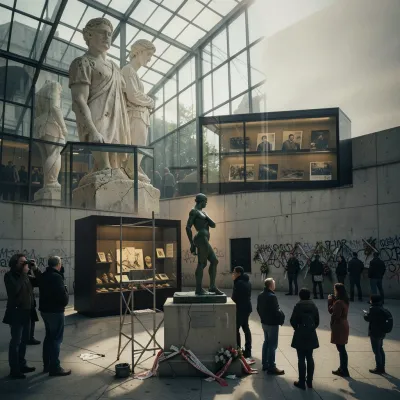
This book provides an extensive inquiry into how the material landscape of Europe—its monuments, museums, and streetscapes—functions as a contested terrain for collective memory and political identity. The author establishes that remembrance is never a neutral act of historical recording but a deliberate, ongoing negotiation shaped by those in power. By examining "memoryscapes," the text explores how physical objects like the Arc de Triomphe or the Stolpersteine translate complex, often traumatic histories into public narratives that either bolster national pride or force uncomfortable reckonings with perpetration and loss.
A significant portion of the book focuses on the evolution of Holocaust memorialization and the shift from triumphant national myths to "counter-monuments" that emphasize absence and self-reflection. The narrative traces the transition in countries like Germany and France, where decades of "organized forgetting" eventually gave way to institutionalized "coming to terms with the past." It highlights how sites like Auschwitz have transitioned from nationalistic shrines of martyrdom to global "sites of conscience" that connect the horrors of the 20th century to contemporary human rights education and civic responsibility.
The book also delves into the "monument wars" currently reshaping Western Europe, specifically regarding the legacies of colonialism and the slave trade. In nations like Belgium, the Netherlands, and the United Kingdom, the uncritical celebration of imperial figures is being challenged by descendant communities and activists. These debates over the removal or recontextualization of statues reveal deep-seated tensions between traditional national identities and a more inclusive, multivocal understanding of history. The author argues that these controversies are signs of democratic vitality rather than mere historical erasure.
Ultimately, the text advocates for a "shared but plural" European memory. It acknowledges the "memory asymmetries" between Eastern and Western Europe—particularly the competing focus on the Holocaust versus Soviet-era totalitarianism—and suggests that a unified European identity cannot be imposed from the top down. Instead, the book concludes that a resilient European memory culture must accommodate multiple, sometimes conflicting stories, ensuring that marginalized voices are heard while maintaining a common moral commitment to the lessons of past atrocities.
What You'll Find Inside:
- How European memoryscapes reveal power dynamics through what is remembered, forgotten, and contested in public spaces, from monuments to street names
- The evolution of Holocaust memorialization from national monuments to decentralized practices like Stolpersteine that insert memory into everyday urban life
- How former colonial powers across Europe are confronting imperial legacies through monument debates, museum reforms, and educational changes
- The critical role of education in transmitting difficult histories and shaping future generations' understanding of national pasts and responsibilities
- Europe's ongoing effort to create a shared but plural memory that acknowledges diverse national traumas while fostering common democratic values
Who's It For:
This book is ideal for students and scholars of European history, memory studies, museum studies, and transitional justice, as well as professionals working in heritage institutions, education, and policymaking who seek to understand how societies construct and contest memories of difficult pasts. It will also appeal to general readers interested in how monuments, museums, and commemorative practices shape national identity and collective memory across Europe.
Table of Contents:
- Introduction
- Chapter 1 Memoryscapes: Concepts and Contours
- Chapter 2 The Politics of Commemoration
- Chapter 3 Museums as Memory Machines
- Chapter 4 Monuments, Counter-monuments, and Absence
- Chapter 5 National Narratives and the Uses of History
- Chapter 6 Education and the Pedagogies of the Past
- Chapter 7 Transitional Justice and Remembering Wrongdoing
- Chapter 8 Holocaust Memorialization: Landscapes of Loss
- Chapter 9 Stolpersteine and the Intimacy of Remembrance
- Chapter 10 Auschwitz, Sites of Conscience, and Global Memory
- Chapter 11 Postwar Germany: Vergangenheitsbewältigung Revisited
- Chapter 12 France: From Resistance Myth to Multivocal Memory
- Chapter 13 Spain: Civil War Graves and the Valley of the Fallen
- Chapter 14 Italy: Fascist Ruins and the Politics of Reuse
- Chapter 15 Poland and the Politics of History Laws
- Chapter 16 The Baltics: Occupation Museums and Competing Traumas
- Chapter 17 The Balkans: Remembering War and Seeking Justice
- Chapter 18 The United Kingdom: Empire, Statues, and Street Debates
- Chapter 19 Belgium: Congo Legacies and Royal Memory
- Chapter 20 The Netherlands: Slavery, Trade, and Maritime Memory
- Chapter 21 Portugal: Discoveries, Dictatorship, and Decolonization
- Chapter 22 Monuments of Empire: Contestation and Removal
- Chapter 23 Local Memory Work: Town Squares, Plaques, and Rituals
- Chapter 24 Digital Memory: Archives, Algorithms, and Activism
- Chapter 25 Toward a Shared but Plural European Memory
Author:
Published By:
Date Published:
May 15, 2026
Type:
Nonfiction
Language:
English
Word Count:
81,672 words
Reading Time:
5 hours 43 minutes
Sample:
Order:
Order Modern Memory: How Europe Remembers its Past (Hardcover) on MixCache.com:
Buy NowPrint copy is made to order and ships worldwide. Includes the ebook free, ready to read instantly.
$5 account credit for all new MixCache.com accounts, usable toward any ebook purchase!*