Browse by Category
Fiction
- Action & Adventure
- African American
- Anthologies
- Children's Fiction
- Classics
- Comics & Graphic Novels
- Coming of Age
- Contemporary
- Cultural & Regional
- Drama
- Erotica
- Fantasy
- General
- Historical Fiction
- Horror
- Humor & Satire
- Literary Fiction
- Mystery, Thriller & Suspense
- Poetry
- Religious & Inspirational
- Romance
- Science Fiction
- Short Stories
- War & Military
- Westerns
- Women's Fiction
- Young Adult
Non-Fiction
- Antiques & Collectibles
- Arts & Photography
- Biographies & Memoirs
- Business & Money
- Children's Non-Fiction
-
Computers & Technology
- Artificial Intelligence
- Computer Science
- Cybersecurity & Cryptography
- Data Science & Analytics
- Databases & Big Data
- Game Development & Design
- General
- Hardware & DIY
- Mobile App Development
- Networking & Cloud Computing
- Operating Systems
- Programming
- Robotics
- Software
- Software Engineering
- User Experience (UX) & Design
- Web Development & Design
- Cooking, Food & Wine
- Crafts, Hobbies & Home
- Education & Teaching
- Engineering
- General
- Health, Fitness & Dieting
-
History
- African History
- African History - North Africa
- African History - Sub-Saharan Africa
- American History
- American History - 20th Century
- American History - Civil War
- American History - Colonial Period
- Ancient History
- Asian History
- Asian History - China
- Asian History - India
- Asian History - Japan
- Asian History - Southeast Asia
- European History
- European History - Ancient Greece
- European History - Ancient Rome
- European History - Medieval
- European History - Modern
- European History - Renaissance
- General
- Middle Eastern History
- Military History
- Military History - Aviation
- Military History - Naval
- Social & Cultural History
- World History
- Humor & Entertainment
- Industrial Technology
- Language Learning
- Law
- LGBTQ+ Non-Fiction
- Literary Criticism
- Medical Books
- Parenting & Relationships
- Philosophy
- Politics & Social Sciences
- Reference
- Religion & Spirituality
-
Science & Math
- Agricultural Sciences
- Astronomy & Space Science
- Behavioral Sciences
- Biological Sciences
- Botany & Plant Science
- Chemistry
- Earth Sciences
- Engineering - Chemical
- Engineering - Civil
- Engineering - Electrical
- Engineering - Mechanical
- Environment
- General
- Geology
- Mathematics
- Nature & Ecology
- Oceanography
- Paleontology
- Physics
- Statistics
- Self-Help
- Sports & Outdoors
- Study Aids
- Sustainability & Green Living
- Textbooks
- Transportation
- Travel
- True Crime
- Urban Planning & Development
- Veterinary Medicine
- Writing & Publishing
Jump to Section
MixCache.com Total Access
Unlimited reading and audiobooks for every book published by MixCache.com.
Included titles carry the MTA badge.
Learn more →
Logistics Wins Wars: Supply Chains, Transportation, and Sustaining Combat Power
MTA
Practical Lessons from Historical Campaigns on Feeding, Fueling, and Moving Armies
About this book:
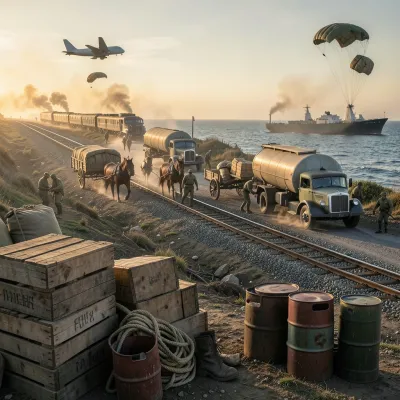
*Logistics Wins Wars* provides a comprehensive historical and practical analysis of how supply chains, transportation, and sustainment determine the outcome of military conflicts. The book argues that while strategy and tactics provide the design for battle, logistics dictates the limits of the possible. By examining the "mathematics of movement"—the relentless arithmetic of distance, consumption, and lift capacity—the author demonstrates that even the most brilliant maneuvers inevitably fail if the "engine" of the army lacks fuel, food, ammunition, and maintenance.
Through a series of detailed case studies ranging from the Roman Empire to the Yom Kippur War, the text illustrates recurring patterns of logistical success and failure. Highlights include Napoleon’s disastrous Russian campaign, where ambition outran supply; the American Civil War’s revolutionary use of rail and river networks; and the industrial-scale attrition of World War I. The book also explores specialized domains such as strategic sealift in the Pacific, the innovative "air bridge" of the Berlin Airlift, and the high-stakes mobilization of national industry during total war.
The latter portion of the book addresses the complexities of modern "joint logistics" in a contested world. It examines the shift from the relatively permissive environments of the Gulf War to the extreme challenges of the post-9/11 era, where asymmetric threats like IEDs and sophisticated anti-access/area denial (A2/AD) strategies target the supply chain directly. The author emphasizes that modern resilience depends on information advantage, "total asset visibility," and the integration of civilian contractors and commercial capacity into military operations.
Ultimately, the book serves as a practitioner's guide to preserving combat power. It concludes that the most successful commanders are those who treat logistics not as a secondary concern, but as a primary strategic lever. In an era of cyber threats, precision-guided munitions, and global reach, the ability to protect and adapt the supply chain remains the decisive factor in converting national resource potential into persistent, winning force on the battlefield.
What You'll Find Inside:
- How logistics determines war outcomes more than battlefield brilliance - proven through historical case studies from ancient Rome to modern conflicts
- The mathematical foundations of military movement: distance, capacity, time consumption, and the compounding effects that break overextended forces
- Practical frameworks for estimating supply needs, designing resilient supply chains, and balancing speed with sustainability in operations
- Evolution of military logistics across energy transitions (forage to JP-8), ammunition systems, and technological innovations like aerial resupply and digital tracking
- Modern challenges of contested logistics including cyber threats, A2/AD strategies, and the need for dispersed, resilient supply networks
Who's It For:
This book is essential for military planners, logisticians, and defense professionals who need to understand how supply chains shape operational success. It also serves historians and students of military science seeking to analyze campaigns through a logistics lens, as well as industry partners involved in defense contracting who must align their offerings with real-world sustainment requirements. Staff officers will find practical tools for stress testing campaign plans, while strategists will gain insight into how logistical constraints shape the art of the possible in modern warfare.
Table of Contents:
- Introduction
- Chapter 1 Why Logistics Wins Wars
- Chapter 2 The Mathematics of Movement: Distance, Capacity, and Time
- Chapter 3 Feeding the Fight: Rations, Water, and Health
- Chapter 4 Fueling Armies: Energy Transitions from Forage to JP-8
- Chapter 5 Ammunition and the Weight of Firepower
- Chapter 6 Maintenance and Medical: Preserving Combat Power
- Chapter 7 Lines of Communication: Roads, Rails, Rivers, and Pipelines
- Chapter 8 Sea Power and Strategic Sealift
- Chapter 9 Airlift, Airdrop, and the Art of Aerial Resupply
- Chapter 10 Prepositioning, Stockpiles, and War Reserve Management
- Chapter 11 Mobilization: Turning Industry and Society into Force
- Chapter 12 Theater Sustainment: From Port Opening to the Last Tactical Mile
- Chapter 13 Contracting, Civ-Mil Collaboration, and the Market on the Battlefield
- Chapter 14 Information Advantage: Visibility, Forecasting, and C2 of Logistics
- Chapter 15 Attacking and Protecting Logistics: Denial, Deception, and Resilience
- Chapter 16 Case Study: Rome’s Road Network and the Logistics of Empire
- Chapter 17 Case Study: Napoleon in Russia—Ambition Outrunning Supply
- Chapter 18 Case Study: Rails, Rivers, and the American Civil War
- Chapter 19 Case Study: World War I—Industrial Scale and the Logistics of Attrition
- Chapter 20 Case Study: North Africa—Ports, Deserts, and Competing Supply Lines
- Chapter 21 Case Study: The Eastern Front—Distance, Weather, and Failure to Sustain
- Chapter 22 Case Study: The Pacific War—Island Hopping and Naval Logistics
- Chapter 23 Case Study: The Berlin Airlift—Building an Air Bridge
- Chapter 24 Case Study: The Yom Kippur War—Mobilization, Resupply, and Adaptation
- Chapter 25 From Desert Storm to the Present: Joint Logistics in a Contested World
Author:
Published By:
Date Published:
May 13, 2026
Type:
Nonfiction
Language:
English
Word Count:
81,394 words
Reading Time:
5 hours 42 minutes
Sample:
Order:
Order Logistics Wins Wars: Supply Chains, Transportation, and Sustaining Combat Power (Hardcover) on MixCache.com:
Buy NowPrint copy is made to order and ships worldwide. Includes the ebook free, ready to read instantly.
$5 account credit for all new MixCache.com accounts, usable toward any ebook purchase!*