Browse by Category
Fiction
- Action & Adventure
- African American
- Anthologies
- Children's Fiction
- Classics
- Comics & Graphic Novels
- Coming of Age
- Contemporary
- Cultural & Regional
- Drama
- Erotica
- Fantasy
- General
- Historical Fiction
- Horror
- Humor & Satire
- Literary Fiction
- Mystery, Thriller & Suspense
- Poetry
- Religious & Inspirational
- Romance
- Science Fiction
- Short Stories
- War & Military
- Westerns
- Women's Fiction
- Young Adult
Non-Fiction
- Antiques & Collectibles
- Arts & Photography
- Biographies & Memoirs
- Business & Money
- Children's Non-Fiction
-
Computers & Technology
- Artificial Intelligence
- Computer Science
- Cybersecurity & Cryptography
- Data Science & Analytics
- Databases & Big Data
- Game Development & Design
- General
- Hardware & DIY
- Mobile App Development
- Networking & Cloud Computing
- Operating Systems
- Programming
- Robotics
- Software
- Software Engineering
- User Experience (UX) & Design
- Web Development & Design
- Cooking, Food & Wine
- Crafts, Hobbies & Home
- Education & Teaching
- Engineering
- General
- Health, Fitness & Dieting
-
History
- African History
- African History - North Africa
- African History - Sub-Saharan Africa
- American History
- American History - 20th Century
- American History - Civil War
- American History - Colonial Period
- Ancient History
- Asian History
- Asian History - China
- Asian History - India
- Asian History - Japan
- Asian History - Southeast Asia
- European History
- European History - Ancient Greece
- European History - Ancient Rome
- European History - Medieval
- European History - Modern
- European History - Renaissance
- General
- Middle Eastern History
- Military History
- Military History - Aviation
- Military History - Naval
- Social & Cultural History
- World History
- Humor & Entertainment
- Industrial Technology
- Language Learning
- Law
- LGBTQ+ Non-Fiction
- Literary Criticism
- Medical Books
- Parenting & Relationships
- Philosophy
- Politics & Social Sciences
- Reference
- Religion & Spirituality
-
Science & Math
- Agricultural Sciences
- Astronomy & Space Science
- Behavioral Sciences
- Biological Sciences
- Botany & Plant Science
- Chemistry
- Earth Sciences
- Engineering - Chemical
- Engineering - Civil
- Engineering - Electrical
- Engineering - Mechanical
- Environment
- General
- Geology
- Mathematics
- Nature & Ecology
- Oceanography
- Paleontology
- Physics
- Statistics
- Self-Help
- Sports & Outdoors
- Study Aids
- Sustainability & Green Living
- Textbooks
- Transportation
- Travel
- True Crime
- Urban Planning & Development
- Veterinary Medicine
- Writing & Publishing
Jump to Section
MixCache.com Total Access
Unlimited reading and audiobooks for every book published by MixCache.com.
Included titles carry the MTA badge.
Learn more →
Medicine on the Battlefield: Trauma Care, Epidemics, and Military Medicine
MTA
Evolution of Treatment, Triage, and Public Health in Wartime
About this book:
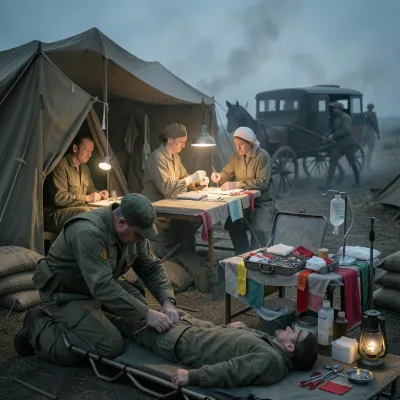
"Medicine on the Battlefield" chronicles the evolution of military medical practices from ancient times to the present day, emphasizing how wartime necessities have consistently driven medical innovation. The book begins by examining rudimentary wound care in ancient civilizations, noting early observations on hemorrhage and infection, and progresses through classical Greek and Roman medicine, highlighting the Hippocratic corpus's pragmatic approach and the Romans' pioneering establishment of military hospitals (valetudinaria). The medieval period, often perceived as a medical dark age, is reframed as a time of preservation and selective advancement, particularly in the Islamic world's sophisticated bimaristans and surgical texts.
A significant turning point arrived with the "Gunpowder Revolution," which introduced devastating new wound patterns that challenged traditional cautery-based treatments. This led to Ambroise Paré's revolutionary advocacy for gentle wound care and ligature over cautery in the 16th century, marking a renaissance in surgical philosophy. The Age of Sail further expanded military medicine's scope, confronting diseases like scurvy and malaria, with James Lind's clinical trial for scurvy prevention standing out as an early triumph of evidence-based medicine. The Napoleonic Wars then propelled advancements in rapid evacuation and triage under Dominique Jean Larrey, whose "flying ambulances" laid the groundwork for modern emergency medical services.
The 19th century witnessed transformative breakthroughs: the widespread adoption of anesthesia, dramatically reducing surgical pain and enabling more complex procedures, and Joseph Lister's introduction of antiseptic surgery, which finally began to curb the rampant infections that had plagued military hospitals for millennia. These innovations were critically tested in the American Civil War, leading to organized hospital systems, dedicated ambulance corps under Jonathan Letterman, and the formal emergence of military nursing. The horrors of World War I, with its industrialized casualties and trench warfare, forced the creation of a sophisticated, multi-tiered evacuation chain and spurred innovations in plastic surgery and orthopedic care. The 1918 influenza pandemic, riding on the back of wartime mobilization, tragically highlighted the inseparable link between military health and global public health.
World War II marked another paradigm shift with the widespread availability of blood transfusions and penicillin, fundamentally altering survival rates for severe trauma and infection. This was further refined in the Korean War with the advent of Mobile Army Surgical Hospitals (MASH) and systematic helicopter evacuation, drastically reducing time from injury to definitive care. The Vietnam War continued to push these boundaries, refining rapid aeromedical evacuation and confronting complex tropical diseases and the unique trauma of improvised explosive devices (IEDs). Concurrently, the post-WWII era saw the formalization of international humanitarian law, particularly the Geneva Conventions, emphasizing the protection of combatants and civilians, and the rise of NGOs like Médecins Sans Frontières, challenging the traditional neutrality of medical aid.
The conflicts in Iraq and Afghanistan epitomized the challenges of asymmetric warfare and IED trauma, driving the formalization of Tactical Combat Casualty Care (TCCC), the re-adoption of tourniquets, and unprecedented advances in rehabilitation and prosthetics, including microprocessor-controlled limbs and neural interfaces. This period also saw significant focus on "invisible wounds" like Post-Traumatic Stress Disorder (PTSD) and moral injury. Crucially, the late 20th and early 21st centuries saw a revolution in information management, with large-scale trauma registries, telemedicine, and the emergence of AI transforming data collection, analysis, and clinical decision-making, creating a continuous feedback loop from battlefield experience to improved protocols. The book concludes by looking at future frontiers: the impact of climate change on operational environments and disease patterns, the medical challenges of space exploration, and the ever-evolving ethical dilemmas posed by advanced technology and the blurring lines between military and civilian health.
What You'll Find Inside:
- The evolution of battlefield medicine from ancient wound care to modern trauma systems, demonstrating how military innovations often reshape civilian medical practices
- The development and impact of triage and evacuation systems, from Larrey's flying ambulances to helicopter MEDEVAC and emerging drone technology
- How epidemics and disease have historically caused more military casualties than combat, driving public health innovations that later benefited civilian populations
- Advances in surgical techniques, anesthesia, antisepsis, and antibiotics that dramatically improved survival rates from battlefield injuries across centuries
- The growing recognition and treatment of psychological and moral injury (PTSD, TBI, moral injury) as critical components of contemporary military medicine
Who's It For:
This book is essential reading for military medical personnel, medical historians, public health officials, and policymakers interested in the evolution of warfare medicine. It will particularly benefit trauma surgeons, emergency medicine specialists, and veterans affairs professionals seeking to understand how battlefield innovations translate to civilian care. Students of military strategy and those interested in the ethical dimensions of wartime medicine will also find valuable insights throughout the text.
Table of Contents:
- Introduction
- Chapter 1 Origins: Healers in Ancient Warfare
- Chapter 2 From Hippocrates to Galen: Classical Doctrines and Battlefield Care
- Chapter 3 Siegecraft and Surgery: Medicine in the Medieval Age
- Chapter 4 The Gunpowder Revolution: Amputations, Cautery, and Innovation
- Chapter 5 Ambroise Paré and the Renaissance of Surgery
- Chapter 6 Empires at Sea: Naval Medicine, Scurvy, and Malaria Control
- Chapter 7 Napoleonic Lessons: Larrey, Flying Ambulances, and Modern Triage
- Chapter 8 Anesthesia and Antisepsis: The Operative Turn
- Chapter 9 The American Civil War: Hospitals, Evacuation, and Nursing
- Chapter 10 World War I: Industrialized Casualties and Systems of Care
- Chapter 11 Pandemic in Uniform: The 1918 Influenza and Military Mobilization
- Chapter 12 World War II: Blood, Antibiotics, and Mass Casualty Management
- Chapter 13 Korea and the Cold War: MASH Units and Helicopter Evacuation
- Chapter 14 Vietnam: Trauma, Tropical Disease, and Public Opinion
- Chapter 15 Decolonization and Laws of War: Protecting Combatants and Civilians
- Chapter 16 CBRN Medicine: Chemical, Biological, Radiological, and Nuclear Threats
- Chapter 17 Counterinsurgency and Urban Warfare: Iraq and Afghanistan
- Chapter 18 Telemedicine, Robotics, and Drones at the Point of Injury
- Chapter 19 Psychological and Moral Injury: Psychiatry, Stigma, and Resilience
- Chapter 20 Rehabilitation and Prosthetics: Restoring Function and Dignity
- Chapter 21 Civil–Military Health: NGOs, Public Health, and Stabilization
- Chapter 22 Logistics and Lifelines: Supply Chains, Blood, and Field Laboratories
- Chapter 23 Training and Simulation: Readiness, Human Factors, and Decision-Making
- Chapter 24 Data, AI, and Trauma Systems: From Battlefield to Registry
- Chapter 25 Future Frontiers: Climate, Space, and the Ethics of Care
Author:
Published By:
Date Published:
May 12, 2026
Type:
Nonfiction
Language:
English
Word Count:
72,595 words
Reading Time:
5 hours 5 minutes
Sample:
Order:
Order Medicine on the Battlefield: Trauma Care, Epidemics, and Military Medicine (Paperback) on MixCache.com:
Buy NowPrint copy is made to order and ships worldwide. Includes the ebook free, ready to read instantly.
$5 account credit for all new MixCache.com accounts, usable toward any ebook purchase!*