
Browse by Category
Fiction
- Action & Adventure
- African American
- Anthologies
- Children's Fiction
- Classics
- Comics & Graphic Novels
- Coming of Age
- Contemporary
- Cultural & Regional
- Drama
- Erotica
- Fantasy
- General
- Historical Fiction
- Horror
- Humor & Satire
- Literary Fiction
- Mystery, Thriller & Suspense
- Poetry
- Religious & Inspirational
- Romance
- Science Fiction
- Short Stories
- War & Military
- Westerns
- Women's Fiction
- Young Adult
Non-Fiction
- Antiques & Collectibles
- Arts & Photography
- Biographies & Memoirs
- Business & Money
- Children's Non-Fiction
-
Computers & Technology
- Artificial Intelligence
- Computer Science
- Cybersecurity & Cryptography
- Data Science & Analytics
- Databases & Big Data
- Game Development & Design
- General
- Hardware & DIY
- Mobile App Development
- Networking & Cloud Computing
- Operating Systems
- Programming
- Robotics
- Software
- Software Engineering
- User Experience (UX) & Design
- Web Development & Design
- Cooking, Food & Wine
- Crafts, Hobbies & Home
- Education & Teaching
- Engineering
- General
- Health, Fitness & Dieting
-
History
- African History
- African History - North Africa
- African History - Sub-Saharan Africa
- American History
- American History - 20th Century
- American History - Civil War
- American History - Colonial Period
- Ancient History
- Asian History
- Asian History - China
- Asian History - India
- Asian History - Japan
- Asian History - Southeast Asia
- European History
- European History - Ancient Greece
- European History - Ancient Rome
- European History - Medieval
- European History - Modern
- European History - Renaissance
- General
- Middle Eastern History
- Military History
- Military History - Aviation
- Military History - Naval
- Social & Cultural History
- World History
- Humor & Entertainment
- Industrial Technology
- Language Learning
- Law
- LGBTQ+ Non-Fiction
- Literary Criticism
- Medical Books
- Parenting & Relationships
- Philosophy
- Politics & Social Sciences
- Reference
- Religion & Spirituality
-
Science & Math
- Agricultural Sciences
- Astronomy & Space Science
- Behavioral Sciences
- Biological Sciences
- Botany & Plant Science
- Chemistry
- Earth Sciences
- Engineering - Chemical
- Engineering - Civil
- Engineering - Electrical
- Engineering - Mechanical
- Environment
- General
- Geology
- Mathematics
- Nature & Ecology
- Oceanography
- Paleontology
- Physics
- Statistics
- Self-Help
- Sports & Outdoors
- Study Aids
- Sustainability & Green Living
- Textbooks
- Transportation
- Travel
- True Crime
- Urban Planning & Development
- Veterinary Medicine
- Writing & Publishing
Jump to Section
MixCache.com Total Access
Unlimited reading and audiobooks for every book published by MixCache.com.
Included titles carry the MTA badge.
Learn more →
Blitzkrieg to Total War: Mechanized Warfare in World War II
MTA
Armored Doctrine, Airpower Integration, and Combined Arms Operations
About this book:
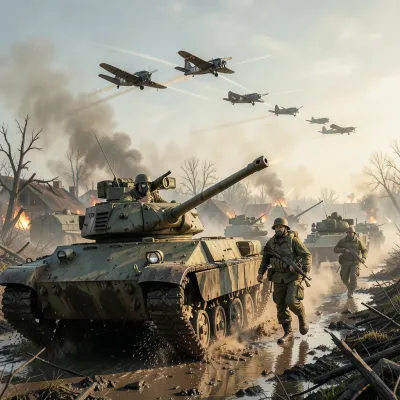
"Blitzkrieg to Total War: Mechanized Warfare in World War II" meticulously chronicles the evolution and application of mechanized warfare from its interwar theoretical roots to its decisive role in World War II. The book begins by detailing the intellectual ferment of the 1920s and 1930s, highlighting figures like Fuller, Liddell Hart, Guderian, and Tukhachevsky, who envisioned tanks, motorized infantry, and aircraft as central to future conflicts. It examines how Germany forged its formidable Panzerwaffe, emphasizing integrated training, robust radio communications, and the *Auftragstaktik* (mission command) philosophy, which contrasted sharply with the more conservative, infantry-centric armored doctrines of France, Britain, and the early Soviet Union. This foundational period also covers the nascent integration of close air support, an often-contested role for air forces initially focused on strategic bombing.
The narrative then transitions into operational case studies, illustrating how these doctrines were tested and adapted across diverse theaters. Campaigns like Poland (1939) and France (1940) showcased the devastating effectiveness of the German blitzkrieg, characterized by rapid armored thrusts and coordinated air-ground attacks that shattered conventional defenses. The Balkans and Crete (1941) highlighted the adaptability of mechanized forces in difficult terrain and the critical, though costly, potential of large-scale airborne operations. North Africa (1940-1943) became a crucible for mobile desert warfare, underscoring the paramount importance of logistics and air superiority in vast, open environments, and demonstrating the Allies' painful but transformative learning curve at engagements like Kasserine Pass.
The book delves into the Eastern Front, revealing the colossal scale and brutal attrition that challenged the very limits of mechanized warfare. Operation Barbarossa (1941) saw initial German breakthroughs devolve into overextension against vast distances, a harsh climate, and a resilient, adapting Soviet adversary. The ensuing winter battles around Moscow (1941-1942) exposed blitzkrieg's limitations, while the pivotal Battle of Stalingrad (1942-1943) demonstrated the inherent weaknesses of armor in urban combat and the Soviets' re-emergence with sophisticated deep operations. Kursk (1943) marked the climax of armored collision, where Soviet deep defensive belts and overwhelming numbers, combined with superior intelligence, blunted the German offensive and solidified the Red Army's strategic initiative.
Later chapters focus on the Western Allied maturation in Italy (1943-1945), a grinding campaign that emphasized firepower, engineering, and combined arms in mountainous terrain, and Normandy (1944), where Allied air superiority and tactical innovation overcame the restrictive *bocage* to achieve a decisive breakout. The daring but flawed Operation Market Garden (1944) highlighted the critical role of logistics and accurate intelligence, while the desperate German Ardennes counteroffensive (1944-1945) showcased the limits of mechanized surprise against an adaptive, air-superior foe. The Soviet "Red Storm" offensives of 1944-1945—culminating in the drive to Berlin—represented the full realization of Soviet deep operations, combining mass, doctrinal sophistication, and industrial might. Finally, the Pacific War details a unique form of mechanized warfare, integrating armor with amphibious assault, naval fire support, and carrier aviation in restrictive island environments.
The book concludes by drawing enduring lessons from these diverse experiences. It emphasizes that no single tank was inherently superior; rather, success hinged on a holistic system encompassing doctrine, industrial capacity, logistics, crew training, and effective command, control, and communications (C3). Reliability and maintainability often outweighed raw technological specifications, and the ability to sustain operations over vast distances proved as critical as tactical brilliance. The interplay of intelligence, deception, and air superiority transformed the battlefield, granting decisive advantages to those who could integrate them. Ultimately, "Blitzkrieg to Total War" argues that World War II irrevocably established combined arms integration, responsive logistics, and adaptable command structures as the indispensable foundations of modern mechanized warfare, lessons that continue to shape military thinking in the post-war and contemporary eras.
What You'll Find Inside:
- How integrated combined arms cooperation - tanks, infantry, artillery, engineers, and airpower working together under coherent doctrine - was the true determinant of mechanized warfare success, not individual technological superiority
- The critical role of logistics and sustainment in enabling or limiting mechanized operations, demonstrated by German advances stalling when they outran fuel and ammunition supplies
- The evolution of close air support from ad-hoc tactics to sophisticated systems like forward air controllers and 'cab rank' procedures that became essential for battlefield success
- Comparative analysis of how different nations adapted mechanized warfare to their specific contexts - German Blitzkrieg, Soviet deep operations, and Allied combined arms approaches across diverse theaters
- Enduring lessons about the relationship between technology, doctrine, organization, and human factors in mechanized warfare that remain relevant to modern military thought
Who's It For:
This book is ideal for military historians, defense professionals, and serious students of WWII who seek to understand the operational realities of mechanized warfare beyond technological speculations. It will particularly benefit those studying combined arms doctrine, military logistics, or the evolution of air-ground integration, as well as officers seeking historical insights applicable to contemporary joint operations.
Table of Contents:
- Introduction
- Chapter 1 Engines of Change: From Interwar Experimentation to Mechanized Doctrine
- Chapter 2 Forging the Panzerwaffe: Organization, Training, and Industry
- Chapter 3 Soviet Deep Battle: Theory, Mechanized Corps, and Adaptation
- Chapter 4 Allied Concepts Before 1941: British, French, and American Armored Ideas
- Chapter 5 Partners in the Sky: Close Air Support and the Tools of Integration
- Chapter 6 Poland 1939: Proof of Concept and Operational Shock
- Chapter 7 France 1940: The Sickle Cut and the Collapse of a Great Power
- Chapter 8 Balkans and Crete: Airborne Surprise and Air–Ground Synergy
- Chapter 9 North Africa 1940–1943: Maneuver, Desert Logistics, and Mobile Warfare
- Chapter 10 Barbarossa: Breakthroughs, Overreach, and the Cost of Momentum
- Chapter 11 Moscow and the Winter Battles: Limits of Blitzkrieg
- Chapter 12 Stalingrad: Mechanization in the Urban Maze
- Chapter 13 Tunisia and Sicily: Allied Learning and the Craft of Combined Arms
- Chapter 14 Italy 1943–1945: Mountains, Mud, and Firepower Coordination
- Chapter 15 The Eastern Front 1943: From Kharkov to the Edge of Kursk
- Chapter 16 Kursk 1943: The Climax of Armored Collision
- Chapter 17 Normandy 1944: Hedgerows, Airpower, and the Breakout to the Seine
- Chapter 18 Operation Market Garden: Bridges, Bottlenecks, and Risk
- Chapter 19 The Ardennes 1944–1945: Winter Counteroffensive and Response
- Chapter 20 Red Storm 1944–1945: Deep Operations Realized
- Chapter 21 The Pacific War: Armor, Amphibious Assault, and Air–Ground Cooperation
- Chapter 22 Technology vs. Doctrine: Tigers, T-34s, Shermans, and the Reliability Factor
- Chapter 23 Sustainment at Speed: Logistics, Maintenance, and Recovery
- Chapter 24 Command, Control, and Communications: Radios, Intelligence, and Mission Command
- Chapter 25 Legacies and Lessons: From Blitzkrieg to Modern Combined Arms
Author:
Published By:
Date Published:
May 12, 2026
Type:
Nonfiction
Language:
English
Word Count:
83,411 words
Reading Time:
5 hours 50 minutes
Sample:
MixCache.com Total Access
Get unlimited access to this book + all books published by MixCache.com for $11.99/month
Subscribe to MTAOr purchase this book individually below
Order:
Buy the Blitzkrieg to Total War: Mechanized Warfare in World War II ebook on MixCache.com:
Buy Now
Full ebook will be available immediately
- read online or download as a PDF file.
$5 account credit for all new MixCache.com accounts, usable toward any ebook purchase!*




Ratings & Reviews
Ask Questions About This Book
Have a question about the content? Ask our AI assistant!
Start by asking a question about "Blitzkrieg to Total War: Mechanized Warfare in World War II"
Example: "Does this book mention William Shakespeare?"
Thinking...