
Browse by Category
Fiction
- Action & Adventure
- African American
- Anthologies
- Children's Fiction
- Classics
- Comics & Graphic Novels
- Coming of Age
- Contemporary
- Cultural & Regional
- Drama
- Erotica
- Fantasy
- General
- Historical Fiction
- Horror
- Humor & Satire
- Literary Fiction
- Mystery, Thriller & Suspense
- Poetry
- Religious & Inspirational
- Romance
- Science Fiction
- Short Stories
- War & Military
- Westerns
- Women's Fiction
- Young Adult
Non-Fiction
- Antiques & Collectibles
- Arts & Photography
- Biographies & Memoirs
- Business & Money
- Children's Non-Fiction
-
Computers & Technology
- Artificial Intelligence
- Computer Science
- Cybersecurity & Cryptography
- Data Science & Analytics
- Databases & Big Data
- Game Development & Design
- General
- Hardware & DIY
- Mobile App Development
- Networking & Cloud Computing
- Operating Systems
- Programming
- Robotics
- Software
- Software Engineering
- User Experience (UX) & Design
- Web Development & Design
- Cooking, Food & Wine
- Crafts, Hobbies & Home
- Education & Teaching
- Engineering
- General
- Health, Fitness & Dieting
-
History
- African History
- African History - North Africa
- African History - Sub-Saharan Africa
- American History
- American History - 20th Century
- American History - Civil War
- American History - Colonial Period
- Ancient History
- Asian History
- Asian History - China
- Asian History - India
- Asian History - Japan
- Asian History - Southeast Asia
- European History
- European History - Ancient Greece
- European History - Ancient Rome
- European History - Medieval
- European History - Modern
- European History - Renaissance
- General
- Middle Eastern History
- Military History
- Military History - Aviation
- Military History - Naval
- Social & Cultural History
- World History
- Humor & Entertainment
- Industrial Technology
- Language Learning
- Law
- LGBTQ+ Non-Fiction
- Literary Criticism
- Medical Books
- Parenting & Relationships
- Philosophy
- Politics & Social Sciences
- Reference
- Religion & Spirituality
-
Science & Math
- Agricultural Sciences
- Astronomy & Space Science
- Behavioral Sciences
- Biological Sciences
- Botany & Plant Science
- Chemistry
- Earth Sciences
- Engineering - Chemical
- Engineering - Civil
- Engineering - Electrical
- Engineering - Mechanical
- Environment
- General
- Geology
- Mathematics
- Nature & Ecology
- Oceanography
- Paleontology
- Physics
- Statistics
- Self-Help
- Sports & Outdoors
- Study Aids
- Sustainability & Green Living
- Textbooks
- Transportation
- Travel
- True Crime
- Urban Planning & Development
- Veterinary Medicine
- Writing & Publishing
Jump to Section
MixCache.com Total Access
Unlimited reading and audiobooks for every book published by MixCache.com.
Included titles carry the MTA badge.
Learn more →
Air War Decoded: Strategic Bombing, Air Superiority, and the Ethics of Targeting
MTA
From First Air Raids to Precision-Guided Munitions and Civilian Protection
About this book:
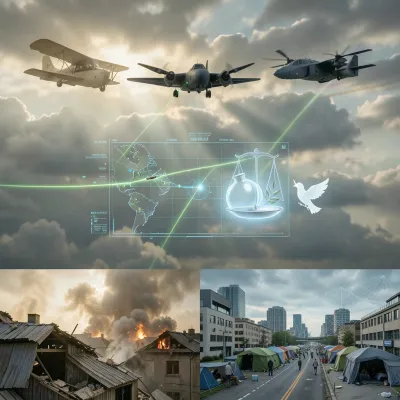
*Air War Decoded* provides a comprehensive examination of the evolution of airpower, from the early theoretical foundations laid by figures like Douhet and Mitchell to the modern era of precision-guided munitions and artificial intelligence. The book traces the development of strategic bombing through major 20th-century conflicts, highlighting the persistent tension between the promise of surgical precision and the reality of widespread civilian suffering. By analyzing the shift from the mass area bombing of World War II to the technologically sophisticated campaigns in the Gulf, Kosovo, and the post-9/11 era, the text illustrates how airpower has increasingly become a tool of coercive diplomacy and counterinsurgency.
Central to the book’s analysis is the intricate "joint targeting cycle," which serves as the connective tissue between political objectives and military execution. The text demystifies the mechanics of modern air warfare, explaining the critical roles of Intelligence, Surveillance, and Reconnaissance (ISR), and the specialized mission of suppressing enemy air defenses (SEAD). It argues that while technology has vastly improved the ability to "find, fix, and finish" targets, the fundamental challenge remains the "intelligence gap"—the difficulty of achieving true certainty in the chaotic environment of war, where dual-use infrastructure and mobile adversaries complicate every strike.
A significant portion of the work is dedicated to the legal and ethical frameworks governing the sky. The author explores the core principles of the Law of Armed Conflict—distinction, proportionality, and necessity—and evaluates how they are applied (and often strained) in practice. As air warfare moves into the realms of remote drone operations, cyber-enabled strikes, and autonomous systems, the book raises urgent questions about accountability and the potential for a "precision paradox," where the perceived cleanliness of modern weapons may lower the political threshold for engaging in conflict.
Finally, the book looks toward the future of strategic competition, focusing on the emergence of hypersonic weapons, saturation tactics, and the integration of space and cyber domains. It posits that the era of uncontested air superiority is ending, replaced by a highly contested environment where offensive speed and defensive resilience are in a state of constant, high-stakes competition. Ultimately, the book concludes that while technology continues to redefine the means of air warfare, the fundamental moral and strategic dilemmas—how to project power effectively while protecting non-combatants—remain as unresolved and essential as ever.
What You'll Find Inside:
- The historical evolution of airpower theory from Douhet and Mitchell to modern precision-guided munitions, revealing how technological promises have repeatedly collided with operational realities and ethical dilemmas across a century of warfare.
- How modern air operations function through detailed processes like the joint targeting cycle, intelligence surveillance and reconnaissance (ISR), and weaponeering - exposing the complex mechanics behind what appears as 'push-button' warfare.
- The persistent ethical and legal challenges in air warfare, particularly regarding distinction, proportionality, and civilian protection, which technological advances have complicated rather than resolved throughout the book's case studies.
- Empirical evidence from major conflicts (WWII European and Pacific theaters, Vietnam, Gulf War, Kosovo, Afghanistan/Iraq) demonstrating both the potential and severe limitations of airpower as a standalone strategic instrument.
- Emerging challenges and future directions including hypersonic weapons, AI-enabled targeting, drone proliferation, and the growing importance of cyber and space domains that are transforming the offense-defense competition in air operations.
Who's It For:
This book is designed for policymakers, military practitioners, and students of strategy or international relations who seek a rigorous understanding of airpower's historical development, operational mechanics, and ethical dimensions. It will also benefit interested citizens concerned with the effectiveness and morality of modern warfare, providing them with the analytical tools to evaluate claims about precision, effectiveness, and civilian protection in air operations. Readers involved in defense planning, targeting operations, or humanitarian advocacy will find particular value in the book's examination of the joint targeting cycle, collateral damage estimation, and the law of armed conflict as applied to contemporary conflicts.
Table of Contents:
- Introduction
- Chapter 1 The Origins of Airpower: Douhet, Mitchell, and de Seversky
- Chapter 2 Strategic Bombing in World War II: The European Theater
- Chapter 3 Strategic Bombing in World War II: The Pacific War
- Chapter 4 Air Superiority and Air Defense: The Battle for the Skies
- Chapter 5 The Cold War Bomber and Missile Age: Deterrence and Targeting
- Chapter 6 Vietnam: Rolling Thunder to Linebacker—Effectiveness and Ethics
- Chapter 7 Precision Emerges: Laser-Guided Bombs and the 1991 Gulf War
- Chapter 8 Kosovo 1999: Coercion from the Air
- Chapter 9 From 9/11 to Counterinsurgency: Airpower in Afghanistan and Iraq
- Chapter 10 Drones and Remote Warfare: Persistence, Precision, and Pitfalls
- Chapter 11 Targeting 101: The Joint Targeting Cycle and Command and Control
- Chapter 12 Intelligence, Surveillance, and Reconnaissance: Finding, Fixing, Finishing
- Chapter 13 Suppression and Destruction of Enemy Air Defenses (SEAD/DEAD)
- Chapter 14 Air Campaign Design: Centers of Gravity, Effects, and Measures
- Chapter 15 Weapons, Weaponeering, and Collateral Damage Estimation
- Chapter 16 Law of Armed Conflict and Just War: Distinction, Proportionality, Necessity
- Chapter 17 The Ethics of Targeting: Dual-Use, Leadership, and Infrastructure
- Chapter 18 Civilian Protection: Policy, Practice, and Accountability
- Chapter 19 Information, Perception, and Legitimacy: Media and Strategic Narratives
- Chapter 20 Coalition Airpower: Interoperability, Burden Sharing, and Politics
- Chapter 21 Joint and Maritime Integration: Airpower at Sea and on Land
- Chapter 22 Integrated Air and Missile Defense: The Offense–Defense Competition
- Chapter 23 Cyber and Space as Enablers of the Air War
- Chapter 24 Autonomy and AI in Targeting: Promise and Peril
- Chapter 25 The Future of Strategic Bombing: Hypersonics, Saturation, and Policy Choices
Author:
Published By:
Date Published:
May 12, 2026
Type:
Nonfiction
Language:
English
Word Count:
82,856 words
Reading Time:
5 hours 48 minutes
Sample:
Order:
Order Air War Decoded: Strategic Bombing, Air Superiority, and the Ethics of Targeting (Hardcover) on MixCache.com:
Buy NowPrint copy is made to order and ships worldwide. Includes the ebook free, ready to read instantly.
$5 account credit for all new MixCache.com accounts, usable toward any ebook purchase!*


