Browse by Category
Fiction
- Action & Adventure
- African American
- Anthologies
- Children's Fiction
- Classics
- Comics & Graphic Novels
- Coming of Age
- Contemporary
- Cultural & Regional
- Drama
- Erotica
- Fantasy
- General
- Historical Fiction
- Horror
- Humor & Satire
- Literary Fiction
- Mystery, Thriller & Suspense
- Poetry
- Religious & Inspirational
- Romance
- Science Fiction
- Short Stories
- War & Military
- Westerns
- Women's Fiction
- Young Adult
Non-Fiction
- Antiques & Collectibles
- Arts & Photography
- Biographies & Memoirs
- Business & Money
- Children's Non-Fiction
-
Computers & Technology
- Artificial Intelligence
- Computer Science
- Cybersecurity & Cryptography
- Data Science & Analytics
- Databases & Big Data
- Game Development & Design
- General
- Hardware & DIY
- Mobile App Development
- Networking & Cloud Computing
- Operating Systems
- Programming
- Robotics
- Software
- Software Engineering
- User Experience (UX) & Design
- Web Development & Design
- Cooking, Food & Wine
- Crafts, Hobbies & Home
- Education & Teaching
- Engineering
- General
- Health, Fitness & Dieting
-
History
- African History
- African History - North Africa
- African History - Sub-Saharan Africa
- American History
- American History - 20th Century
- American History - Civil War
- American History - Colonial Period
- Ancient History
- Asian History
- Asian History - China
- Asian History - India
- Asian History - Japan
- Asian History - Southeast Asia
- European History
- European History - Ancient Greece
- European History - Ancient Rome
- European History - Medieval
- European History - Modern
- European History - Renaissance
- General
- Middle Eastern History
- Military History
- Military History - Aviation
- Military History - Naval
- Social & Cultural History
- World History
- Humor & Entertainment
- Industrial Technology
- Language Learning
- Law
- LGBTQ+ Non-Fiction
- Literary Criticism
- Medical Books
- Parenting & Relationships
- Philosophy
- Politics & Social Sciences
- Reference
- Religion & Spirituality
-
Science & Math
- Agricultural Sciences
- Astronomy & Space Science
- Behavioral Sciences
- Biological Sciences
- Botany & Plant Science
- Chemistry
- Earth Sciences
- Engineering - Chemical
- Engineering - Civil
- Engineering - Electrical
- Engineering - Mechanical
- Environment
- General
- Geology
- Mathematics
- Nature & Ecology
- Oceanography
- Paleontology
- Physics
- Statistics
- Self-Help
- Sports & Outdoors
- Study Aids
- Sustainability & Green Living
- Textbooks
- Transportation
- Travel
- True Crime
- Urban Planning & Development
- Veterinary Medicine
- Writing & Publishing
Jump to Section
MixCache.com Total Access
Unlimited reading and audiobooks for every book published by MixCache.com.
Included titles carry the MTA badge.
Learn more →
Siegecraft in Stone and Steel: The History of Siege Warfare
MTA
From Battering Rams to Artillery Barrages and Urban Destruction
About this book:
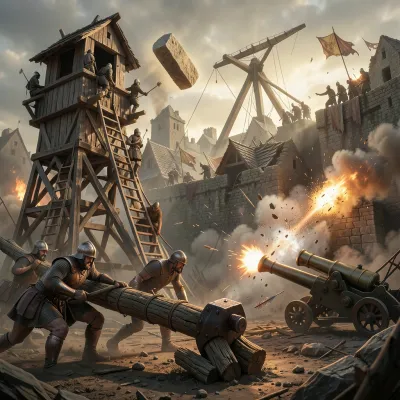
*Siegecraft in Stone and Steel* traces the five-millennium evolution of siege warfare, from the Neolithic mudbrick walls of Jericho to the high-tech urban battlefields of the twenty-first century. The book illustrates a relentless technological arms race where defensive innovations, like the geometric *trace italienne* and Vauban’s scientific fortifications, were perpetually challenged by offensive breakthroughs, including torsion artillery, the gunpowder revolution, and industrialized rifled cannon. Throughout these eras, the fundamental logic of the siege—isolating an enemy, controlling resources, and exhausting the will of the garrison—remained a constant strategic grammar.
The narrative transitions from the "age of stone," defined by medieval castles and crusader keeps, into the "industrial turn," where railroads, telegraphs, and massive shellfire transformed cities like Sevastopol and Paris into meat grinders of attrition. The twentieth century further expanded the battlefield into the third dimension with the advent of strategic airpower and naval blockades, leading to the total-war ordures of Leningrad and Stalingrad. These chapters emphasize that as weapons became more sophisticated and destructive, the distinction between combatant and noncombatant dissolved, placing the civilian population at the center of the ordeal.
In the contemporary era, the book examines how asymmetric conflicts and decolonization gave rise to new forms of encirclement, such as those seen at Dien Bien Phu and Sarajevo. In the twenty-first century, sieges in Fallujah, Aleppo, Mosul, and Mariupol demonstrate the integration of social media, drones, and precision munitions into ancient tactics of investment. The book highlights how the "smart city" has become a fragile target, vulnerable to cyber sieges that can disable vital infrastructure without a single shot being fired, proving that the city under siege is not a medieval relic but a recurring modern condition.
Ultimately, the book argues that while technologies shift from battering rams to autonomous drones, the moral and logistical calculus of the siege remains unchanged. It concludes with a sobering reflection on the persistent human cost of these conflicts, noting that the laws and ethics of warfare often struggle to keep pace with the ingenuity of destruction. As urbanization increases and new digital frontiers emerge, the ancient practice of forcing a decision through isolation and suffering remains an enduring and pitiless feature of human ambition and conflict.
What You'll Find Inside:
- The fundamental logic of siege warfare—concentrate force, isolate the target, exhaust resources, and compel surrender—has remained remarkably consistent for over five thousand years despite technological evolution.
- Logistics and resource management consistently determine siege outcomes more than battlefield heroics or engineering brilliance, with starvation often proving the decisive weapon.
- Civilian populations bear the disproportionate burden of sieges across all historical periods, suffering from starvation, disease, bombardment, and displacement while having little influence on the decision to resist.
- Offensive and defensive technologies engage in a continuous arms race, where each innovation (battering rams, gunpowder, drones) prompts counter-adaptations in fortification and attack methods.
- Siege warfare functions as political theater and psychological operations, where terror, propaganda, information campaigns, and the demonstration of resolve complement physical attacks to shape enemy perceptions.
Who's It For:
This book is essential reading for military historians, defense analysts, and students of international relations seeking to understand the enduring patterns of urban conflict. It will particularly appeal to readers interested in how technological innovation intersects with ancient strategic principles, as well as those studying the humanitarian impact of warfare on civilian populations. The work provides valuable context for comprehending contemporary sieges in places like Mariupol, Gaza, and other modern urban battlefields by revealing the historical continuity beneath changing technologies.
Table of Contents:
- Introduction
- Chapter 1 Why Cities Become Battlefields: The Logic of Siege Warfare
- Chapter 2 Fortified Worlds of Antiquity: From Jericho to Assyria
- Chapter 3 Greeks and Hellenists at the Walls: Poliorcetics and Ingenuity
- Chapter 4 Rome Encircled: Engineering, Lines of Contravallation, and Exemplary Punishment
- Chapter 5 Castles and Keeps: Medieval Europe’s Age of Stone
- Chapter 6 Walls of Empire: Byzantium, the Caliphates, and Crusader Frontiers
- Chapter 7 Siegecraft Across Asia: China, Korea, and Japan before Gunpowder Supremacy
- Chapter 8 Beneath the Ramparts: Mining, Sapping, and Countermining
- Chapter 9 Hunger, Pestilence, and Powder: Logistics as a Weapon
- Chapter 10 The Gunpowder Revolution: Cannon Fire and the Fall of High Walls
- Chapter 11 The Trace Italienne: Bastions, Geometry, and New Doctrines
- Chapter 12 Vauban and His Rivals: The Codification of Siege Science
- Chapter 13 The Ottoman Art of Siege: From Constantinople to Vienna
- Chapter 14 Sea Lanes and Siege Lines: Naval Blockades and Island Redoubts
- Chapter 15 Revolution and Empire: From Yorktown to Napoleon
- Chapter 16 The Industrial Turn: Sevastopol, Petersburg, and Paris 1870–71
- Chapter 17 Total War at the Gates: Sieges and Blockades in World War I
- Chapter 18 Cities Under Fire: Leningrad, Stalingrad, and Sevastopol in World War II
- Chapter 19 Airpower and the Urban Fortress: Bombardment, Relief, and Resistance
- Chapter 20 Decolonization and Cold War: Dien Bien Phu, Khe Sanh, and Beyond
- Chapter 21 From Sarajevo to Grozny: Post–Cold War Urban Sieges
- Chapter 22 The Twenty-First Century: Fallujah, Aleppo, Mosul, and Mariupol
- Chapter 23 Law and Ethics Under Siege: Starvation, Evacuation, and Humanitarian Relief
- Chapter 24 Minds at the Ramparts: Information, Negotiation, and Psychological Pressure
- Chapter 25 The Next Siege: Drones, Cyber, and the Return of Fortified Cities
Author:
Published By:
Date Published:
May 12, 2026
Type:
Nonfiction
Language:
English
Word Count:
82,971 words
Reading Time:
5 hours 49 minutes
Sample:
Order:
Order Siegecraft in Stone and Steel: The History of Siege Warfare (Paperback) on MixCache.com:
Buy NowPrint copy is made to order and ships worldwide. Includes the ebook free, ready to read instantly.
$5 account credit for all new MixCache.com accounts, usable toward any ebook purchase!*