Browse by Category
Fiction
- Action & Adventure
- African American
- Anthologies
- Children's Fiction
- Classics
- Comics & Graphic Novels
- Coming of Age
- Contemporary
- Cultural & Regional
- Drama
- Erotica
- Fantasy
- General
- Historical Fiction
- Horror
- Humor & Satire
- Literary Fiction
- Mystery, Thriller & Suspense
- Poetry
- Religious & Inspirational
- Romance
- Science Fiction
- Short Stories
- War & Military
- Westerns
- Women's Fiction
- Young Adult
Non-Fiction
- Antiques & Collectibles
- Arts & Photography
- Biographies & Memoirs
- Business & Money
- Children's Non-Fiction
-
Computers & Technology
- Artificial Intelligence
- Computer Science
- Cybersecurity & Cryptography
- Data Science & Analytics
- Databases & Big Data
- Game Development & Design
- General
- Hardware & DIY
- Mobile App Development
- Networking & Cloud Computing
- Operating Systems
- Programming
- Robotics
- Software
- Software Engineering
- User Experience (UX) & Design
- Web Development & Design
- Cooking, Food & Wine
- Crafts, Hobbies & Home
- Education & Teaching
- Engineering
- General
- Health, Fitness & Dieting
-
History
- African History
- African History - North Africa
- African History - Sub-Saharan Africa
- American History
- American History - 20th Century
- American History - Civil War
- American History - Colonial Period
- Ancient History
- Asian History
- Asian History - China
- Asian History - India
- Asian History - Japan
- Asian History - Southeast Asia
- European History
- European History - Ancient Greece
- European History - Ancient Rome
- European History - Medieval
- European History - Modern
- European History - Renaissance
- General
- Middle Eastern History
- Military History
- Military History - Aviation
- Military History - Naval
- Social & Cultural History
- World History
- Humor & Entertainment
- Industrial Technology
- Language Learning
- Law
- LGBTQ+ Non-Fiction
- Literary Criticism
- Medical Books
- Parenting & Relationships
- Philosophy
- Politics & Social Sciences
- Reference
- Religion & Spirituality
-
Science & Math
- Agricultural Sciences
- Astronomy & Space Science
- Behavioral Sciences
- Biological Sciences
- Botany & Plant Science
- Chemistry
- Earth Sciences
- Engineering - Chemical
- Engineering - Civil
- Engineering - Electrical
- Engineering - Mechanical
- Environment
- General
- Geology
- Mathematics
- Nature & Ecology
- Oceanography
- Paleontology
- Physics
- Statistics
- Self-Help
- Sports & Outdoors
- Study Aids
- Sustainability & Green Living
- Textbooks
- Transportation
- Travel
- True Crime
- Urban Planning & Development
- Veterinary Medicine
- Writing & Publishing
Jump to Section
MixCache.com Total Access
Unlimited reading and audiobooks for every book published by MixCache.com.
Included titles carry the MTA badge.
Learn more →
Roots of Rebellion
MTA
Grassroots Uprising and Everyday Life During a Peasant Revolt
About this book:
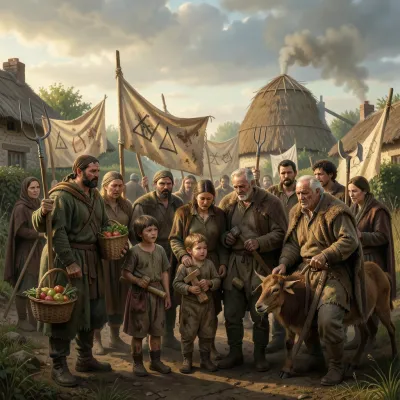
"Roots of Rebellion" chronicles Marta, a peasant woman in the village of Cheddon, who initiates a grassroots uprising against the oppressive manorial system. Initially focused on the unfair tithes and tallies imposed by the lord's steward, Godfrey Cray, Marta resurrects her deceased father's secret ledger, which meticulously records the true agricultural yields and the actual amounts extracted from the villagers. This discovery reveals a systematic pattern of incremental theft that keeps the community in perpetual debt and scarcity.
Marta begins to build a clandestine network of resistance, utilizing seemingly innocuous channels like letters hidden in flour sacks and a whisper network operating out of the local alehouse. She connects with other wronged tenants in neighboring parishes—Thornhallow, Brindleford, and Wren's End—who share similar grievances and their own hidden accounts. The network grows, developing a shared language of songs, symbols, and communal understanding, all centered around a collective commitment to meticulously record and compare their own figures against the lord's. This leads to a coordinated withholding of grain from the lord's mill, a quiet act of defiance that disrupts the steward's expected revenue.
The movement escalates when Cray, unable to suppress the growing dissent, summons Marta and other villagers to the Manorial Court for contumacy. In response, Marta orchestrates a mass march to Averham, the market town, where over seventy peasants present their collective evidence to the lord's treasurer. While the court doesn't immediately rule in their favor, the public display of organized resistance and the sheer volume of their "true accounts" force the treasurer to appoint an independent measurer. However, this measurer is quickly revealed to be compromised, having secretly met with the steward.
Undeterred, the network adapts, moving its hidden grain stores to various cellars and barns, and relying on hand querns for milling when the Brindleford mill is seized by soldiers and a cannon is deployed. The resistance shifts from direct confrontation to an enduring, invisible system of self-sufficiency and mutual aid, symbolized by red threads worn on wrists and new songs that encode messages. This sustained, quiet defiance, coupled with the detailed financial records meticulously kept by the network, eventually forces the steward to concede a small but significant reduction in the tithe, acknowledging the validity of the tenants' numbers without overtly admitting defeat. The book concludes with the understanding that while the struggle is ongoing, the roots of this rebellion—a community bound by shared knowledge and collective action—have taken firm hold.
Table of Contents:
- Introduction
- Chapter 1 Smoke over the Barley
- Chapter 2 Marta’s Ledger
- Chapter 3 Letters Hidden in Flour Sacks
- Chapter 4 The Alehouse Whisper Network
- Chapter 5 Tithes and Tallies
- Chapter 6 Oaths by Lamplight
- Chapter 7 The Bailiff’s Visit
- Chapter 8 Market Day, Market Lies
- Chapter 9 A Meeting in the Orchard
- Chapter 10 Songs that Carry Further than Bells
- Chapter 11 The First Refusal
- Chapter 12 Winter Kitchens, Quiet Plans
- Chapter 13 Roadside Communion
- Chapter 14 Muster on the Common
- Chapter 15 Field Drills and Folktales
- Chapter 16 Red Thread at the Wrist
- Chapter 17 Crossroads at Dusk
- Chapter 18 Bread, Salt, and Strategy
- Chapter 19 Cartwheels and Cannon Smoke
- Chapter 20 The Turning of the Mill
- Chapter 21 Splinters in the Council Bench
- Chapter 22 A Night of Broken Shoes
- Chapter 23 The Tide under the Bridge
- Chapter 24 Harvest of Ash and Wheat
- Chapter 25 Roots That Remember
Author:
Published By:
Date Published:
May 12, 2026
Type:
Fiction
Language:
English
Word Count:
87,077 words
Reading Time:
6 hours 6 minutes
Sample:
Order:
Order Roots of Rebellion (Hardcover) on MixCache.com:
Buy NowPrint copy is made to order and ships worldwide. Includes the ebook free, ready to read instantly.
$5 account credit for all new MixCache.com accounts, usable toward any ebook purchase!*