Browse by Category
Fiction
- Action & Adventure
- African American
- Anthologies
- Children's Fiction
- Classics
- Comics & Graphic Novels
- Coming of Age
- Contemporary
- Cultural & Regional
- Drama
- Erotica
- Fantasy
- General
- Historical Fiction
- Horror
- Humor & Satire
- Literary Fiction
- Mystery, Thriller & Suspense
- Poetry
- Religious & Inspirational
- Romance
- Science Fiction
- Short Stories
- War & Military
- Westerns
- Women's Fiction
- Young Adult
Non-Fiction
- Antiques & Collectibles
- Arts & Photography
- Biographies & Memoirs
- Business & Money
- Children's Non-Fiction
-
Computers & Technology
- Artificial Intelligence
- Computer Science
- Cybersecurity & Cryptography
- Data Science & Analytics
- Databases & Big Data
- Game Development & Design
- General
- Hardware & DIY
- Mobile App Development
- Networking & Cloud Computing
- Operating Systems
- Programming
- Robotics
- Software
- Software Engineering
- User Experience (UX) & Design
- Web Development & Design
- Cooking, Food & Wine
- Crafts, Hobbies & Home
- Education & Teaching
- Engineering
- General
- Health, Fitness & Dieting
-
History
- African History
- African History - North Africa
- African History - Sub-Saharan Africa
- American History
- American History - 20th Century
- American History - Civil War
- American History - Colonial Period
- Ancient History
- Asian History
- Asian History - China
- Asian History - India
- Asian History - Japan
- Asian History - Southeast Asia
- European History
- European History - Ancient Greece
- European History - Ancient Rome
- European History - Medieval
- European History - Modern
- European History - Renaissance
- General
- Middle Eastern History
- Military History
- Military History - Aviation
- Military History - Naval
- Social & Cultural History
- World History
- Humor & Entertainment
- Industrial Technology
- Language Learning
- Law
- LGBTQ+ Non-Fiction
- Literary Criticism
- Medical Books
- Parenting & Relationships
- Philosophy
- Politics & Social Sciences
- Reference
- Religion & Spirituality
-
Science & Math
- Agricultural Sciences
- Astronomy & Space Science
- Behavioral Sciences
- Biological Sciences
- Botany & Plant Science
- Chemistry
- Earth Sciences
- Engineering - Chemical
- Engineering - Civil
- Engineering - Electrical
- Engineering - Mechanical
- Environment
- General
- Geology
- Mathematics
- Nature & Ecology
- Oceanography
- Paleontology
- Physics
- Statistics
- Self-Help
- Sports & Outdoors
- Study Aids
- Sustainability & Green Living
- Textbooks
- Transportation
- Travel
- True Crime
- Urban Planning & Development
- Veterinary Medicine
- Writing & Publishing
Jump to Section
MixCache.com Total Access
Unlimited reading and audiobooks for every book published by MixCache.com.
Included titles carry the MTA badge.
Learn more →
Pilgrim's Ledger
MTA
Interlocking Pilgrimage Stories and Practical Pilgrim Life in Medieval Europe
About this book:
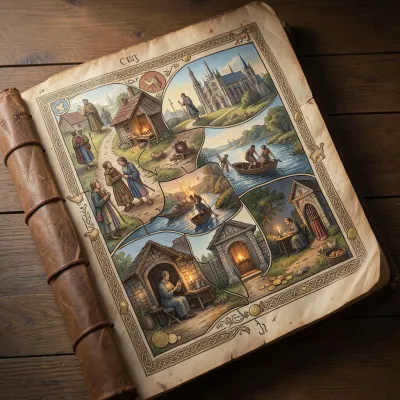
*Pilgrim’s Ledger* is a fictional chronicle of medieval travel, structured around the interlocking lives of diverse wayfarers bound for the great shrines of Europe and the Holy Land. The narrative begins at the Hospital of Saint-Jean-des-Vignes, where Brother Thomas maintains a ledger that meticulously tracks the "arithmetic of salvation"—the costs, names, and vows of those passing through. The story follows a central group of travelers: Gilbert, an aging tanner seeking reckoning; Marta, a widow walking for her disabled son; and Arnald, a young, debt-ridden clerk disguised as a pilgrim. Their journey is a gritty exploration of the "economies of passage," where spiritual devotion is constantly negotiated through practical survival, from bartering for "Hospitaller’s bread" to navigating the complex bureaucracy of safe-conduct letters and city taxes.
As the company moves from the Pyrenees to the Mediterranean and eventually to Jerusalem, the book highlights the transactional nature of medieval piety. The characters encounter various figures who embody the road’s diverse social strata: the cynical relic dealer Pons, the pragmatic merchant Giacomo, the protective knight Sir Kaelan, and the "Weaver of Navarre," whose woven patches provide a more effective safe conduct than official seals. A pivotal plot element involves a small, battered ledger of "deathbed confessions" entrusted to Arnald by a dying leper. This "living record" of raw human truth stands in stark contrast to the formal, monetary ledgers kept by the Church, shifting Arnald’s focus from a search for absolution to a duty of bearing witness.
The final chapters depict the fragmentation of the group as they reach the Holy Land and eventually begin their long returns. Theobald, a cupbearer from Chartres, fails in his mission to purchase a holy relic, leading to a profound disillusionment with the institutionalized commerce of faith. Meanwhile, Arnald serves as a scribe in a Jerusalem hospital, learning that the most significant human truths are often recorded in the "margins" of official history. The story concludes in Canterbury, where Arnald finally passes the book of confessions to another dying pilgrim, fulfilling his vow. He realizes that the true pilgrimage was never about the destination or the relics, but the transformative experience of the journey itself.
Ultimately, *Pilgrim's Ledger* serves as a meditation on the human condition and the nature of belief. It portrays the medieval road as a crucible that strips away social status and certainties, leaving only the essential connections between strangers. By closing the ledger on a note of personal resolution rather than religious triumph, the book suggests that grace is found not in the shrines at the end of the world, but in the shared bread, the kept promises, and the honest recording of human struggle.
Table of Contents:
- Introduction
- Chapter 1 The Ledger Opens
- Chapter 2 The Shell and the Crossroads
- Chapter 3 Hospitaller’s Bread, Merchant’s Coin
- Chapter 4 Vows Written in Dust
- Chapter 5 Bandits by Starlight
- Chapter 6 Letters of Safe Conduct
- Chapter 7 The Weaver of Navarre
- Chapter 8 Relics and Receipts
- Chapter 9 A Bargain at the Shrine
- Chapter 10 The Road to Roncesvalles
- Chapter 11 Pilgrim Law, Pilgrim Lore
- Chapter 12 The Thames at Low Tide
- Chapter 13 The Inn of the Hundred Tongues
- Chapter 14 A Leper’s Blessing
- Chapter 15 The Sea to Jaffa
- Chapter 16 The Jerusalem Tax
- Chapter 17 Oaths at the Holy Sepulchre
- Chapter 18 Broken Boots, Kept Promises
- Chapter 19 The Cupbearer of Chartres
- Chapter 20 Miracles and Margins
- Chapter 21 The Dice at the Bridge
- Chapter 22 Winter Quarters in Burgos
- Chapter 23 A Heretic in Pilgrim Grey
- Chapter 24 The Long Return
- Chapter 25 The Ledger Closes
Author:
Published By:
Date Published:
May 12, 2026
Type:
Fiction
Language:
English
Word Count:
83,038 words
Reading Time:
5 hours 49 minutes
Sample:
Order:
Order Pilgrim's Ledger (Hardcover) on MixCache.com:
Buy NowPrint copy is made to order and ships worldwide. Includes the ebook free, ready to read instantly.
$5 account credit for all new MixCache.com accounts, usable toward any ebook purchase!*