
Browse by Category
Fiction
- Action & Adventure
- African American
- Anthologies
- Children's Fiction
- Classics
- Comics & Graphic Novels
- Coming of Age
- Contemporary
- Cultural & Regional
- Drama
- Erotica
- Fantasy
- General
- Historical Fiction
- Horror
- Humor & Satire
- Literary Fiction
- Mystery, Thriller & Suspense
- Poetry
- Religious & Inspirational
- Romance
- Science Fiction
- Short Stories
- War & Military
- Westerns
- Women's Fiction
- Young Adult
Non-Fiction
- Antiques & Collectibles
- Arts & Photography
- Biographies & Memoirs
- Business & Money
- Children's Non-Fiction
-
Computers & Technology
- Artificial Intelligence
- Computer Science
- Cybersecurity & Cryptography
- Data Science & Analytics
- Databases & Big Data
- Game Development & Design
- General
- Hardware & DIY
- Mobile App Development
- Networking & Cloud Computing
- Operating Systems
- Programming
- Robotics
- Software
- Software Engineering
- User Experience (UX) & Design
- Web Development & Design
- Cooking, Food & Wine
- Crafts, Hobbies & Home
- Education & Teaching
- Engineering
- General
- Health, Fitness & Dieting
-
History
- African History
- African History - North Africa
- African History - Sub-Saharan Africa
- American History
- American History - 20th Century
- American History - Civil War
- American History - Colonial Period
- Ancient History
- Asian History
- Asian History - China
- Asian History - India
- Asian History - Japan
- Asian History - Southeast Asia
- European History
- European History - Ancient Greece
- European History - Ancient Rome
- European History - Medieval
- European History - Modern
- European History - Renaissance
- General
- Middle Eastern History
- Military History
- Military History - Aviation
- Military History - Naval
- Social & Cultural History
- World History
- Humor & Entertainment
- Industrial Technology
- Language Learning
- Law
- LGBTQ+ Non-Fiction
- Literary Criticism
- Medical Books
- Parenting & Relationships
- Philosophy
- Politics & Social Sciences
- Reference
- Religion & Spirituality
-
Science & Math
- Agricultural Sciences
- Astronomy & Space Science
- Behavioral Sciences
- Biological Sciences
- Botany & Plant Science
- Chemistry
- Earth Sciences
- Engineering - Chemical
- Engineering - Civil
- Engineering - Electrical
- Engineering - Mechanical
- Environment
- General
- Geology
- Mathematics
- Nature & Ecology
- Oceanography
- Paleontology
- Physics
- Statistics
- Self-Help
- Sports & Outdoors
- Study Aids
- Sustainability & Green Living
- Textbooks
- Transportation
- Travel
- True Crime
- Urban Planning & Development
- Veterinary Medicine
- Writing & Publishing
Jump to Section

Want unlimited access to all books published by MixCache.com (plus their audiobooks)? Try MixCache.com Total Access. Look for the MTA badge on book covers to identify included titles.
Access to infinite ebooks: Don't see the book you want? Suggest it and we'll create it (free!) for you from scratch with our powerful AI book writer. Then read it with MTA - besides profiting from any sales it makes!
Trenches, Tanks, and Total War: The First World War Reexamined
MTA
Industrialized combat, doctrine, and social consequences of World War I
About this book:
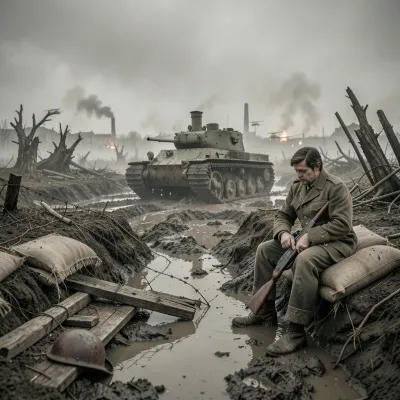
"Trenches, Tanks, and Total War: The First World War Reexamined" offers a comprehensive analysis of the First World War, moving beyond conventional military history to explore the conflict as an integrated system of industrialized combat and profound societal transformation. The book argues that the war was a crucial hinge between the 19th-century imperial-industrial age and modern warfare, fundamentally reshaping battlefield techniques, national economies, political cultures, and civilian societies. It traces the evolution of warfare from the initial, mistaken reliance on offensive doctrines, such as the German Schlieffen Plan and French Plan XVII, to the brutal realities of trench warfare, emphasizing how technology, doctrine, and logistics continually adapted to the challenges of unprecedented firepower.
The narrative delves deeply into the technological advancements that defined the war, highlighting the ascendancy of artillery as the dominant arm, the devastating impact of machine guns and mortars, and the ethical and tactical dilemmas introduced by poison gas. It also examines the nascent stages of airpower, initially used for reconnaissance but rapidly evolving into a contested domain for aerial combat and bombing, and the cumbersome beginnings of tanks, which offered the first glimmer of restoring mobility to the static front. Crucially, the book illustrates how these individual innovations were gradually integrated into a "combined arms" approach, synchronizing infantry, artillery, armor, and air support in a continuous struggle to break the stalemate.
Beyond the battlefield, the book extensively covers the "total war" dimensions of the conflict. It explores the immense pressures on the home front, including the mobilization of labor, the unprecedented entry of women into the workforce, and the widespread implementation of rationing and state control over economies. Propaganda and censorship emerged as critical tools for managing public opinion and dissent, while medical services grappled with new types of wounds, psychological trauma like shell shock, and devastating epidemics. The book also dedicates significant attention to the often-overlooked Eastern Front, highlighting its unique challenges of vast spaces, fluid warfare, and the eventual collapse of the Russian Empire, which profoundly altered the strategic balance by leading to the American entry and the subsequent Hundred Days offensive that ultimately broke the German lines.
Finally, "Trenches, Tanks, and Total War" examines the profound legacies of the conflict, from the immediate armistice and the contested settlements of Versailles to the long-term impact on military doctrine, international law, and collective memory. It argues that the war's innovations in technology, organization, and societal mobilization created a template for future conflicts, influencing the interwar period and setting the stage for World War II. The book concludes that the First World War forever altered the relationship between states and their societies, demonstrating that modern conflict demands a total commitment of national resources and will, and that its lessons about endurance, adaptation, and the terrifying efficiency of industrialized violence remain relevant for understanding warfare today.
What You'll Find Inside:
- The book examines how artillery became the dominant battlefield force, transforming tactics through innovations like the creeping barrage and inflicting approximately 60% of all casualties.
- It analyzes the trench system as a dynamic engineering response to industrialized firepower, covering construction, daily life, and continuous adaptation throughout the war.
- The work explores WWI as the first true 'total war,' detailing societal mobilization through economic controls, women's unprecedented entry into war industries, and home front sacrifices.
- It traces technological innovations including poison gas, tanks, aircraft, and machine guns, showing how they drove tactical adaptations like infiltration tactics and combined arms operations.
- The book argues that WWI's lessons directly influenced interwar military doctrine and set the stage for WWII, challenging myths about static warfare and futility.
Who's It For:
This book is ideal for students, scholars, and enthusiasts of military history who seek a comprehensive understanding of World War I as an integrated system of industrialized combat. It will particularly benefit readers interested in how technological innovations, tactical evolution, and societal mobilization interacted to create the first modern total war, and how these developments shaped 20th-century warfare and society.
Author:
Published By:
Date Published:
May 6, 2026
Type:
Nonfiction
Language:
English
Word Count:
67,070 words
Reading Time:
4 hours 42 minutes
Sample:
MixCache.com Total Access
Get unlimited access to this book + all books published by MixCache.com for $11.99/month
Subscribe to MTAOr purchase this book individually below
Order:
Buy the Trenches, Tanks, and Total War: The First World War Reexamined ebook on MixCache.com:
Buy Now
Full ebook will be available immediately
- read online or download as a PDF file.
$5 account credit for all new MixCache.com accounts, usable toward any ebook purchase!*





Ratings & Reviews
Ask Questions About This Book
Have a question about the content? Ask our AI assistant!
Start by asking a question about "Trenches, Tanks, and Total War: The First World War Reexamined"
Example: "Does this book mention William Shakespeare?"
Thinking...