Browse by Category
Fiction
- Action & Adventure
- African American
- Anthologies
- Children's Fiction
- Classics
- Comics & Graphic Novels
- Coming of Age
- Contemporary
- Cultural & Regional
- Drama
- Erotica
- Fantasy
- General
- Historical Fiction
- Horror
- Humor & Satire
- Literary Fiction
- Mystery, Thriller & Suspense
- Poetry
- Religious & Inspirational
- Romance
- Science Fiction
- Short Stories
- War & Military
- Westerns
- Women's Fiction
- Young Adult
Non-Fiction
- Antiques & Collectibles
- Arts & Photography
- Biographies & Memoirs
- Business & Money
- Children's Non-Fiction
-
Computers & Technology
- Artificial Intelligence
- Computer Science
- Cybersecurity & Cryptography
- Data Science & Analytics
- Databases & Big Data
- Game Development & Design
- General
- Hardware & DIY
- Mobile App Development
- Networking & Cloud Computing
- Operating Systems
- Programming
- Robotics
- Software
- Software Engineering
- User Experience (UX) & Design
- Web Development & Design
- Cooking, Food & Wine
- Crafts, Hobbies & Home
- Education & Teaching
- Engineering
- General
- Health, Fitness & Dieting
-
History
- African History
- African History - North Africa
- African History - Sub-Saharan Africa
- American History
- American History - 20th Century
- American History - Civil War
- American History - Colonial Period
- Ancient History
- Asian History
- Asian History - China
- Asian History - India
- Asian History - Japan
- Asian History - Southeast Asia
- European History
- European History - Ancient Greece
- European History - Ancient Rome
- European History - Medieval
- European History - Modern
- European History - Renaissance
- General
- Middle Eastern History
- Military History
- Military History - Aviation
- Military History - Naval
- Social & Cultural History
- World History
- Humor & Entertainment
- Industrial Technology
- Language Learning
- Law
- LGBTQ+ Non-Fiction
- Literary Criticism
- Medical Books
- Parenting & Relationships
- Philosophy
- Politics & Social Sciences
- Reference
- Religion & Spirituality
-
Science & Math
- Agricultural Sciences
- Astronomy & Space Science
- Behavioral Sciences
- Biological Sciences
- Botany & Plant Science
- Chemistry
- Earth Sciences
- Engineering - Chemical
- Engineering - Civil
- Engineering - Electrical
- Engineering - Mechanical
- Environment
- General
- Geology
- Mathematics
- Nature & Ecology
- Oceanography
- Paleontology
- Physics
- Statistics
- Self-Help
- Sports & Outdoors
- Study Aids
- Sustainability & Green Living
- Textbooks
- Transportation
- Travel
- True Crime
- Urban Planning & Development
- Veterinary Medicine
- Writing & Publishing
Jump to Section
MixCache.com Total Access
Unlimited reading and audiobooks for every book published by MixCache.com.
Included titles carry the MTA badge.
Learn more →
Rail, Telegraph, and Rifle: Logistics and Innovation in the American Civil War
MTA
Technology, supply chains, and tactical adaptation in a continental conflict
About this book:
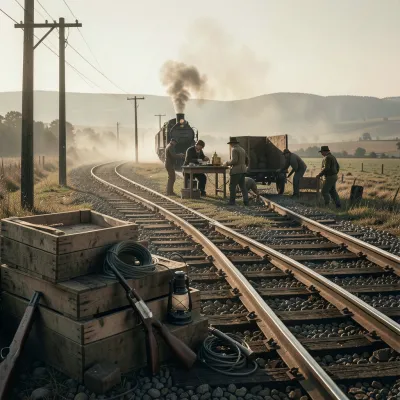
"Rail, Telegraph, and Rifle: Logistics and Innovation in the American Civil War" examines how technological advancements and logistical ingenuity profoundly shaped the conflict, moving beyond conventional narratives of battles and generals. The book posits that the war was as much a contest of industrial capacity, supply chain management, and adaptive command as it was of battlefield prowess. Key technologies—railroads, telegraphy, rifled weapons, and organized medical systems—are explored as integral to strategy and campaign outcomes, demonstrating how the ability to move men, materiel, messages, and the wounded dictated the pace and scope of operations.
The narrative emphasizes that the sheer scale of the continental conflict necessitated an unprecedented logistical effort. Railroads transformed the geometry of operations, allowing rapid troop and supply movements, but also became critical targets for destruction and vulnerable to varying gauges and limited repair capabilities, particularly in the South. The telegraph revolutionized command by collapsing distance, enabling near real-time communication between capitals and corps, yet also introduced challenges of information overload and the temptation for distant micromanagement. Rifled weapons dramatically increased lethality and accuracy, forcing tactical adaptations like entrenchments and dispersed formations, which in turn increased logistical demands for ammunition and support. Concurrently, medical innovation, from ambulance corps to general hospitals, became a strategic resource, improving survivability and maintaining combat strength.
The book delves into specific case studies and logistical challenges, such as the arduous task of feeding and fueling vast armies (Quartermasters and Commissaries), the crucial role of animal power (horses and mules) for last-mile mobility, and the constant struggle of "repair, wreck, and raid" on vital lifelines. It also highlights "the human factor," emphasizing how training, discipline, and the adoption of innovation, including the pivotal contributions of African American laborers and soldiers, were essential for operational effectiveness. Major campaigns like Atlanta and the sieges of Vicksburg and Petersburg are analyzed through a logistical lens, illustrating how control over supply lines and infrastructure determined their outcomes.
Ultimately, the text argues that the Civil War served as a crucial laboratory for modern warfare, revealing that victory depended not just on courage and tactical brilliance, but on designing redundant, repairable systems, protecting and deceiving lifelines, pacing decisions to the speed of information, and cultivating adaptable leadership. The innovations and logistical lessons of the war, from centralized procurement to organized medical services, continued to influence Reconstruction, the settlement of the American West, and global military doctrine, offering enduring guidance for contemporary warfighters on the systemic nature of conflict and the critical importance of robust, flexible logistics.
What You'll Find Inside:
- How railways transformed Civil War strategy by enabling rapid troop movement and sustaining power through controlled junctions and rolling stock
- The revolutionary impact of telegraphy on command and control, creating both opportunities and risks through near-real-time battlefield communication
- How rifled weapons increased lethality and forced tactical adaptations like trench warfare and dispersed formations
- The critical role of medical innovation as a strategic resource that preserved fighting strength through organized evacuation and hospitalization
- Enduring lessons for modern warfighters on designing resilient systems, protecting lifelines, and cultivating adaptive leadership under pressure
Who's It For:
This book is written for military professionals seeking practical lessons from historical logistics and innovation, as well as history readers interested in how technologies migrate from promise to practice in wartime contexts. It will particularly benefit those studying the intersection of technology, supply chains, and tactical adaptation in military history.
Table of Contents:
- Introduction
- Chapter 1 The Continental Problem: Scale, Space, and Supply
- Chapter 2 Industrial America on the Eve of War
- Chapter 3 Building the Iron Road: Rail Networks North and South
- Chapter 4 The Telegraph Takes Command: Wires, Codes, and Control
- Chapter 5 From Smoothbore to Rifle: Firepower and the Battlefield
- Chapter 6 Steam and Steel at Sea: Rivers, Coasts, and the Logistics of Blockade
- Chapter 7 Quartermasters and Commissaries: Feeding and Fueling Armies
- Chapter 8 Horses, Mules, and Mobility: Animal Power in a Mechanizing War
- Chapter 9 The Medical Line of Communications: Evacuation, Hospitals, and Survival
- Chapter 10 Repair, Wreck, and Raid: Cutting and Rebuilding the Lifelines
- Chapter 11 The Human Factor: Training, Discipline, and Adoption of Innovation
- Chapter 12 Mapping and Measurement: Survey, Reconnaissance, and Rail Timetables
- Chapter 13 Civil–Military Coordination: Governments, Corporations, and War Departments
- Chapter 14 The Western Theater: Distance as a Weapon
- Chapter 15 The Eastern Theater: Density, Hubs, and Operational Stalemate
- Chapter 16 Atlanta in Motion: The Logistics of a Campaign
- Chapter 17 The Siege Mindset: Petersburg, Vicksburg, and Supply Under Fire
- Chapter 18 Guerrillas, Partisans, and the Logistics of Disorder
- Chapter 19 Labor, Freedom, and Force Multipliers: African American Contributions
- Chapter 20 Innovation Under Pressure: Field Expedients and Improvisation
- Chapter 21 Information, Misinformation, and the Speed of Decision
- Chapter 22 Leadership Cases: Grant, Lee, Sherman, and Rosecrans on Supply and Signal
- Chapter 23 Political Economy of War: Contracts, Corruption, and Capacity
- Chapter 24 Afterlives of Innovation: Reconstruction, the West, and Global Influence
- Chapter 25 Lessons for Modern Warfighters: Logistics, Networks, and Adaptation
Author:
Published By:
Date Published:
May 6, 2026
Type:
Nonfiction
Language:
English
Word Count:
64,347 words
Reading Time:
4 hours 30 minutes
Sample:
Order:
Order Rail, Telegraph, and Rifle: Logistics and Innovation in the American Civil War (Hardcover) on MixCache.com:
Buy NowPrint copy is made to order and ships worldwide. Includes the ebook free, ready to read instantly.
$5 account credit for all new MixCache.com accounts, usable toward any ebook purchase!*