
Browse by Category
Fiction
- Action & Adventure
- African American
- Anthologies
- Children's Fiction
- Classics
- Comics & Graphic Novels
- Coming of Age
- Contemporary
- Cultural & Regional
- Drama
- Erotica
- Fantasy
- General
- Historical Fiction
- Horror
- Humor & Satire
- Literary Fiction
- Mystery, Thriller & Suspense
- Poetry
- Religious & Inspirational
- Romance
- Science Fiction
- Short Stories
- War & Military
- Westerns
- Women's Fiction
- Young Adult
Non-Fiction
- Antiques & Collectibles
- Arts & Photography
- Biographies & Memoirs
- Business & Money
- Children's Non-Fiction
-
Computers & Technology
- Artificial Intelligence
- Computer Science
- Cybersecurity & Cryptography
- Data Science & Analytics
- Databases & Big Data
- Game Development & Design
- General
- Hardware & DIY
- Mobile App Development
- Networking & Cloud Computing
- Operating Systems
- Programming
- Robotics
- Software
- Software Engineering
- User Experience (UX) & Design
- Web Development & Design
- Cooking, Food & Wine
- Crafts, Hobbies & Home
- Education & Teaching
- Engineering
- General
- Health, Fitness & Dieting
-
History
- African History
- African History - North Africa
- African History - Sub-Saharan Africa
- American History
- American History - 20th Century
- American History - Civil War
- American History - Colonial Period
- Ancient History
- Asian History
- Asian History - China
- Asian History - India
- Asian History - Japan
- Asian History - Southeast Asia
- European History
- European History - Ancient Greece
- European History - Ancient Rome
- European History - Medieval
- European History - Modern
- European History - Renaissance
- General
- Middle Eastern History
- Military History
- Military History - Aviation
- Military History - Naval
- Social & Cultural History
- World History
- Humor & Entertainment
- Industrial Technology
- Language Learning
- Law
- LGBTQ+ Non-Fiction
- Literary Criticism
- Medical Books
- Parenting & Relationships
- Philosophy
- Politics & Social Sciences
- Reference
- Religion & Spirituality
-
Science & Math
- Agricultural Sciences
- Astronomy & Space Science
- Behavioral Sciences
- Biological Sciences
- Botany & Plant Science
- Chemistry
- Earth Sciences
- Engineering - Chemical
- Engineering - Civil
- Engineering - Electrical
- Engineering - Mechanical
- Environment
- General
- Geology
- Mathematics
- Nature & Ecology
- Oceanography
- Paleontology
- Physics
- Statistics
- Self-Help
- Sports & Outdoors
- Study Aids
- Sustainability & Green Living
- Textbooks
- Transportation
- Travel
- True Crime
- Urban Planning & Development
- Veterinary Medicine
- Writing & Publishing
Jump to Section

Want unlimited access to all books published by MixCache.com (plus their audiobooks)? Try MixCache.com Total Access. Look for the MTA badge on book covers to identify included titles.
Access to infinite ebooks: Don't see the book you want? Suggest it and we'll create it (free!) for you from scratch with our powerful AI book writer. Then read it with MTA - besides profiting from any sales it makes!
Empires at War: Spain, Portugal, Britain, France, and the Contest for the Americas
MTA
Colonial rivalries and the making of modern borders from the 16th to 19th centuries
About this book:
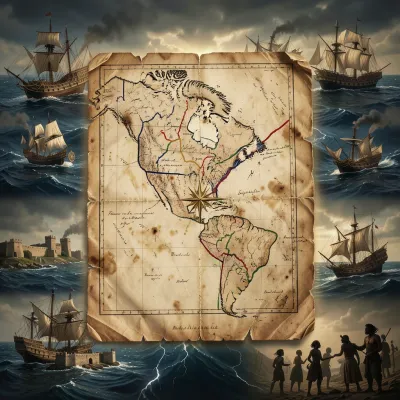
*Empires at War* provides a comprehensive geopolitical history of how Spain, Portugal, Britain, and France competed for dominion in the Americas from the 16th to the 19th centuries. The narrative moves from the initial "Atlantic collision" between European voyagers and complex Indigenous polities to the eventual hardening of fluid frontiers into the fixed borders of modern nation-states. It explores how various imperial structures—such as Spain’s centralized viceroyalties, Portugal’s littoral Luso-Atlantic system, Britain’s self-governing settler colonies, and France’s alliance-based fur trade—interacted with the landscape and Indigenous diplomacy to shape the continent's development.
The book details how extractive economies centered on silver, sugar, and slavery served as the primary engines of empire, fueling global trade while entrenching brutal social hierarchies. This competition frequently erupted into systemic warfare, including the Seven Years’ War and the War of the Spanish Succession, which redrew maps and rebalanced Atlantic power. Throughout these contests, Indigenous nations and enslaved peoples are presented as active agents who leveraged diplomacy, mobility, and resistance to redirect imperial designs, most notably seen in the transformative shockwaves of the Haitian Revolution.
As the late 18th century brought administrative overhauls like the Bourbon and Pombaline reforms, the internal tensions within these empires reached a breaking point. The text traces the unraveling of European control through the American Revolution and the Spanish American wars of liberation, which transformed colonial provinces into a patchwork of new republics. The narrative highlights how Napoleon’s gambits in Louisiana and Iberia acted as a catalyst for this fragmentation, forcing a transition from imperial rule to a modern state system characterized by national consolidation and the "fixing" of frontiers through science and survey.
In its conclusion, the book reflects on the enduring legacies of these colonial rivalries, noting that contemporary borders, legal traditions, and social memories are deeply rooted in these early modern contests. The transition from empires to nations did not immediately resolve territorial ambiguities; instead, it inaugurated a long process of institutionalizing sovereignty over spaces once governed by rumor and roving bands. Ultimately, the work contends that the modern map of the Americas is a testament to three centuries of negotiation, violence, and the persistent interplay between human ambition and the stubborn geography of the New World.
What You'll Find Inside:
- Comparative analysis of four imperial systems: Spain's viceroyalties, Portugal's captaincies, Britain's self-governing colonies, and France's alliance-based trade networks in the Americas.
- The transformation of fluid frontiers into fixed borders through wars, treaties, surveys, and fortifications from the 16th to 19th centuries.
- Indigenous nations and African-descended peoples as active historical agents who resisted, negotiated, and reshaped imperial ambitions across the Americas.
- How extractive economies centered on silver, sugar, and slavery drove imperial competition and transformed societies, economies, and landscapes.
- The enduring legacy of colonial border-making in modern Americas, where today's boundaries reflect centuries of imperial contest and compromise.
Who's It For:
This book is ideal for students, scholars, and general readers interested in comparative colonial history, Atlantic world studies, and the geopolitical foundations of modern nation-states in the Americas. It will particularly benefit those seeking to understand how 16th-19th century imperial rivalries between Spain, Portugal, Britain, and France created the territorial frameworks that continue to shape borders, conflicts, and identities across the hemisphere today.
Author:
Published By:
Date Published:
May 5, 2026
Type:
Nonfiction
Language:
English
Word Count:
59,938 words
Reading Time:
4 hours 12 minutes
Sample:
MixCache.com Total Access
Get unlimited access to this book + all books published by MixCache.com for $11.99/month
Subscribe to MTAOr purchase this book individually below
Order:
Buy the Empires at War: Spain, Portugal, Britain, France, and the Contest for the Americas ebook on MixCache.com:
Buy Now
Full ebook will be available immediately
- read online or download as a PDF file.
$5 account credit for all new MixCache.com accounts, usable toward any ebook purchase!*



Ratings & Reviews
Ask Questions About This Book
Have a question about the content? Ask our AI assistant!
Start by asking a question about "Empires at War: Spain, Portugal, Britain, France, and the Contest for the Americas"
Example: "Does this book mention William Shakespeare?"
Thinking...