
Browse by Category
Fiction
- Action & Adventure
- African American
- Anthologies
- Children's Fiction
- Classics
- Comics & Graphic Novels
- Coming of Age
- Contemporary
- Cultural & Regional
- Drama
- Erotica
- Fantasy
- General
- Historical Fiction
- Horror
- Humor & Satire
- Literary Fiction
- Mystery, Thriller & Suspense
- Poetry
- Religious & Inspirational
- Romance
- Science Fiction
- Short Stories
- War & Military
- Westerns
- Women's Fiction
- Young Adult
Non-Fiction
- Antiques & Collectibles
- Arts & Photography
- Biographies & Memoirs
- Business & Money
- Children's Non-Fiction
-
Computers & Technology
- Artificial Intelligence
- Computer Science
- Cybersecurity & Cryptography
- Data Science & Analytics
- Databases & Big Data
- Game Development & Design
- General
- Hardware & DIY
- Mobile App Development
- Networking & Cloud Computing
- Operating Systems
- Programming
- Robotics
- Software
- Software Engineering
- User Experience (UX) & Design
- Web Development & Design
- Cooking, Food & Wine
- Crafts, Hobbies & Home
- Education & Teaching
- Engineering
- General
- Health, Fitness & Dieting
-
History
- African History
- African History - North Africa
- African History - Sub-Saharan Africa
- American History
- American History - 20th Century
- American History - Civil War
- American History - Colonial Period
- Ancient History
- Asian History
- Asian History - China
- Asian History - India
- Asian History - Japan
- Asian History - Southeast Asia
- European History
- European History - Ancient Greece
- European History - Ancient Rome
- European History - Medieval
- European History - Modern
- European History - Renaissance
- General
- Middle Eastern History
- Military History
- Military History - Aviation
- Military History - Naval
- Social & Cultural History
- World History
- Humor & Entertainment
- Industrial Technology
- Language Learning
- Law
- LGBTQ+ Non-Fiction
- Literary Criticism
- Medical Books
- Parenting & Relationships
- Philosophy
- Politics & Social Sciences
- Reference
- Religion & Spirituality
-
Science & Math
- Agricultural Sciences
- Astronomy & Space Science
- Behavioral Sciences
- Biological Sciences
- Botany & Plant Science
- Chemistry
- Earth Sciences
- Engineering - Chemical
- Engineering - Civil
- Engineering - Electrical
- Engineering - Mechanical
- Environment
- General
- Geology
- Mathematics
- Nature & Ecology
- Oceanography
- Paleontology
- Physics
- Statistics
- Self-Help
- Sports & Outdoors
- Study Aids
- Sustainability & Green Living
- Textbooks
- Transportation
- Travel
- True Crime
- Urban Planning & Development
- Veterinary Medicine
- Writing & Publishing
Jump to Section
MixCache.com Total Access
Unlimited reading and audiobooks for every book published by MixCache.com.
Included titles carry the MTA badge.
Learn more →
Commerce and Coin: A Financial History of Imperial China
MTA
Money, markets, taxation, and merchant culture across dynastic change
About this book:
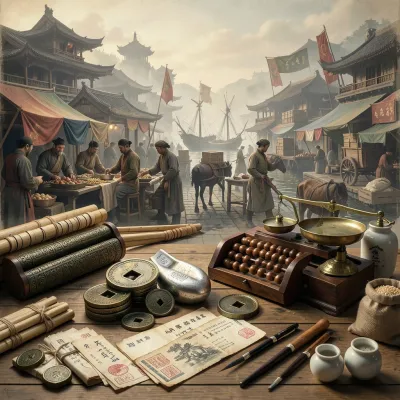
*Commerce and Coin: A Financial History of Imperial China* provides a comprehensive chronological and thematic analysis of the evolution of money, taxation, and markets from the pre-imperial era to the fall of the Qing dynasty. The narrative begins by tracing the transition from varied early currencies like cowries and bronze tools to the standardized round coins of the Qin and Han, establishing the foundation for an imperial fiscal order. It explores the sophisticated interplay between state monopolies—particularly salt and tea—and the development of a monetized tax system, highlighting how these institutions anchored military logistics and state capacity across successive dynasties.
A central theme of the book is the recurring tension between metallic currency and the invention of paper money. The text details the Song dynasty’s pioneering use of *jiaozi* and *huizi*, the Yuan’s ambitious yet inflationary experiments with fiat currency, and the eventual "silvering" of the Chinese realm during the Ming and Qing. This shift toward silver, accelerated by global bullion flows from the Americas and Japan, transformed the fiscal landscape through reforms like the Single-Whip system, which simplified rural obligations into silver-based payments. This monetization linked the domestic agricultural economy to international maritime trade and the volatile treaty-port systems of the nineteenth century.
The book also emphasizes the vital role of private institutions and social networks in facilitating commerce. It examines the emergence of native-place associations, guilds, and the sophisticated banking systems of the Huizhou and Shanxi merchants, such as the *piaohao* (remittance houses) and *qianzhuang* (local money shops). These private networks provided essential credit and trust where official law was often opaque or absent. Furthermore, the text addresses the human dimensions of finance, including the roles of women in household management, the impact of price volatility on famine relief, and the ways in which war and rebellion repeatedly forced fiscal innovation and reordering.
Ultimately, the book argues that Imperial China’s financial history was a persistent negotiation between central authority and market initiative. It concludes by reflecting on the legacies of imperial fiscal practices, such as the reliance on kinship-based credit and the sophisticated quantification of the state, as they transitioned into modern balance sheets and the banking structures of the early twentieth century. By following the movement of coin and credit, the work illustrates how finance served as the circulatory system that both bound the empire together and exposed its vulnerabilities to internal and global shocks.
What You'll Find Inside:
- Traces the evolution of Chinese currency from cowrie shells and bronze coins to paper money and silver, showing how monetary innovations responded to copper shortages and military financing needs.
- Examines how fiscal systems like the Tang Two-Tax System and Ming Single-Whip reform transformed taxation by aligning revenue collection with economic cycles and monetizing obligations in silver.
- Details the development of sophisticated credit networks including piaohao remittance banks and qianzhuang local banks that enabled long-distance commerce despite fragmented official currency systems.
- Analyzes the role of state monopolies (salt, tea, iron) as fiscal engines that funded military expenditures while creating complex merchant-state relationships and regional trade networks.
- Explores how global silver flows from the Americas and Japan reshaped China's economy from the 16th century onward, creating bimetallic tensions and integrating the empire into world markets.
Who's It For:
This book will be valuable for students and scholars of Chinese history, economic history, and finance who seek to understand how monetary systems, taxation, and merchant culture interacted across dynastic change. It will particularly interest those studying the historical development of paper money, banking systems, and state-market relations in pre-modern economies. Professionals in economics or finance looking for comparative perspectives on currency evolution and fiscal institutions will also find relevant insights. The work's combination of quantitative analysis with merchant biographies makes it suitable for readers who appreciate both macroeconomic trends and human-scale historical narratives.
Table of Contents:
- Introduction
- Chapter 1 Coins, Cowries, and Bronze: Money Before Empire
- Chapter 2 Unification and Standardization: Qin and Early Han Monetary Orders
- Chapter 3 Silk, Salt, and Surplus: Taxation and Markets in the Han
- Chapter 4 Court, Commanderies, and Credit: Finance from the Three Kingdoms to Jin
- Chapter 5 Equal-Field Revenues: Northern and Southern Dynasties Experiments
- Chapter 6 Tang Tax Revolutions: The Two-Tax System and Urban Markets
- Chapter 7 Tea, Horses, and Tribute: State Monopolies and Military Finance
- Chapter 8 Paper Promises: The Song Invention of Jiaozi and Huizi
- Chapter 9 Ports, Porcelain, and Profits: Commercialization in the Song Economy
- Chapter 10 Mongol Money: Yuan Paper Currency and the Perils of Inflation
- Chapter 11 Silvering the Realm: Early Ming Fiscal Reforms and the Single-Whip
- Chapter 12 The Flow of Silver: Global Bullion and the Ming–Qing Transition
- Chapter 13 Copper Cash and Silver Taels: Bimetallism in Late Imperial China
- Chapter 14 The Salt Monopoly and State Capacity across Dynasties
- Chapter 15 Guilds, Gentry, and the Market: Urban Institutions and Commercial Law
- Chapter 16 The Huizhou and Shanxi Merchants: Networks, Trust, and Family Firms
- Chapter 17 Piaohao and Qianzhuang: Banking, Remittance, and Credit
- Chapter 18 Grain, Copper, and Crisis: Price Volatility and Famine Relief
- Chapter 19 Frontier Furs to Canton Tea: Internal and Maritime Trade Corridors
- Chapter 20 Maritime Customs and Treaty Ports: Fiscal Reordering in the Nineteenth Century
- Chapter 21 Taxing the Countryside: Land, Labor, and Household Levies
- Chapter 22 Women, Work, and the Cash Economy: Gendered Dimensions of Commerce
- Chapter 23 Counting the Empire: Statistics, Ledgers, and the Rise of Quantification
- Chapter 24 Finance and Rebellion: The Costs of War from An Lushan to Taiping
- Chapter 25 From Imperial Ledgers to Modern Balance Sheets: Legacies after 1911
Author:
Published By:
Date Published:
May 4, 2026
Type:
Nonfiction
Language:
English
Word Count:
66,991 words
Reading Time:
4 hours 41 minutes
Sample:
MixCache.com Total Access
Get unlimited access to this book + all books published by MixCache.com for $11.99/month
Subscribe to MTAOr purchase this book individually below
Order:
Buy the Commerce and Coin: A Financial History of Imperial China ebook on MixCache.com:
Buy Now
Full ebook will be available immediately
- read online or download as a PDF file.
$5 account credit for all new MixCache.com accounts, usable toward any ebook purchase!*





Ratings & Reviews
Ask Questions About This Book
Have a question about the content? Ask our AI assistant!
Start by asking a question about "Commerce and Coin: A Financial History of Imperial China"
Example: "Does this book mention William Shakespeare?"
Thinking...