
Browse by Category
Fiction
- Action & Adventure
- African American
- Anthologies
- Children's Fiction
- Classics
- Comics & Graphic Novels
- Coming of Age
- Contemporary
- Cultural & Regional
- Drama
- Erotica
- Fantasy
- General
- Historical Fiction
- Horror
- Humor & Satire
- Literary Fiction
- Mystery, Thriller & Suspense
- Poetry
- Religious & Inspirational
- Romance
- Science Fiction
- Short Stories
- War & Military
- Westerns
- Women's Fiction
- Young Adult
Non-Fiction
- Antiques & Collectibles
- Arts & Photography
- Biographies & Memoirs
- Business & Money
- Children's Non-Fiction
-
Computers & Technology
- Artificial Intelligence
- Computer Science
- Cybersecurity & Cryptography
- Data Science & Analytics
- Databases & Big Data
- Game Development & Design
- General
- Hardware & DIY
- Mobile App Development
- Networking & Cloud Computing
- Operating Systems
- Programming
- Robotics
- Software
- Software Engineering
- User Experience (UX) & Design
- Web Development & Design
- Cooking, Food & Wine
- Crafts, Hobbies & Home
- Education & Teaching
- Engineering
- General
- Health, Fitness & Dieting
-
History
- African History
- African History - North Africa
- African History - Sub-Saharan Africa
- American History
- American History - 20th Century
- American History - Civil War
- American History - Colonial Period
- Ancient History
- Asian History
- Asian History - China
- Asian History - India
- Asian History - Japan
- Asian History - Southeast Asia
- European History
- European History - Ancient Greece
- European History - Ancient Rome
- European History - Medieval
- European History - Modern
- European History - Renaissance
- General
- Middle Eastern History
- Military History
- Military History - Aviation
- Military History - Naval
- Social & Cultural History
- World History
- Humor & Entertainment
- Industrial Technology
- Language Learning
- Law
- LGBTQ+ Non-Fiction
- Literary Criticism
- Medical Books
- Parenting & Relationships
- Philosophy
- Politics & Social Sciences
- Reference
- Religion & Spirituality
-
Science & Math
- Agricultural Sciences
- Astronomy & Space Science
- Behavioral Sciences
- Biological Sciences
- Botany & Plant Science
- Chemistry
- Earth Sciences
- Engineering - Chemical
- Engineering - Civil
- Engineering - Electrical
- Engineering - Mechanical
- Environment
- General
- Geology
- Mathematics
- Nature & Ecology
- Oceanography
- Paleontology
- Physics
- Statistics
- Self-Help
- Sports & Outdoors
- Study Aids
- Sustainability & Green Living
- Textbooks
- Transportation
- Travel
- True Crime
- Urban Planning & Development
- Veterinary Medicine
- Writing & Publishing
Jump to Section
MixCache.com Total Access
Unlimited reading and audiobooks for every book published by MixCache.com.
Included titles carry the MTA badge.
Learn more →
Voices of Transition: Oral Histories from China's Twentieth Century
MTA
Methodology and collected testimonies revealing everyday life through wars, reforms, and modernization
About this book:
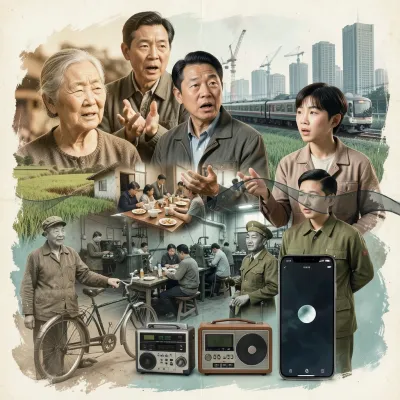
*Voices of Transition* provides an extensive exploration of China’s twentieth century by balancing rigorous oral history methodology with a vast collection of personal testimonies. The book begins by establishing a framework for ethical interviewing, the nuances of translating regional dialects, and the necessity of "triangulation"—comparing subjective memories with official archival records. By foregrounding the "ethics of care," the authors argue that history is best understood not just through state decrees, but through the emotional textures and everyday choices of individuals living through systemic upheaval.
The chronological core of the work traces China’s evolution from the collapse of the Qing Dynasty through the chaos of the warlord era and the brutal realities of the Japanese occupation. Narrators describe these macro-historical events through micro-details: the smell of occupation placards, the strategic hiding of family ledgers, and the sensory shift of moving from hand-woven silk to factory-produced textiles. These accounts complicate standard historical binaries, showing how survival often required a "moral calculus" that blurred the lines between resistance, accommodation, and quiet endurance.
As the narrative moves into the socialist era and the subsequent reform period, the testimonies highlight the profound reorganization of rural and urban life. Chapters on land reform, the Great Leap Forward, and the Cultural Revolution reveal the human cost of political campaigns, characterized by the militarization of language and the precariousness of social labeling. Conversely, the later sections on the "Opening of the Gates" and the restructuring of state-owned enterprises capture the vertigo of China’s rapid modernization. Here, workers and migrants discuss the loss of the "iron rice bowl" and the emergence of a society defined by competition, geographic mobility, and new aspirations.
The book concludes by examining how these lived experiences are preserved in the contemporary era through museums, memorials, and digital media. It acknowledges that memory is an active, ongoing process that is often sanitized by institutional curation but remains vibrant in the informal "folk archives" of family stories and online forums. Ultimately, *Voices of Transition* serves as a chorus of remembered lives, insisting that the history of modern China is found in the "lower registers" of conversation—the jokes, silences, and everyday ingenuity of those who navigated a century of relentless change.
What You'll Find Inside:
- Practical guidance on conducting ethical oral histories, from informed consent and trauma‑sensitive interviewing to transparent editing and reciprocity.
- Explores how dialect, code‑switching, and translation mediate memory, showing why linguistic nuance is essential for interpreting personal testimonies.
- Demonstrates triangulation of oral testimony with archives, photographs, local chronicles, and material objects to build a richer, more reliable historical record.
- Presents curated narratives that reveal everyday life during wars, reforms, and modernization across China's twentieth century, from farmers to factory workers.
- Highlights continuities and ruptures in Chinese society, illustrating how ordinary people negotiated political campaigns, economic shifts, and changing gender roles.
Who's It For:
This book will be valuable for scholars of modern Chinese history and oral‑history methodology, students learning qualitative research techniques, and general readers interested in the lived experiences of ordinary people during war, revolution, and reform. Practitioners seeking concrete, ethically grounded advice on interview design, translation, and archival dialogue will also find it a useful reference.
Table of Contents:
- Introduction
- Chapter 1 Listening to a Century: Why Oral History Matters
- Chapter 2 Ethics of Care: Consent, Risk, and Reciprocity
- Chapter 3 Asking Good Questions: Interview Design and Field Practice
- Chapter 4 Translating Voices: Dialect, Mediation, and Meaning
- Chapter 5 From File to Fireside: Archives and Oral Histories in Dialogue
- Chapter 6 Fragments from the Late Qing and 1911
- Chapter 7 Living under Warlords: Order, Banditry, and Everyday Calculus
- Chapter 8 Occupation and Survival: War with Japan in Civilians’ Words
- Chapter 9 Partings and Returns: Civil War, Flight, and Homecoming
- Chapter 10 1949 Seen from the Street: Liberation, Loss, and Beginnings
- Chapter 11 Breaking the Soil: Land Reform and Rural Lives
- Chapter 12 Socialist Remakings: Industry, Commerce, and Collectivization
- Chapter 13 Brief Spring, Harsh Winter: Hundred Flowers and Anti-Rightist Memories
- Chapter 14 Leap and Hunger: Work Brigades, Shortages, and Quiet Mutual Aid
- Chapter 15 Campaign Time: Schools, Work Units, and the Cultural Revolution
- Chapter 16 Sent-Down Youth: Learning Country, Leaving City
- Chapter 17 Opening the Gates: Reform, Enterprise, and Migration
- Chapter 18 After the Factory Siren: SOE Restructuring and Laid-Off Workers
- Chapter 19 City of Cranes: Housing, Demolition, and Neighborhood Memory
- Chapter 20 Exams and Aspirations: Education as Ladder
- Chapter 21 Work, Love, and Care: Gendered Labors across Decades
- Chapter 22 Borderlands and Centers: Voices from China’s Peripheries
- Chapter 23 Belief and Belonging: Faith, Ritual, and Moral Worlds
- Chapter 24 Shocks and Solidarities: Disaster, Risk, and Civic Response
- Chapter 25 Remembering Tomorrow: Museums, Memorials, and Digital Memory
Author:
Published By:
Date Published:
May 4, 2026
Type:
Nonfiction
Language:
English
Word Count:
84,976 words
Reading Time:
5 hours 57 minutes
Sample:
MixCache.com Total Access
Get unlimited access to this book + all books published by MixCache.com for $11.99/month
Subscribe to MTAOr purchase this book individually below
Order:
Buy the Voices of Transition: Oral Histories from China's Twentieth Century ebook on MixCache.com:
Buy Now
Full ebook will be available immediately
- read online or download as a PDF file.
$5 account credit for all new MixCache.com accounts, usable toward any ebook purchase!*



Ratings & Reviews
Ask Questions About This Book
Have a question about the content? Ask our AI assistant!
Start by asking a question about "Voices of Transition: Oral Histories from China's Twentieth Century"
Example: "Does this book mention William Shakespeare?"
Thinking...