
Browse by Category
Fiction
- Action & Adventure
- African American
- Anthologies
- Children's Fiction
- Classics
- Comics & Graphic Novels
- Coming of Age
- Contemporary
- Cultural & Regional
- Drama
- Erotica
- Fantasy
- General
- Historical Fiction
- Horror
- Humor & Satire
- Literary Fiction
- Mystery, Thriller & Suspense
- Poetry
- Religious & Inspirational
- Romance
- Science Fiction
- Short Stories
- War & Military
- Westerns
- Women's Fiction
- Young Adult
Non-Fiction
- Antiques & Collectibles
- Arts & Photography
- Biographies & Memoirs
- Business & Money
- Children's Non-Fiction
-
Computers & Technology
- Artificial Intelligence
- Computer Science
- Cybersecurity & Cryptography
- Data Science & Analytics
- Databases & Big Data
- Game Development & Design
- General
- Hardware & DIY
- Mobile App Development
- Networking & Cloud Computing
- Operating Systems
- Programming
- Robotics
- Software
- Software Engineering
- User Experience (UX) & Design
- Web Development & Design
- Cooking, Food & Wine
- Crafts, Hobbies & Home
- Education & Teaching
- Engineering
- General
- Health, Fitness & Dieting
-
History
- African History
- African History - North Africa
- African History - Sub-Saharan Africa
- American History
- American History - 20th Century
- American History - Civil War
- American History - Colonial Period
- Ancient History
- Asian History
- Asian History - China
- Asian History - India
- Asian History - Japan
- Asian History - Southeast Asia
- European History
- European History - Ancient Greece
- European History - Ancient Rome
- European History - Medieval
- European History - Modern
- European History - Renaissance
- General
- Middle Eastern History
- Military History
- Military History - Aviation
- Military History - Naval
- Social & Cultural History
- World History
- Humor & Entertainment
- Industrial Technology
- Language Learning
- Law
- LGBTQ+ Non-Fiction
- Literary Criticism
- Medical Books
- Parenting & Relationships
- Philosophy
- Politics & Social Sciences
- Reference
- Religion & Spirituality
-
Science & Math
- Agricultural Sciences
- Astronomy & Space Science
- Behavioral Sciences
- Biological Sciences
- Botany & Plant Science
- Chemistry
- Earth Sciences
- Engineering - Chemical
- Engineering - Civil
- Engineering - Electrical
- Engineering - Mechanical
- Environment
- General
- Geology
- Mathematics
- Nature & Ecology
- Oceanography
- Paleontology
- Physics
- Statistics
- Self-Help
- Sports & Outdoors
- Study Aids
- Sustainability & Green Living
- Textbooks
- Transportation
- Travel
- True Crime
- Urban Planning & Development
- Veterinary Medicine
- Writing & Publishing
Jump to Section
MixCache.com Total Access
Unlimited reading and audiobooks for every book published by MixCache.com.
Included titles carry the MTA badge.
Learn more →
Surface to Abyss: An Accessible Introduction to Oceanography
MTA
A beginner's guide to physical, chemical, biological, and geological marine science for curious readers
About this book:
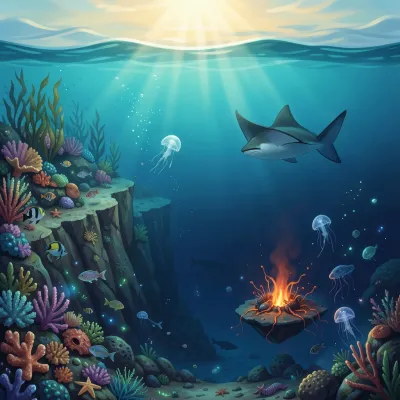
"Surface to Abyss: An Accessible Introduction to Oceanography" offers a comprehensive, interdisciplinary guide to understanding Earth's oceans, emphasizing their critical role in sustaining life and regulating global climate. The book begins by establishing the ocean's fundamental importance as a primary oxygen producer, a massive heat sink, and a major driver of global weather and climate patterns, including its function as a vital carbon sink. It then delves into the history of ocean discovery, tracing humanity's evolving understanding from early voyagers' practical observations to modern scientific expeditions and technological innovations.
The text systematically explores the physical properties of seawater, detailing the unique structure of water molecules, its high heat capacity, and the significance of salinity in determining density. These foundational concepts lead to an examination of ocean stratification—how the sea arranges itself into layers based on density differences—and the resulting mixed layers, thermoclines, and haloclines. Building on this, the book explains the dynamics of waves, from ripples to tsunamis, and the gravitational forces that drive tides, highlighting their impact on coastal life and ecosystems. It further elucidates the mechanisms of surface winds and currents, introducing Ekman transport, upwelling, and the formation of global gyres that redistribute heat and nutrients across ocean basins.
"Surface to Abyss" also dives into the chemical and biological aspects of marine science. It covers the chemistry of dissolved gases like oxygen and carbon dioxide, the cycling of essential nutrients, and the intricate carbonate system that buffers ocean pH. A dedicated chapter addresses ocean acidification, explaining how increased atmospheric CO2 is altering ocean chemistry and threatening calcifying organisms and marine food webs. The book then shifts to biological oceanography, outlining the role of light and photosynthesis in primary productivity, and classifying marine life into plankton, nekton, and benthos across various life zones. It details the complexity of marine food webs and energy flow, from microscopic producers to apex predators, and highlights the crucial role of decomposers and the biological pump in carbon cycling.
Finally, the book examines diverse marine ecosystems, from the highly productive coastal zones, including estuaries, mangroves, and seagrasses, to the spectacular and vulnerable world of coral reefs, addressing threats like bleaching and ocean acidification. It explores the extreme environments of the deep sea, uncovering the unique ecosystems around hydrothermal vents and the vast, mysterious abyssal plains. Geological chapters introduce plate tectonics, explaining seafloor spreading, subduction zones, and the geological history preserved in marine sediments. The narrative culminates by discussing the dynamic interplay between people and the ocean, focusing on resources, hazards like sea level rise and erosion, and the imperative for stewardship. The concluding chapter encourages further exploration through data analysis, career paths in oceanography, and citizen science, emphasizing that understanding and protecting the ocean is a collective and ongoing endeavor essential for our shared future.
What You'll Find Inside:
- The ocean as an interconnected system where physical, chemical, biological, and geological processes continuously interact to shape Earth's climate and support life.
- Fundamental ocean circulation patterns including wind-driven surface currents, Ekman transport, upwelling zones, subtropical gyres, and the global thermohaline conveyor belt.
- Marine chemistry basics covering the carbonate system, nutrient cycles, and how human-driven ocean acidification affects shell-forming organisms and food webs.
- Diverse marine ecosystems from sunlit coastal zones (estuaries, mangroves, coral reefs) to the dark deep sea (hydrothermal vents, abyssal plains) and their unique adaptations.
- Human relationships with the ocean including vital resources, coastal hazards, climate change impacts, and pathways for stewardship through citizen science and informed choices.
Who's It For:
This book is designed for curious readers without specialized science training who want an accessible introduction to oceanography. It's ideal for students beginning their science education, educators seeking clear explanations for teaching, and interested members of the public who want to understand how the ocean works and why it matters to their daily lives. No advanced math or prior science background is required—only a willingness to explore evidence-based explanations of ocean phenomena.
Table of Contents:
- Introduction
- Chapter 1 Planet Ocean: Why the Seas Matter
- Chapter 2 A Brief History of Ocean Discovery
- Chapter 3 Tools and Maps: How We Observe the Ocean
- Chapter 4 The Water Itself: Structure, Heat, and Salinity
- Chapter 5 Density, Stratification, and Layers of the Sea
- Chapter 6 Waves: From Ripples to Swells
- Chapter 7 Tides and Tidal Life
- Chapter 8 Surface Winds and Currents
- Chapter 9 Ekman Transport, Upwelling, and Gyres
- Chapter 10 Thermohaline Circulation and the Global Conveyor
- Chapter 11 Air–Sea Interaction and Weather
- Chapter 12 Climate Variability: El Niño, La Niña, and Beyond
- Chapter 13 Marine Chemistry: Gases, Nutrients, and the Carbonate System
- Chapter 14 Ocean Acidification and the Changing Carbon Cycle
- Chapter 15 Light, Photosynthesis, and Primary Productivity
- Chapter 16 Plankton, Nekton, and Benthos: Life Zones of the Sea
- Chapter 17 Food Webs and Energy Flow
- Chapter 18 Coastal Ecosystems: Estuaries, Mangroves, and Seagrasses
- Chapter 19 Coral Reefs: Builders, Biodiversity, and Bleaching
- Chapter 20 The Deep Sea: Hydrothermal Vents and Abyssal Plains
- Chapter 21 Plate Tectonics and Seafloor Geology
- Chapter 22 Marine Sediments and the Stories They Tell
- Chapter 23 Coasts in Motion: Erosion, Beaches, and Sea Level Rise
- Chapter 24 People and the Ocean: Resources, Hazards, and Stewardship
- Chapter 25 Exploring Further: Data, Careers, and Citizen Science
Author:
Published By:
Date Published:
May 3, 2026
Type:
Nonfiction
Language:
English
Word Count:
60,584 words
Reading Time:
4 hours 15 minutes
Sample:
Order:
Order Surface to Abyss: An Accessible Introduction to Oceanography (Hardcover) on MixCache.com:
Buy NowPrint copy is made to order and ships worldwide. Includes the ebook free, ready to read instantly.
$5 account credit for all new MixCache.com accounts, usable toward any ebook purchase!*


