Browse by Category
Fiction
- Action & Adventure
- African American
- Anthologies
- Children's Fiction
- Classics
- Comics & Graphic Novels
- Coming of Age
- Contemporary
- Cultural & Regional
- Drama
- Erotica
- Fantasy
- General
- Historical Fiction
- Horror
- Humor & Satire
- Literary Fiction
- Mystery, Thriller & Suspense
- Poetry
- Religious & Inspirational
- Romance
- Science Fiction
- Short Stories
- War & Military
- Westerns
- Women's Fiction
- Young Adult
Non-Fiction
- Antiques & Collectibles
- Arts & Photography
- Biographies & Memoirs
- Business & Money
- Children's Non-Fiction
-
Computers & Technology
- Artificial Intelligence
- Computer Science
- Cybersecurity & Cryptography
- Data Science & Analytics
- Databases & Big Data
- Game Development & Design
- General
- Hardware & DIY
- Mobile App Development
- Networking & Cloud Computing
- Operating Systems
- Programming
- Robotics
- Software
- Software Engineering
- User Experience (UX) & Design
- Web Development & Design
- Cooking, Food & Wine
- Crafts, Hobbies & Home
- Education & Teaching
- Engineering
- General
- Health, Fitness & Dieting
-
History
- African History
- African History - North Africa
- African History - Sub-Saharan Africa
- American History
- American History - 20th Century
- American History - Civil War
- American History - Colonial Period
- Ancient History
- Asian History
- Asian History - China
- Asian History - India
- Asian History - Japan
- Asian History - Southeast Asia
- European History
- European History - Ancient Greece
- European History - Ancient Rome
- European History - Medieval
- European History - Modern
- European History - Renaissance
- General
- Middle Eastern History
- Military History
- Military History - Aviation
- Military History - Naval
- Social & Cultural History
- World History
- Humor & Entertainment
- Industrial Technology
- Language Learning
- Law
- LGBTQ+ Non-Fiction
- Literary Criticism
- Medical Books
- Parenting & Relationships
- Philosophy
- Politics & Social Sciences
- Reference
- Religion & Spirituality
-
Science & Math
- Agricultural Sciences
- Astronomy & Space Science
- Behavioral Sciences
- Biological Sciences
- Botany & Plant Science
- Chemistry
- Earth Sciences
- Engineering - Chemical
- Engineering - Civil
- Engineering - Electrical
- Engineering - Mechanical
- Environment
- General
- Geology
- Mathematics
- Nature & Ecology
- Oceanography
- Paleontology
- Physics
- Statistics
- Self-Help
- Sports & Outdoors
- Study Aids
- Sustainability & Green Living
- Textbooks
- Transportation
- Travel
- True Crime
- Urban Planning & Development
- Veterinary Medicine
- Writing & Publishing
Jump to Section
MixCache.com Total Access
Unlimited reading and audiobooks for every book published by MixCache.com.
Included titles carry the MTA badge.
Learn more →
The Economics of Space: Markets, Investments, and Business Models
MTA
How value is created in launch, satellites, lunar resources, and space services
About this book:
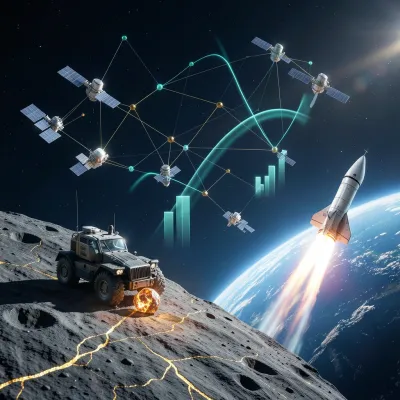
"The Economics of Space" provides a comprehensive framework for understanding value creation, investment, and business models within the burgeoning space economy. The book moves beyond the romanticized view of space, treating it as a functioning marketplace with distinct segments, cost structures, and demand drivers. It meticulously details how value is generated across launch, satellite manufacturing, constellations, in-orbit services, and lunar resources, and how this value is monetized through various downstream applications. A core theme is the interplay between high technical risk, capital intensity, and the evolution of markets.
The book dissects the industry into upstream (launch, manufacturing), midstream (constellations, ground networks), and downstream (data, platforms, applications), highlighting how economics diverge across these layers. Key chapters explore the unique cost curves and pricing strategies in launch, contrasting small launchers focused on cadence with heavy-lift vehicles optimized for mass. Satellite manufacturing is analyzed through the lens of platforms, payloads, and the intricate supply chains that balance boutique craftsmanship with the demands of volume production for constellations across LEO, MEO, and GEO orbits. The discussion extends to the burgeoning markets for in-orbit services like refueling and life extension, and the speculative yet transformative potential of space infrastructure, including stations, depots, and in-space manufacturing.
Crucially, the book emphasizes how non-technical factors profoundly shape the economics of space. Demand is segmented into government, commercial, and dual-use, with governments often acting as anchor tenants that de-risk nascent technologies while commercial demand drives innovation and scalability. Regulation, licensing, and spectrum allocation are presented as market shapers, influencing entry barriers, operational costs, and competitive landscapes. Financing strategies, from venture capital to project finance and public markets, are explored in relation to the risk profiles and capital intensity of different space ventures. The recurring theme of risk, insurance, and catastrophe modeling underscores the industry's inherent fragility and the mechanisms developed to manage potential losses, including the growing economic imperative of sustainability and debris mitigation.
Ultimately, "The Economics of Space" offers a pragmatic guide for investors, entrepreneurs, and policymakers. It stresses the importance of unit economics, learning curves, and strategic planning through scenarios and forecasting to navigate profound uncertainties. Through numerous case studies of successes and failures, the book distills practical lessons, demonstrating that success in the space economy depends not just on technological prowess but on rigorous financial discipline, astute market positioning, and the ability to manage complex partnerships and international dynamics. It argues that the true value of space is increasingly found in the data and services it enables on Earth, pushing the industry towards a software- and analytics-driven future built on reliable orbital infrastructure.
What You'll Find Inside:
- Comprehensive analysis of the space economy value chain from launch to downstream applications, explaining how value is created, who captures it, and which business models are most resilient as the industry scales
- Quantitative frameworks for evaluating space ventures including cost modeling, unit economics, learning curves, and valuation methods (DCF, real options, comparables) tailored to space industry specifics
- Examination of business models across orbital regimes (LEO, MEO, GEO) and emerging segments like lunar resources, in-orbit services, and space tourism with their unique economic drivers
- Detailed coverage of risk management, insurance, financing structures (venture capital, project finance, public markets), and contract types (fixed-price, cost-plus, outcomes-based) specific to space industry challenges
- Policy analysis showing how regulation, licensing, spectrum allocation, and international cooperation shape market dynamics, competitive advantage, and the affordability of critical services
Who's It For:
This book is designed for three primary audiences: investors seeking frameworks to evaluate space opportunities, size markets, and assess risk; entrepreneurs needing tools to shape go-to-market strategies, choose partnership models, and align capital intensity with milestones; and policy analysts wanting to understand how licensing, spectrum policy, and sovereign procurement influence the competitive landscape and service affordability for civil, commercial, and national security users.
Table of Contents:
- Introduction
- Chapter 1 The Space Economy: Scope, Segments, and Definitions
- Chapter 2 Industry Structure and Value Chains
- Chapter 3 Demand Drivers: Government, Commercial, and Dual-Use
- Chapter 4 Launch Market Economics and Pricing
- Chapter 5 Small Launchers vs. Heavy Lift: Capacity, Cost Curves, and Strategy
- Chapter 6 Satellite Manufacturing: Platforms, Payloads, and Supply Chains
- Chapter 7 Constellations and Communications: LEO, MEO, GEO Business Models
- Chapter 8 Earth Observation and Geospatial Analytics: From Pixels to Products
- Chapter 9 Navigation, Timing, and PNT Services
- Chapter 10 In-Orbit Services: Refueling, Tugging, and Life Extension
- Chapter 11 Space Infrastructure: Stations, Depots, and In-Space Manufacturing
- Chapter 12 Lunar Resources and Cislunar Logistics: Prospecting to Processing
- Chapter 13 Space Tourism and Human Spaceflight: Demand, Safety, and Economics
- Chapter 14 Data, Platforms, and Applications: Monetizing Downstream Value
- Chapter 15 Risk, Insurance, and Catastrophe Modeling in Space
- Chapter 16 Regulation, Licensing, and Spectrum: Policy as a Market Shaper
- Chapter 17 Financing the Frontier: Venture, Project Finance, and Public Markets
- Chapter 18 Contracts and Revenue Models: Fixed-Price, Cost-Plus, and Outcomes-Based
- Chapter 19 Cost Modeling and Unit Economics: Learning Curves and Margins
- Chapter 20 Valuation in Space Ventures: DCF, Real Options, and Comparables
- Chapter 21 Partnerships, Ecosystems, and Standards
- Chapter 22 International Competition and Cooperation
- Chapter 23 Sustainability and Debris Mitigation: Economics of Space Environmentalism
- Chapter 24 Scenarios, Forecasting, and Strategic Planning
- Chapter 25 Case Studies: Lessons from Successes and Failures
Author:
Published By:
Date Published:
May 3, 2026
Type:
Nonfiction
Language:
English
Word Count:
61,015 words
Reading Time:
4 hours 16 minutes
Sample:
Order:
Order The Economics of Space: Markets, Investments, and Business Models (Paperback) on MixCache.com:
Buy NowPrint copy is made to order and ships worldwide. Includes the ebook free, ready to read instantly.
$5 account credit for all new MixCache.com accounts, usable toward any ebook purchase!*