
Browse by Category
Fiction
- Action & Adventure
- African American
- Anthologies
- Children's Fiction
- Classics
- Comics & Graphic Novels
- Coming of Age
- Contemporary
- Cultural & Regional
- Drama
- Erotica
- Fantasy
- General
- Historical Fiction
- Horror
- Humor & Satire
- Literary Fiction
- Mystery, Thriller & Suspense
- Poetry
- Religious & Inspirational
- Romance
- Science Fiction
- Short Stories
- War & Military
- Westerns
- Women's Fiction
- Young Adult
Non-Fiction
- Antiques & Collectibles
- Arts & Photography
- Biographies & Memoirs
- Business & Money
- Children's Non-Fiction
-
Computers & Technology
- Artificial Intelligence
- Computer Science
- Cybersecurity & Cryptography
- Data Science & Analytics
- Databases & Big Data
- Game Development & Design
- General
- Hardware & DIY
- Mobile App Development
- Networking & Cloud Computing
- Operating Systems
- Programming
- Robotics
- Software
- Software Engineering
- User Experience (UX) & Design
- Web Development & Design
- Cooking, Food & Wine
- Crafts, Hobbies & Home
- Education & Teaching
- Engineering
- General
- Health, Fitness & Dieting
-
History
- African History
- African History - North Africa
- African History - Sub-Saharan Africa
- American History
- American History - 20th Century
- American History - Civil War
- American History - Colonial Period
- Ancient History
- Asian History
- Asian History - China
- Asian History - India
- Asian History - Japan
- Asian History - Southeast Asia
- European History
- European History - Ancient Greece
- European History - Ancient Rome
- European History - Medieval
- European History - Modern
- European History - Renaissance
- General
- Middle Eastern History
- Military History
- Military History - Aviation
- Military History - Naval
- Social & Cultural History
- World History
- Humor & Entertainment
- Industrial Technology
- Language Learning
- Law
- LGBTQ+ Non-Fiction
- Literary Criticism
- Medical Books
- Parenting & Relationships
- Philosophy
- Politics & Social Sciences
- Reference
- Religion & Spirituality
-
Science & Math
- Agricultural Sciences
- Astronomy & Space Science
- Behavioral Sciences
- Biological Sciences
- Botany & Plant Science
- Chemistry
- Earth Sciences
- Engineering - Chemical
- Engineering - Civil
- Engineering - Electrical
- Engineering - Mechanical
- Environment
- General
- Geology
- Mathematics
- Nature & Ecology
- Oceanography
- Paleontology
- Physics
- Statistics
- Self-Help
- Sports & Outdoors
- Study Aids
- Sustainability & Green Living
- Textbooks
- Transportation
- Travel
- True Crime
- Urban Planning & Development
- Veterinary Medicine
- Writing & Publishing
Jump to Section
MixCache.com Total Access
Unlimited reading and audiobooks for every book published by MixCache.com.
Included titles carry the MTA badge.
Learn more →
Big Data from Space: Processing and Applying Satellite Data for Business
MTA
Techniques and case studies for ingesting, cleaning, analyzing, and monetizing satellite-derived datasets
About this book:
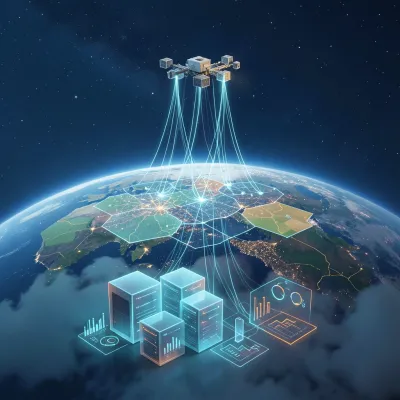
*Big Data from Space* provides a comprehensive framework for transforming raw satellite telemetry into commercially viable analytics. The book begins by detailing the technical foundations of Earth observation, including sensor physics (optical, SAR, thermal), orbital mechanics, and the necessity of cloud-native architectures. It emphasizes the importance of modern standards like SpatioTemporal Asset Catalogs (STAC) and Cloud-Optimized GeoTIFFs (COG) to ensure interoperability and efficient data handling within cloud environments such as AWS, Azure, and Google Cloud.
The core of the book focuses on the end-to-end data pipeline, moving from scalable ingestion and automated preprocessing—covering radiometric, atmospheric, and geometric corrections—to advanced feature engineering and machine learning. It provides practical guidance on building robust models for classification, segmentation, and object detection, while highlighting the critical role of MLOps in managing experiment tracking, model versioning, and drift detection. Specialized chapters on time-series analysis and multi-source fusion (integrating satellite data with AIS, ADS-B, and IoT signals) demonstrate how to extract deep temporal narratives from orbital data.
To ground these technical concepts in business reality, the book features detailed case studies in agriculture, insurance, and logistics. These sections explore high-value applications such as crop yield forecasting, parametric insurance triggers, and global trade flow monitoring. The text also addresses the commercial side of the industry, offering strategies for product design, API development, and various monetization models, ranging from data subscriptions to "Insights-as-a-Service."
Finally, the book examines the operational and ethical dimensions of building an Earth observation business. It covers performance and cost optimization to manage the high "total cost of ownership" associated with spatial data, alongside rigorous validation and uncertainty quantification. The concluding chapters provide a roadmap for team building and organizational structure, while stressing the vital importance of data governance, privacy, and the ethical responsibility to mitigate algorithmic bias in global monitoring systems.
What You'll Find Inside:
- Learn to design scalable ingestion pipelines that index satellite scenes as they arrive, enabling efficient event-driven processing and STAC-based cataloging.
- Master preprocessing techniques including radiometric, atmospheric, and geometric corrections to transform raw satellite data into reliable, analysis-ready datasets.
- Build and productionize machine learning models for imagery classification, segmentation, and detection using MLOps practices for experiment tracking, versioning, and continuous delivery.
- Explore real-world case studies in agriculture, insurance, and logistics to see how satellite data drives decisions on crop yield, catastrophe response, and global trade flows.
- Implement data governance, cost optimization, and ethical frameworks to ensure compliance, scalability, and responsible use of satellite analytics in business applications.
Who's It For:
This book is intended for startup founders validating new Earth observation products, enterprise teams modernizing geospatial stacks, and analysts seeking to move beyond prototypes into reliable services. Readers should possess foundational skills in Python, SQL, and cloud console operations. By following the practical guidance, you will gain the ability to ingest, clean, analyze, and monetize satellite-derived datasets with confidence, ship customer-facing APIs and dashboards, and scale operations without sacrificing scientific rigor.
Table of Contents:
- Introduction
- Chapter 1 The Earth Observation Landscape: Sensors, Orbits, and Markets
- Chapter 2 Data Sources and Licensing: Open, Commercial, and Tasking
- Chapter 3 Spatial Fundamentals: Projections, Grids, and Datacubes
- Chapter 4 Standards and Metadata: STAC, Cloud-Optimized GeoTIFFs, and Interoperability
- Chapter 5 Architectures in the Cloud: AWS, Azure, and Google Cloud for EO
- Chapter 6 Storage Patterns: Data Lakes, Lakehouses, and Tiling Strategies
- Chapter 7 Ingestion at Scale: ETL/ELT, Event-Driven Pipelines, and STAC Indexing
- Chapter 8 Cleaning and Preprocessing: Radiometric, Atmospheric, and Geometric Corrections
- Chapter 9 Feature Engineering: Spectral Indices, Textures, and Spatiotemporal Aggregations
- Chapter 10 Machine Learning for Imagery: Classification, Segmentation, and Detection
- Chapter 11 Time-Series and Change Detection: Monitoring, Alerts, and Forecasting
- Chapter 12 Multi-Source Fusion: Optical, SAR, Thermal, AIS/ADS‑B, and IoT
- Chapter 13 MLOps for EO: Experiment Tracking, Model Versioning, and Continuous Delivery
- Chapter 14 Validation and Uncertainty: QA/QC, Benchmarks, and Ground Truthing
- Chapter 15 Performance and Cost Optimization: GPUs, Serverless, and TCO Management
- Chapter 16 Data Governance, Privacy, and Compliance for Satellite Analytics
- Chapter 17 APIs and Products: Tiles, Vectors, and Insights‑as‑a‑Service
- Chapter 18 Monetization Models: Pricing, Packaging, and Contracts
- Chapter 19 Case Study—Agriculture: Crop Type, Yield, and Field Health
- Chapter 20 Case Study—Insurance: Catastrophe, Exposure, and Parametric Triggers
- Chapter 21 Case Study—Logistics: Port Congestion, Routing, and Trade Flows
- Chapter 22 Enterprise Integration: Snowflake, Databricks, and BI Tooling
- Chapter 23 Go‑to‑Market: Pilots, Partnerships, and Cloud Marketplaces
- Chapter 24 Building the Team: Roles, Skills, and Operating Models
- Chapter 25 Ethics and Responsible Use: Bias, Transparency, and Societal Impact
Author:
Published By:
Date Published:
May 3, 2026
Type:
Nonfiction
Language:
English
Word Count:
53,174 words
Reading Time:
3 hours 43 minutes
Sample:
Order:
Order Big Data from Space: Processing and Applying Satellite Data for Business (Paperback) on MixCache.com:
Buy NowPrint copy is made to order and ships worldwide. Includes the ebook free, ready to read instantly.
$5 account credit for all new MixCache.com accounts, usable toward any ebook purchase!*


