
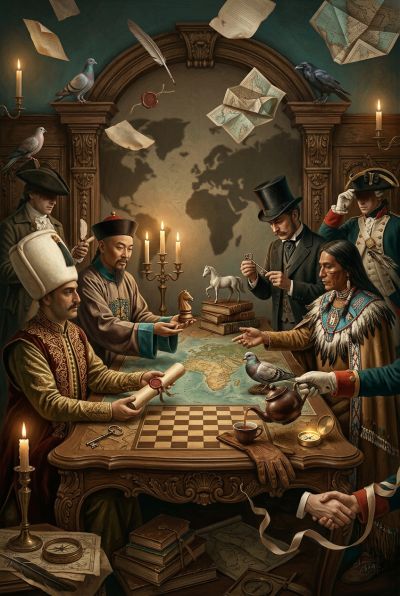
When most people picture diplomacy, they imagine solemn ambassadors exchanging sealed documents in paneled rooms. Unusual Diplomacy flips that image, inviting readers into the stranger corners of international relations where a table‑tennis match, a model kitchen, or a furry ambassador from China has tipped the scales of power. The book reads like a guided tour through history’s most inventive, audacious, and occasionally bizarre moments when states chose to communicate beyond the usual playbook.
What the book is about
Spanning twenty‑five chapters plus an introduction, Unusual Diplomacy moves chronologically and thematically from early modern papal decrees to twenty‑first‑century cyber negotiations. Each chapter isolates a single episode—such as the Ping‑Pong Diplomacy of 1971, the Kitchen Debate of 1959, or the Cod Wars of the 1970s—detailing the actors, the unconventional tools employed, and the political fallout. The author’s tone is curious rather than triumphalist, aiming to show how creativity, desperation, or sheer audacity can rewrite the rules of statecraft. The intended audience includes history students, foreign‑affairs practitioners, and any reader who enjoys learning how seemingly trivial gestures—a silk‑screen portrait, a pair of pandas, a carefully edited telegram—have altered the course of nations.
Ping‑pong as an accidental icebreaker
The opening chapter recounts how a missed bus at the 1971 World Table Tennis Championships set in motion a thaw between the United States and China. Glenn Cowan, an American player with a hippie persona, boarded the Chinese team’s bus, prompting Zhuang Zedong to offer a silk‑screen portrait of the Huangshan Mountains as a gift. The text notes that Zhuang "chose to defy the prevailing caution" and that Mao later quipped the "little ball" of ping pong would move the "big ball" of the Earth. This simple, low‑stakes exchange produced a photograph that flashed worldwide, leading Mao to invite the American team to China. As the book relates, the visit culminated in Premier Zhou Enlai declaring, "You have opened a new page in the relations of the Chinese and American people," and Nixon soon easing the two‑decade‑old trade embargo. The episode illustrates how a spontaneous, non‑governmental gesture can create the diplomatic groundwork for far more formal negotiations.
The Kitchen Debate: ideology over appliances
Chapter 4 transforms a model American kitchen in Moscow into a surreal Cold War showdown between Vice‑President Richard Nixon and Soviet Premier Nikita Khrushchev. Surrounded by reporters, the two leaders squared off over washing machines, color television, and processed foods. Nixon opened with, "In America, we like to make life easier for women," to which Khrushchev shot back, "Your capitalistic attitude toward women does not occur under Communism." The debate later shifted to a broader question: "Would it not be better to compete in the relative merit of washing machines than in the strength of rockets?" Khrushchev sarcastically asked, "Don't you have a machine that puts food into the mouth and pushes it down?" The exchange, recorded and broadcast in both countries, became a piece of political theatre that reframed the superpower rivalry around everyday comforts rather than missiles. The book argues that the Kitchen Debate captured the shifting battle for hearts and minds, where the promise of a better life—symbolized by a gleaming, futuristic kitchen—became a diplomatic weapon.
The Cod Wars: cutting nets, not cannon fire
Chapter 5 details Iceland’s inventive, non‑lethal tactics against the far stronger Royal Navy during a series of confrontations over fishing rights. Faced with British trawlers operating in disputed waters, the Icelandic Coast Guard deployed specially designed "trawl wire cutters"—sharp hooks towed behind patrol vessels that would snag the steel cables connecting a trawler to its net, allowing the net’s drag to snap the cable and send the gear to the sea floor. As one observer noted in the text, "A trawler without a trawl had nothing to do but go home." The Icelanders used this tactic to cut at least eighty‑two trawls during the Second Cod War, despite being hopelessly outmatched at sea. Crucially, Iceland leveraged its NATO membership and the strategic Keflavík airbase, threatening to close the base unless Britain conceded. The book emphasizes that Iceland, "a nation with a population smaller than a medium‑sized British city and no military," won every confrontation through a mix of audacious, non‑lethal maneuvers at sea and shrewd exploitation of its geopolitical leverage on land.
Panda Diplomacy: soft power in black and white
Chapter 6 explores how China transformed the giant panda from a rare bear into a potent diplomatic asset. The text describes panda diplomacy as "a masterclass in soft power, transforming a rare and beloved animal into a potent symbol of friendship and goodwill." It traces the practice from Tang‑Dynasty gifts to the 1972 loan of Ling‑Ling and Hsing‑Hsing to the United States following Nixon’s visit, noting that the pandas arrived to "Panda‑monium" and drew 75,000 visitors on their first weekend. The book then explains the shift under Deng Xiaoping: China stopped gifting pandas and began loaning them, with "a standard agreement […] a 10‑year loan of a breeding pair for a fee that can be as high as one million US dollars per year" and stipulating that any cubs born during the loan period "are considered the property of China and must typically be returned to join the country's breeding program before they turn four." The chapter also notes how panda loans have been linked to larger trade deals, such as Scottish salmon and uranium agreements, making the animals a high‑profile symbol of broader strategic partnerships. By presenting pandas as furry emissaries, China has turned a simple gesture into a nuanced instrument of soft power that transcends ideology.
Track II diplomacy: the power of unofficial channels
Chapter 16 examines how private citizens, academics, and NGOs have steered peace processes when official talks stall. The author defines Track II as "the world of secret backchannels, of peacemaking by private citizens," citing the Dartmouth Conferences—which began in 1960 and brought together influential Americans and Soviets for off‑the‑record discussions—as a "crucial and continuous backchannel" that helped manage superpower rivalry. The chapter then highlights the Oslo Accords, where two Israeli professors and a Norwegian sociologist facilitated secret talks that eventually produced the Declaration of Principles, leading to the historic handshake between Yitzhak Rabin and Yasser Arafat on the White House lawn. The text calls this "the quintessential demonstration of the Track II model: using unofficial channels to build trust and create a framework that official diplomacy could then adopt and formalize." The book stresses that while Track II cannot replace the authority of Track I negotiations, it provides a laboratory for new ideas and a sanctuary for building trust, often long before the world notices the seeds of peace have been sown.
Read “Unusual Diplomacy” on MixCache.com →
Please log in or create an account to leave a comment.
No comments yet. Be the first to say something.