

Walking Through Three Millennia of Egyptian Wonder
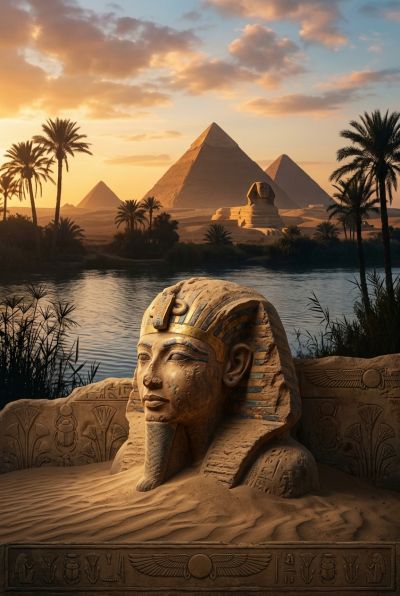
Égypte antique offers something increasingly rare in popular histories: a scholar's command of primary sources wedded to a storyteller's instinct for human detail. Dr. Alex Bugeja doesn't just catalog kings and monuments; he traces the deep currents that let a civilization thrive along the Nile for three thousand years.
What the Book Covers
Spanning thirty-five chapters plus a detailed introduction, Bugeja guides readers from the predynastic settlements of 5000 BCE through the Roman annexation in 30 BCE. The book moves roughly chronologically but constantly circles back to three connecting themes: the centrality of the Nile's annual flood, the concept of Maât (cosmic order), and how Egypticism survived foreign domination. Each period receives thorough treatment—Old Kingdom pyramid builders, Middle Kingdom cultural flowering, New Kingdom empire-building, plus the turbulent intermediate periods and later foreign dynasties. Technical appendices explain writing systems and archaeological evidence. The intended audience is general readers comfortable with French academic prose; prior knowledge helps but isn't required.
Maât: The Order That Bound Everything
Bugeja returns obsessively to Maât, which he defines as "la vérité, l'équilibre, l'ordre, l'harmonie, la loi, la moralité et la justice"—an abstract principle made concrete through the pharaoh's daily responsibilities. This wasn't mere philosophy; it was operational theology. When the Nile flooded predictably, depositing fertile black land, that was Maât. When the king struck down enemies or distributed grain properly, that was Maât. The concept appears everywhere: in Chapter 4's description of how nomarchs maintained local irrigation projects as their share of royal duty, in Chapter 12's discussion of Akhenaton's religious revolution as an assault on Maât itself, and in Chapter 20's account of Persian governors trying to work within Egyptian bureaucratic systems. Readers finish understanding why Egyptian art looks so static and ceremonious—because it was preserving and reenacting Maât, not merely decorating space.
The Democratization of the Afterlife
One of the book's most original threads tracks how access to eternal life slowly widened. Chapter 5 shows Old Kingdom tombs containing "des sépultures d'élite... avec un mobilier funéraire de plus en plus riche et diversifié," suggesting hereditary privilege. But Chapter 6 reveals how the First Intermediate Period, with its collapsing central authority, forced ordinary scribes and officials to seek salvation independently. The breakthrough comes via the Sarcophant Texts—"des textes... destinés à fournir au défunt... la connaissance magique nécessaire pour naviguer dans les dangers du monde souterrain (Douat)" that spread beyond royalty. By New Kingdom times, even common artisans at Deir el-Médineh could contemplate justified judgment before Osiris. This shift from aristocratic afterlife to popular salvation mirrors Egypt's political evolution and makes familiar myths feel freshly complex.
Religion as Political Weapon
The Akhenaton saga (Chapter 12) becomes fascinating not as personality drama but as systemic rupture. Bugeja presents the pharaoh's monotheistic experiment as deliberate assault on established power structures: closing temples meant stripping wealth from "le sacerdoce d'Amon-Rê, qui avait été si vigoureusement réprimé," while erasing divine names threatened enemies' "existence dans l'au-delà." But the aftermath proves even more telling. Chapter 13 shows how Tutankhamun's restoration involved literally rebuilding the temple economy—reopening shrines, restoring clerical salaries, and reestablishing the "rétablissement de leurs offrandes et dotations." Religion wasn't separate from statecraft; it was infrastructure. Even later Persian and Roman rulers understood this—maintaining traditional cult titles and temple construction wasn't courtesy but necessity for extracting wealth from Egypt.
Daily Life in a Sacred Landscape
Chapter 15's descriptions of New Kingdom domestic life reveal how ordinary people lived inside extraordinary beliefs. Houses "souvent composées d'une ou deux pièces, parfois avec une petite cour ouverte pour la cuisine" sit beside temples that housed gods literally. The contrast matters because readers often imagine ancient Egypt as entirely monumental. Instead, Bugeja shows farmers who accepted their tax burdens because they believed correct burial practices, not rebellion, secured happy afterlife. Women "pouvaient posséder, hériter et léguer des biens indépendamment de leur mari," making Egypt unusual among ancient societies. The section on toys—wooden animals, dolls, ball games—makes the past intimate. Yet this intimacy always connected to larger systems: those toys existed because parents believed children needed protection from death's randomness, a fear that justified everything from amulets to state religious festivals.
Foreign Rule as Cultural Mirror
Rather than treating conquest periods as decline, Bugeja shows how each foreign wave engaged Egypticism on its own terms. The Hyksos (Chapter 9) introduced chariots and composite bows but also built temples mixing Egyptian and Canaanite styles. Persian governors (Chapter 20) adopted pharaonic titulary and "faits l’échange d’une certaine clémence et de pragmatisme pour gouverner son vaste empire multiculturel." Even the notorious damnatio memoriae applied to Hatshepsut (Chapter 11) was political theater—"un acte systématique pour effacer le nom et l'image d'Hatshepsut des monuments publics"—aimed at restoring patrilineal succession rather than erasing memory. Each conqueror became, temporarily, more Egyptian than they'd arrived. This isn't cultural surrender but evidence that Egyptian frameworks proved more adaptable than invaders' assumptions.
Who Should Read This
This book rewards patient general readers who enjoy detailed historical narratives and want more than timeline summaries. Anyone fascinated by how environment shapes culture will appreciate the Nile-centered analysis. Readers seeking quick celebrity biographies should look elsewhere—this spends more time on nomarchs and scribes than Ramses II. French proficiency helps since the text assumes familiarity with basic archaeological terminology without defining every term. The book's greatest strength lies in showing how Egyptian achievements emerged from ordinary problem-solving rather than supernatural mystery, making ancient bureaucratic records feel genuinely revelatory.
Read “Égypte antique” on MixCache.com →
Please log in or create an account to leave a comment.
No comments yet. Be the first to say something.