

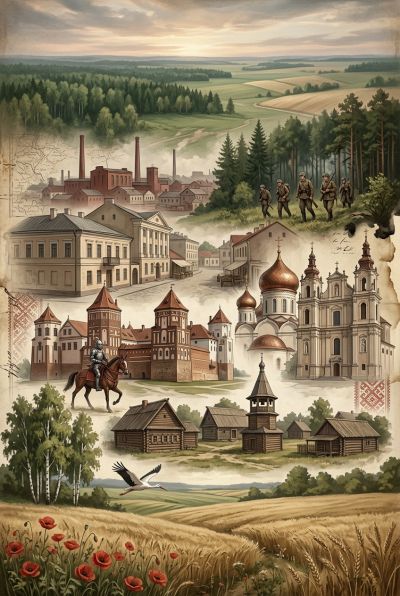
Belarus occupies a unique place in European consciousness—a land often overlooked in broader historical narratives, yet perpetually shaped by the tectonic shifts of empire and ideology. Alexei Sokolov’s A History of Belarus offers a meticulous exploration of how this enigmatic nation evolved from a patchwork of tribal territories into a modern state teetering on the edge of geopolitical uncertainty. The book’s strength lies in its unflinching examination of Belarus’s perpetual struggle to define itself amid foreign dominance, a theme that resonates powerfully in today’s volatile international climate.
What the book covers
The narrative spans from the earliest Baltic and Finno-Ugric settlements to the present day, organized into 25 chapters that trace Belarus’s transformation through distinct historical epochs. Sokolov structures the work around key turning points: the rise and decline of the Principality of Polotsk, the formation of the Grand Duchy of Lithuania, the Polish-Lithuanian Commonwealth, the brutal Russification under the Tsars, the brief flicker of the 1918 Belarusian People’s Republic, the Soviet crucible, and the post-1991 era under Alexander Lukashenka. The intended audience includes readers interested in Eastern European history, post-Soviet transitions, and the complex interplay of national identity and geopolitical strategy.
Geography as Destiny
Sokolov opens by emphasizing how Belarus’s flat terrain and lack of natural barriers made it "a crossroads for armies, traders, and cultures," a vulnerability that defined its historical trajectory. This geographic reality becomes a recurring motif, explaining why the territory "had for centuries been a thoroughfare for armies, a prize in imperial conflicts, and a space where cultures had clashed and mingled." The land’s openness to external forces shaped every major transformation, from Slavic assimilation of Baltic tribes to the devastation of repeated invasions, making geography not just backdrop but a central character in the national story.
The Uniate Schism and Cultural Fragmentation
Religious identity emerges as a source of division in Chapter 6, where the Union of Brest in 1596 fractured the Orthodox Church. Sokolov details how the creation of the Uniate Church—"rejected by Prince Konstanty Ostrogski, who viewed it as a secret conspiracy by a handful of bishops that betrayed the Orthodox faith"—spawned centuries of "Rus' fighting against Rus'." This internal religious schism, born from a desperate bid for unity, created lasting wounds that complicated later national movements, illustrating how attempts to solve cultural dilemmas often generated new complexities.
The Soviet Crucible and Cultural Erasure
Chapters 13 through 17 dissect the Soviet era’s dual character of forced modernization and systematic repression. Sokolov highlights the "Great Break" of the late 1920s, where Stalin’s policies brought "unparalleled devastation; military operations and the brutal Nazi occupation resulted in the loss of about a quarter of the population and the ruin of its economy." The post-war reconstruction, while rebuilding cities like Minsk into "a model socialist city," intensified Russification, creating a citizenry fluent in Russian but estranged from its own linguistic traditions—a legacy that would complicate independence decades later.
Chernobyl: The Invisible Wound
The 1986 Chernobyl disaster is portrayed not merely as an environmental catastrophe but as a catalyst for national awakening. Sokolov notes that the radioactive plume fell "directly north and northwest, into the Byelorussian SSR," with the heaviest fallout devastating southern regions. The official cover-up—"the first reports that reached Moscow were confusing and downplayed the scale of the event"—shattered public trust in the Soviet state, inadvertently fueling the "quiet revolution" of cultural revival that would bloom in the later perestroika era.
The 2020 Revolution and Its Aftermath
The book’s final chapters chronicle the explosive summer of 2020, where the arrest of opposition figures and a disputed election ignited mass protests. Sokolov captures the surreal nature of the crisis; the regime’s attempt to terrorize citizens backfired spectacularly, as evidenced by the "great, festive summer of awakening" turning into a "long, grim political winter" of repression. The aftermath—including the forced landing of a Ryanair flight to arrest journalist Raman Pratasevich—transformed Belarus into "a co-aggressor in the largest European war since 1945," sealing its international isolation and military subjugation to Russia.
Who Should Read This
This book is essential for readers seeking to understand the complexities of Eastern European identity formation, particularly those interested in how small nations navigate the pressures of larger neighbors. It will appeal to history enthusiasts, political scientists studying post-Soviet transitions, and anyone curious about Belarus’s unique path to statehood. Readers expecting a focus on recent events alone may find the extensive medieval and imperial context overwhelming, but for those willing to engage with its sweeping scope, Sokolov provides an indispensable framework for grasping a nation perpetually "at a crossroads between East and West."
Read “A History of Belarus” on MixCache.com →
Please log in or create an account to leave a comment.
No comments yet. Be the first to say something.