

Tracing Humanity’s Sonic Journey Through Time and Technology
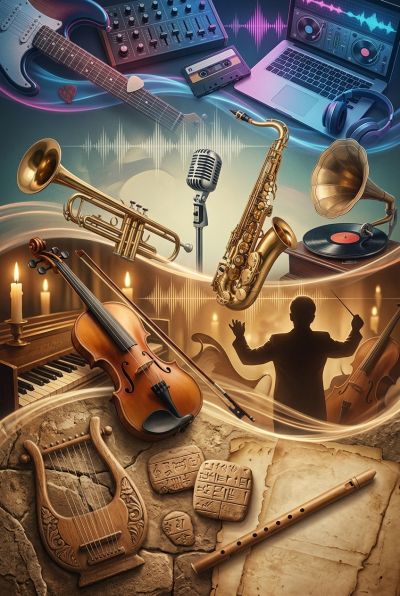
Music is more than melody and rhythm—it is a mirror held up to every civilization that ever existed, reflecting its values, struggles, and aspirations. In A History of Music, Julian Ives offers a sweeping yet intimate exploration of how humanity’s relationship with organized sound evolved from bone flutes in Ice Age caves to algorithmic compositions in our smartphones. The book balances rigorous scholarship with narrative flair, making each epoch feel both immediate and consequential.
What the Book Covers
The volume is organized as a chronological tour through twenty-five chapters, beginning with prehistoric instruments and concluding in the digital present. Its structure mirrors the evolution of musical thought itself: starting with primal sound-making, moving through ancient notation systems, classical forms, romantic expression, modernist ruptures, and ending with today’s streaming platforms. The intended audience ranges from curious newcomers to seasoned listeners seeking a panoramic overview. Readers will encounter detailed portraits of pivotal composers, analyses of technological innovations, and discussions of how social movements shaped compositional choices. The prose assumes no specialized prior knowledge while rewarding attentive engagement with unfamiliar cultures and periods.
The Dawn of Sound – From Flutes to Notation
The opening chapter paints a vivid picture of humanity’s earliest musical impulses, describing how "[t]he voice is the original instrument" and how percussive elements like clapping and foot-stomping "could create powerful, complex rhythms to accompany dance, ritual, or work." Ives details archaeological marvels such as the Divje Babe flute, a possibly thirty-five-thousand-year-old cave-bear femur that might represent "the oldest potential evidence for this ancient impulse," alongside the undisputed German ivory flutes that "feature carefully spaced finger holes that suggest a sophisticated understanding of acoustics." The narrative also highlights early notational milestones, such as the Hurrian Hymn to Nikkal, which survives on a clay tablet as "the oldest known piece of notated music"—a 3,400-year-old melody that can still be performed today.
The Romantic Spirit – Emotion Over Reason
Chapter Ten and its successors chart the Romantic era’s break from Classical restraint, asserting that "[i]n this new age, passion, individualism, and nature supplanted the measured elegance of earlier centuries." Ives explains how composers like Chopin transformed the piano into a vessel for personal confession, noting that Chopin’s études were designed so that "technique should never be an end in itself but should always serve a poetic purpose." The author also connects this emotional turn to broader cultural shifts, observing that "[t]he Romantic composer was a visionary, a seer, a high priest of a new religion of Art," while his listeners became "a public of passive listeners, there to witness the artist's act of self-revelation." This reframing helps readers understand why Romantic symphonies feel so expansive and introspective compared to their predecessors.
Breaking Tradition – The Birth of Minimalism and Electronic Sounds
Chapters Twenty-Two and Twenty-Three examine how 20th-century composers reacted against the dense chromaticism of late Romanticism and early modernism. Ives characterizes minimalism as a response that seeks to "[m]ake music that was more subtle, more suggestive, and more quintessentially French" and later as a movement that valued repetition, steady pulse, and consonant harmony. Terry Riley’s In C is presented as a watershed moment where performers could "decide for themselves how many times they will repeat a given pattern before moving on to the next, with the only rule being that they should try to stay within two or three patterns of each other"—a democratization of compositional process. The transition to electronic music is framed as the realization of a longstanding ambition to "[c]reate sound directly from the imagination" without relying on traditional instruments, a frontier opened by pioneers like Pierre Schaeffer and Karlheinz Stockhausen.
The Global Pulse – From Rock to Hip-Hop and Beyond
In the later chapters, Ives underscores how music became a truly global lingua franca. He notes that "hip-hop became a central thread in the book’s narrative, with its birth traced to the "momentous development" of Clive Campbell (DJ Kool Herc) pioneering turntable techniques in the Bronx." This technique, which extended instrumental breaks indefinitely, laid the foundation for a genre that would eventually become the "dominant voice of global youth culture." The author also examines early rock and roll as a hybrid of rhythm-and-blues and country, but stresses that its pioneers—Bill Haley, Chuck Berry, and Little Richard—"were the true architects" of a sound that would reshape pop culture. In the 21st century, globalization accelerates: "K-Pop... has become an inescapable global hit," and Afrobeats and Latin reggaeton demonstrate that "the global audience no longer demands that its stars conform to an English-language standard."
Technology’s Double Edge – Streaming, Social Media, and AI
The final chapter grapples with the digital transformation of music consumption. Ives describes the industry’s panic when Napster "brought the entire edifice to the brink of collapse" and how streaming platforms "moved music from a product to be purchased into a utility, something constantly available, like water or electricity." He highlights the paradox of abundance, noting that "[t]he album, once the central artistic and commercial statement for a musician, has seen its importance diminish in favor of the single and, even more significantly, the playlist." The rise of artificial intelligence poses both opportunities and anxieties: "AI models... are now capable of generating original compositions in virtually any style, and can even create vocals that are indistinguishable from a human singer," raising questions about "the nature of creativity and authorship."
Who Should Read This
This volume will reward readers who relish deep historical surveys and enjoy tracing cultural currents across centuries. It serves music students seeking a panoramic perspective, casual listeners curious about the forces that shaped their playlists, and anyone fascinated by the interplay between art and technology. Readers seeking only a narrow focus—say, exclusively popular music or contemporary trends—may find the breadth overwhelming, but those willing to follow Ives’s guided tour will emerge with a richer understanding of how every song carries within it echoes of ancient rites, philosophical debates, and technological breakthroughs.
Read “A History of Music” on MixCache.com →
Please log in or create an account to leave a comment.
No comments yet. Be the first to say something.