

An Excerpt from “The World's Greatest Buildings”
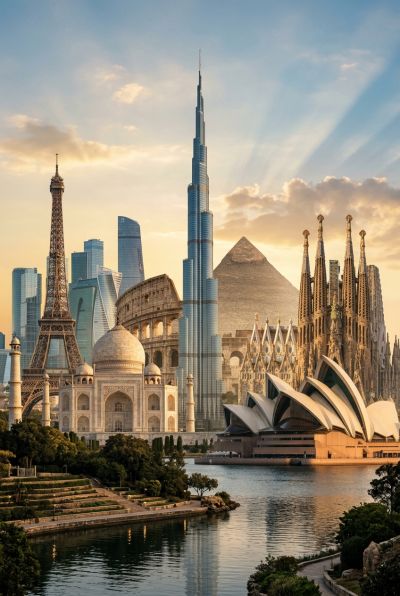
The following is an excerpt from “The World's Greatest Buildings” by Dr Alex Bugeja PhD, available on MixCache.com.
Introduction
What is it that drives us, as a species, to build? The question is almost as fundamental as asking why we breathe or why we dream. The need for shelter is, of course, the simple answer. The earliest humans sought refuge in caves and simple clearings, their architectural ambitions extending no further than a dry place to sleep and a defensible position against things with sharp teeth. But somewhere along the evolutionary road, this basic, practical need blossomed into something far more profound. Utility was joined, and often completely overshadowed, by artistry, ego, faith, and a ferocious desire to create something that would outlast a single human lifetime. We didn't just want to survive the world; we wanted to mark it, to stamp our presence upon the landscape in a way that defied the passage of time.
This book is about the results of that monumental impulse. It is a journey to twenty-five of what can be argued are the world's greatest buildings. Immediately, we run into a problem of definitions. What, precisely, makes a building "great"? The question is fraught with subjectivity. Is it size? Age? Beauty? Influence? The truth is that greatness in architecture is not a single, measurable quality but a confluence of factors. It is a blend of audacious ambition, technical genius, cultural significance, and that ineffable ability to stir the human soul. A building can be considered great because it was a revolutionary feat of engineering that pushed the known limits of its time. Another might earn its place through sheer, breathtaking beauty—a perfect marriage of form, material, and light that elevates it to the level of high art. Yet another may be great because of the history that has unfolded within its walls, its stones silent witnesses to the triumphs and tragedies of civilization.
The selection of the twenty-five buildings profiled in the coming chapters was, therefore, an exercise in balancing these varied criteria. It is not intended to be a definitive, ranked list—such a thing would be impossible and, frankly, a bit silly. There are, without question, hundreds, if not thousands, of other structures that could justifiably be included. Instead, think of this collection as a curated tour through the story of human creativity, told through the medium of stone, steel, glass, and wood. The structures we will explore are scattered across the globe and span millennia, from the inscrutable power of ancient megaliths to the glittering hubris of modern skyscrapers.
In each chapter, we will attempt to understand not just the what, but the why. Why was this particular structure built, in this particular place, at this particular time? We will delve into the minds of its creators—the architects, engineers, and laborers who poured their lives into these projects. Often, the story of a great building is a story of great obsession. It is about the pharaoh seeking a vessel for his journey to the afterlife, the emperor wishing to project his absolute power, or the medieval stonemason dedicating his entire existence to glorifying God, knowing full well he would never see the completed cathedral. These are stories of immense sacrifice, of logistical nightmares, of political maneuvering, and of moments of pure, unadulterated genius.
We will see how architecture has always been a mirror, reflecting the societies that produced it. The soaring arches and stained-glass windows of a Gothic cathedral speak of an age consumed by faith and the promise of the divine. The clean lines and functional focus of a modernist skyscraper reflect a 20th-century preoccupation with efficiency, commerce, and technological progress. The opulent and dizzyingly intricate tilework of an Islamic palace reveals a culture's deep reverence for mathematics, pattern, and the sacred beauty of geometry. By studying these buildings, we gain a deeper understanding not just of architectural history, but of human history itself.
One of the central themes you will encounter throughout this book is ambition. Great buildings are rarely born from modesty. They are acts of supreme confidence, sometimes bordering on arrogance. They are physical arguments against forgetting, statements of intent designed to impress, intimidate, and inspire. Whether it is the ambition to build closer to the heavens, to create a tomb that will last for eternity, or to design an opera house that becomes the symbol of a nation, this driving force is the engine of architectural greatness. It is the refusal to accept the world as it is and the determination to impose a new reality upon it.
Of course, ambition requires ingenuity. Another thread connecting these disparate structures is the relentless pace of innovation. From the moment our ancestors figured out how to make a lintel span an opening, we have been solving problems. How do you lift a multi-ton stone block to the top of a pyramid? How do you create a self-supporting dome of unprecedented size? How do you build a tower so tall that it seems to pierce the clouds? Each of the buildings in this book represents a masterclass in problem-solving. Their builders devised new techniques, invented new tools, and pioneered the use of materials in ways no one had before. They were not just artists; they were brilliant engineers and project managers, orchestrating vast armies of workers and coordinating complex supply chains.
Functionality, too, must be considered. While we may look at many of these structures today primarily as tourist attractions or historical artifacts, they were almost all built with a specific purpose in mind. A fortress must be defensible. A cathedral must be able to accommodate a congregation and inspire reverence. An office building must be a practical and healthy place to work. The enduring greatness of these buildings often lies in how well their form follows their function, how the design serves and enhances the building's purpose in a way that is both efficient and elegant.
Finally, there is the simple, undeniable power of beauty. Aesthetics are subjective, of course, but the structures in this book have achieved a near-universal acclaim for their visual and emotional impact. They possess a harmony of proportion, a mastery of materials, and a quality of light and space that can stop you in your tracks. They have what one might call "emotional resonance"—the ability to make you feel something. It is the sense of awe that washes over you when you first stand before the Colosseum, the feeling of tranquility that pervades the Taj Mahal, or the dizzying vertigo induced by the Eiffel Tower. These buildings are more than just the sum of their parts; they are experiences.
In the pages that follow, we will embark on our tour. For each building, we will explore its conception, the historical context that gave rise to it, the challenges of its construction, and its life story, including its current status. We will journey from the dusty plains of Egypt to the jungles of Cambodia, from the heart of imperial Rome to the bustling metropolis of Dubai. We begin with the oldest and arguably the most mysterious of them all, a structure that has captivated the human imagination for more than four and a half thousand years. It is a building that embodies the monumental impulse in its purest form, a king's megalomaniacal and utterly successful attempt to cheat death and achieve immortality. Let us turn now to Chapter One, and the Great Pyramid of Giza.
Read “The World's Greatest Buildings” on MixCache.com →
Please log in or create an account to leave a comment.
No comments yet. Be the first to say something.