

An Excerpt from “The World's Greatest Aviation Disasters”
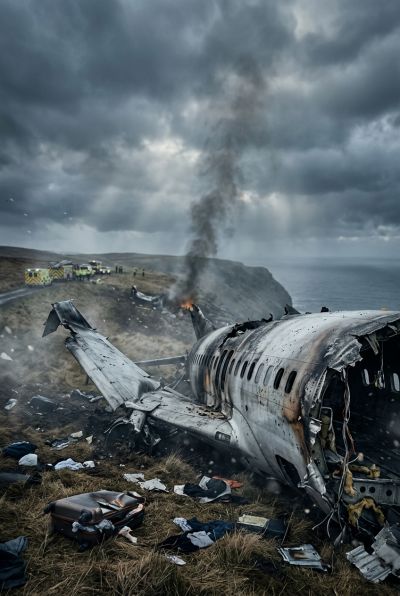
The following is an excerpt from “The World's Greatest Aviation Disasters” by George Hargreaves, available on MixCache.com.
Introduction
To slip the surly bonds of Earth has been a profound, almost primal, human desire for millennia. We have gazed at birds, envied their effortless glide on unseen currents, and dreamed of the freedom of the skies. For most of human history, this remained purely in the realm of myth and fantasy. Yet, in little more than a century, we have transformed that dream into the most mundane of realities. We have built machines of aluminum and composite materials that defy gravity, shrinking our world and connecting its farthest corners in ways previously unimaginable. We board these flying buses with barely a thought, complaining more about the lack of legroom than celebrating the sheer miracle of soaring at thirty-five thousand feet.
This book is about the moments when the miracle fails. It is an exploration of the instances where the intricate dance of physics, engineering, and human skill goes terribly wrong. The history of aviation is one of breathtaking success, but it is a story written on a ledger where the debit column is filled with wreckage and loss. From the very beginning, the pursuit of flight has been shadowed by its inherent dangers. Wilbur Wright’s first attempt at powered flight on December 14, 1903, ended in a stall and a crash into the sand. The first passenger ever carried on a powered airplane, Lieutenant Thomas E. Selfridge, also became the first passenger to die in one, during a demonstration flight with Orville Wright in 1908. The early days of aviation were marked by trial, and immense, often fatal, error.
The pioneers of flight were inventors and daredevils, pushing the limits of primitive technology and their own understanding. The aircraft were fragile constructs of wood, wire, and fabric, their engines temperamental and their behavior in the air often unpredictable. Accidents were tragically common. In the late 1920s, the accident rate was roughly one for every million miles flown. If that rate existed today, it would translate into thousands of fatal crashes every year. Yet, despite the dangers, the allure of the sky was irresistible. Passenger numbers grew, from a mere 6,000 in 1929 to nearly half a million by 1934, even though flying was exclusively the domain of the wealthy.
The period following the Second World War, and particularly the dawn of the Jet Age in the 1950s, transformed aviation completely. The introduction of jet engines revolutionized air travel, making it faster, more efficient, and more reliable. Aircraft became larger and capable of flying much farther, shrinking the globe for a new generation of travelers. By 1955, more people in the United States were traveling by air than by train, and by 1957, airliners had surpassed ocean liners for transatlantic crossings. As the industry boomed, air travel transitioned from a glamorous adventure for the "jet set" to a mode of mass transportation. Between 1955 and 1972, the number of air passengers more than quadrupled.
With this explosion in air traffic came a new and urgent focus on safety. The haphazard, learn-as-you-go approach of the early days was no longer sustainable. The sheer volume of flights demanded a more systematic approach to preventing disasters. This led to the establishment of powerful regulatory bodies, like the Federal Aviation Administration (FAA) in the United States, tasked with creating and enforcing standards for everything from aircraft design and maintenance to pilot training and air traffic control. The primary goal of these organizations was, and remains, to make flying as safe as humanly and technologically possible.
One of the most fundamental concepts to emerge from the study of aviation disasters is the "error chain." Accidents are almost never the result of a single, catastrophic failure or one terrible decision. Instead, they are the culmination of a sequence of smaller, often seemingly minor, events and human errors that link together. If even one link in that chain had been broken, the disaster could have been averted. This concept is a recurring theme throughout the stories in this book.
The organizational theorist James Reason famously illustrated this idea with his "Swiss Cheese Model." He pictured a company's or a system's defenses against failure as slices of Swiss cheese lined up one behind the other. Each slice—be it technology, training, regulations, or procedures—has holes in it, representing weaknesses. These holes are constantly shifting and changing. A disaster occurs only when, by a fatal alignment of circumstances, the holes in all the slices line up, allowing a "trajectory of accident opportunity" to pass through and cause a catastrophic failure.
These holes, or latent failures, can lie dormant within a system for a long time. They can be anything from a flaw in an aircraft's design, a gap in a maintenance schedule, a confusing passage in a flight manual, or a culture of complacency at an airline. The active failures, the unsafe acts themselves, are often the final link in the chain—a pilot's mistake, a maintenance worker's oversight, an air traffic controller's misjudgment. But these actions rarely happen in a vacuum. They are often influenced by the pre-existing holes in the layers of defense behind them.
Understanding this model is key to understanding the nature of modern aviation accidents. It moves the focus from simply blaming an individual—the pilot, the mechanic, the controller—to examining the entire system for the latent weaknesses that allowed the individual's error to have such devastating consequences. It is a philosophy that underpins every major air crash investigation today.
When an airliner does go down, a massive and meticulously organized process kicks into gear. The sole objective of this investigation is not to apportion blame, but to prevent a similar accident from ever happening again. This principle is enshrined in international law, governed by the standards of the International Civil Aviation Organization (ICAO). An investigation is typically led by the authority of the country where the crash occurred, with participation from the countries where the aircraft was designed, manufactured, and operated.
In the United States, this task falls to the National Transportation Safety Board (NTSB), an independent agency responsible for investigating every civil aviation accident. The NTSB's investigators are among the most respected in the world, a multi-disciplinary team of experts who descend upon a crash site to begin the grim, painstaking work of piecing together what happened. They meticulously document the wreckage, collect evidence, and analyze everything from weather data to maintenance logs.
At the heart of almost every modern investigation are the two so-called "black boxes"—the Cockpit Voice Recorder (CVR) and the Flight Data Recorder (FDR). Despite their nickname, these crucial devices are painted bright orange to make them easier to locate in a field of debris. They are engineered to withstand incredible forces of impact and intense fire. The FDR records hundreds of different parameters, tracking the aircraft’s speed, altitude, heading, engine performance, and control inputs with meticulous precision. The CVR captures the sounds of the cockpit: the conversations between the pilots, their communications with air traffic control, and the ambient noises of the aircraft in its final moments.
Together, these two devices provide investigators with an unprecedented window into the final moments of a flight. They allow them to reconstruct the sequence of events with remarkable accuracy, to understand the decisions made by the flight crew, and to identify the technical malfunctions that may have occurred. The analysis of this data, combined with the physical evidence from the wreckage and witness statements, forms the basis of the investigation's final report.
These reports are not just academic exercises. They are the primary catalysts for change in the aviation industry. Their findings and recommendations lead directly to tangible improvements in safety. A design flaw exposed by one crash leads to a mandatory modification for all aircraft of that type. A procedural ambiguity that confused one flight crew is clarified in manuals and training programs worldwide. A weakness in air traffic control protocol is rectified to prevent a recurrence. This is the grim but vital paradox of aviation safety: every disaster holds the seeds of its own prevention. The lessons learned are paid for in human lives, but they are learned, and they make the entire system safer for everyone.
This relentless cycle of investigation and improvement has had a dramatic effect. Flying today is statistically the safest form of transportation by a massive margin. The odds of dying in a plane crash are now measured in the millions to one, far less than the risk associated with driving a car. For major US airlines, there are years that pass without a single passenger fatality. This incredible safety record is not a matter of luck; it is the direct result of the lessons learned from the tragedies detailed in this book and countless other incidents.
Yet, despite the overwhelming statistics, a deep-seated fear of flying remains a common anxiety. Part of this stems from the very nature of the act itself—relinquishing control and hurtling through the sky miles above our natural habitat is, on a primal level, an unnatural act. This fear is also amplified by the way we consume news. A car crash is a local tragedy; a plane crash is a global media event. The dramatic, large-scale nature of an aviation disaster gives it a "hypnotic pull," forcing us to confront our own mortality and imagine ourselves in that terrifying situation.
This book delves into the stories behind the headlines. It examines the chain of events, the human factors, and the technical failures that led to some of the most significant aviation disasters in history. Each chapter is a case study, a self-contained narrative of a specific flight. We will explore incidents caused by catastrophic mechanical failures, by navigational errors, by the cruel hand of weather, and by the deliberate, malicious acts of terrorists. We will see how a confluence of small mistakes on a foggy runway can lead to the deadliest accident of all time, and how a seemingly minor design flaw can bring down a brand-new jet.
These stories are, by their nature, tragic. They involve immense loss of life and profound grief for the families left behind. But they are also stories of heroism and incredible survival. They are tales of investigators working tirelessly to find answers from twisted metal and fragmented data. Most importantly, they are a testament to the resilience of the aviation industry and its unwavering commitment to learning from its failures. By understanding what went wrong, we can better appreciate all the things that have to go right on the millions of flights that safely reach their destinations every year.
Read “The World's Greatest Aviation Disasters” on MixCache.com →
Please log in or create an account to leave a comment.
No comments yet. Be the first to say something.