

An Excerpt from “The History of Explosives”
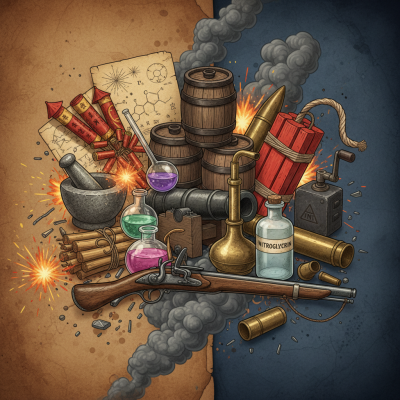
The following is an excerpt from “The History of Explosives” by Thaddeus Grey, available on MixCache.com.
Introduction: Unveiling the Power Within: An Overview of Explosives
The sudden, violent release of energy – it’s a phenomenon that both fascinates and terrifies. From the dazzling spectacle of fireworks painting the night sky to the earth-shattering force that carves tunnels through mountains or reduces fortifications to rubble, explosives represent one of humanity’s most potent and paradoxical creations. They are substances brimming with contained power, reactive materials holding vast amounts of potential energy, waiting for the right trigger to unleash light, heat, sound, and immense pressure in a near-instantaneous event we call an explosion. This book embarks on a journey through time, tracing the history of these remarkable, dangerous, and utterly transformative materials.
Understanding what constitutes an explosive requires differentiating it from materials that merely burn. While wood, oil, or cloth are combustible, releasing energy through fire, they typically do so relatively slowly. An explosive, by contrast, undergoes an extremely rapid, self-propagating decomposition or chemical reaction. This reaction produces a large volume of hot gas almost instantaneously, expanding outwards with tremendous force. The speed of this reaction is key; materials that detonate, where the reaction front blasts through the substance faster than the speed of sound, are termed "high explosives." Those that deflagrate, burning rapidly but subsonically, are "low explosives." Gunpowder, the original explosive, falls into the latter category, while dynamite and TNT exemplify the former.
The quest for control over energy release is ancient, but the specific path to chemical explosives seems rooted, almost poetically, in quests for something else entirely. Long before the principles of chemistry were understood, alchemists sought elixirs of immortality, methods to transmute base metals into gold, or potent medicines. It was within the smoky laboratories of these early experimenters, particularly in Tang Dynasty China, that the accidental discovery of gunpowder occurred. Driven by Taoist philosophies and the search for life-extending substances, these alchemists stumbled upon a mixture – initially charcoal, sulfur, and saltpeter – that possessed startling properties, not of eternal life, but of sudden, fiery destruction. This "fire medicine," as they called it, marked the beginning of a new age.
From these accidental beginnings, the story of explosives unfolds as a stark illustration of human ingenuity's dual nature. The very same force that could shatter rock for quarrying or clear land for farming could be turned, with devastating effect, towards warfare. Gunpowder’s journey from Chinese firecrackers and primitive rockets to the cannons that battered medieval castle walls fundamentally altered the landscape of conflict. It democratized destruction to some extent, rendering the armoured knight less formidable and shifting the balance of power towards those who could master this noisy, smoky technology. The echoes of those early detonations resound through history, heralding the end of feudal warfare and the rise of centralized states capable of fielding gunpowder armies – the so-called Gunpowder Empires.
The development of explosives is inextricably linked to the trajectory of human civilization. The ability to quickly break and move large quantities of earth and rock revolutionized mining and civil engineering. Without explosives, the vast networks of canals, railways, tunnels, and dams that underpin modern infrastructure would have been vastly more difficult, if not impossible, to construct within practical timeframes. Quarrying stone for building, excavating foundations, clearing underwater obstacles for navigation – all became achievable on an unprecedented scale. Explosives literally reshaped the physical world to suit human needs, accelerating industrialization and economic growth.
Yet, this constructive potential has always walked hand-in-hand with destructive capability. The history of explosives is also the history of weaponry becoming progressively more powerful and indiscriminate. From the earliest handheld firearms and grenades to the massive artillery shells of the World Wars, and ultimately to the terrifying power of nuclear fission and fusion, the pursuit of more effective ways to deliver explosive force has driven military innovation. This arms race spurred scientific discovery but also brought unimaginable suffering and ushered in an age where humanity holds the power for its own annihilation. The use of explosives in warfare, terrorism, and crime remains a defining challenge of the modern world.
The journey from the relatively simple mixture of black powder to the complex organic compounds used today reflects centuries of scientific advancement. Early discoveries were often empirical, the result of trial and error. But the 19th century brought a more systematic understanding of chemistry, leading to the isolation and development of substances far more potent than gunpowder. Nitroglycerin, a volatile and dangerous liquid, represented a quantum leap in power but was initially impractical. Alfred Nobel’s genius lay not just in recognizing its potential but in finding a way to stabilize it, leading to the invention of dynamite – an explosive powerful enough for major engineering tasks yet safe enough (relatively) to transport and handle.
This era marked the dawn of high explosives. Following dynamite came a host of other powerful chemical compounds: nitrocellulose, which formed the basis of smokeless powders, revolutionizing firearms; TNT (trinitrotoluene), stable and melt-castable, becoming the standard military explosive for decades; and later, the even more powerful RDX, PETN, and plastic explosives like C-4, offering greater destructive force, stability, and moldability. Each development built upon previous knowledge, refining the balance between power, stability, and sensitivity – the ease with which an explosive can be initiated by heat, friction, or shock. Understanding and manipulating these properties became a core aspect of explosives science.
The scientific understanding of how explosives work also deepened. Chemists and physicists unravelled the processes of decomposition, distinguishing between the rapid burn of deflagration and the supersonic shockwave propagation of detonation. They learned to calculate oxygen balance – the measure of how efficiently an explosive mixture's fuel and oxidizer components react – to optimize power and brisance, the shattering effect crucial for fragmenting munitions. The study of shock physics became essential for designing both explosives and the systems intended to withstand them. This knowledge enabled the precise tailoring of explosives for specific applications, from controlled blasting patterns in mines to the focused energy required for shaped charges used to pierce armor.
The ultimate expression of explosive power arrived in the mid-20th century with the harnessing of nuclear energy. Unlike chemical explosives, which release energy stored in chemical bonds, nuclear weapons unleash the vastly greater energy locked within the atomic nucleus itself, through fission (splitting heavy atoms like uranium or plutonium) or fusion (combining light atoms like hydrogen isotopes). The development of the atomic bomb during the Manhattan Project, and its subsequent use, irrevocably changed geopolitics and warfare, introducing a scale of destruction previously unimaginable and casting a long shadow over international relations ever since.
Given their inherent dangers, the manufacture, storage, transport, and use of explosives have necessitated increasingly stringent controls and safety protocols. Disasters resulting from accidental detonations have spurred regulations aimed at minimizing risks. The development of safer initiating systems, like detonators designed to be less susceptible to accidental firing, and the formulation of insensitive munitions that are less likely to explode if subjected to fire or impact, reflect ongoing efforts to manage the hazards. International treaties and national laws govern the trade and use of explosives, attempting to balance their legitimate commercial and industrial uses against the potential for misuse.
This book aims to navigate this complex and compelling history. We will begin by formally defining explosives and their characteristics, then journey back to ancient China to witness the birth of gunpowder. We will follow its spread across continents and explore its impact on warfare, from fire lances and early cannons to the great bombards that reshaped fortifications. We will examine the rise of handheld firearms, the arquebus and musket, and their role in the formation of powerful empires. The narrative will then shift to the scientific revolution in explosives, covering the discovery of nitroglycerin, Nobel’s dynamite, smokeless powders, TNT, and the potent plastic explosives of the modern era. We will delve into the science behind explosive behaviour – sensitivity, velocity, detonation, and power – and explore the myriad ways explosives are harnessed in mining, engineering, and industry. Finally, we will confront the advent of nuclear weapons, the ongoing efforts to regulate explosive materials and weapons, and the profound human consequences of their use.
The story of explosives is a human story – one of accidental discovery, deliberate invention, scientific pursuit, industrial application, military strategy, devastating conflict, and the ongoing struggle to control immense power. It is a tale filled with brilliant minds, catastrophic accidents, revolutionary technologies, and profound ethical dilemmas. From the alchemist's smoky workshop to the physicist's laboratory, from the miner’s blast face to the soldier’s trench, explosives have left an indelible mark on our world. Join us as we explore this history, seeking to understand how humanity learned to unleash, and attempts to manage, the power within.
Read “The History of Explosives” on MixCache.com →
Please log in or create an account to leave a comment.
No comments yet. Be the first to say something.